If Aadhaar, PAN, Voter ID and Passport Aren’t Proof — What Actually Makes You an Indian Citizen?
By: News Desk | 08 July 2026
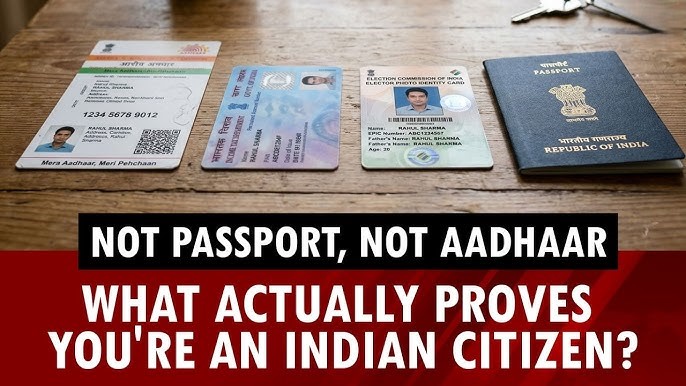
What Proves Indian Citizenship If Not Aadhaar, PAN, Voter ID or Passport?
A government clarification meant to settle a routine query has instead opened up one of the more uncomfortable questions in Indian public life: if you can’t prove your citizenship with the four documents nearly every adult in the country carries, what exactly can you use?
The confusion erupted after the Ministry of External Affairs (MEA) stated that an Indian passport is fundamentally a travel document, not conclusive proof of citizenship. The clarification, though technically consistent with existing law, set off a wave of public disbelief and pointed questions from opposition leaders and citizens alike: if a passport — issued only after some degree of citizenship verification — isn’t enough, then what is?
The Trigger: A Passport Clarification, and a Court Case in the Background
The MEA’s statement did not emerge in a vacuum. It followed months of legal turbulence around a separate, high-stakes exercise: the Election Commission of India’s Special Intensive Revision (SIR) of electoral rolls in Bihar, ordered in 2024 ahead of the state elections. Under the SIR, voters enrolled after 2003 were required to prove their citizenship — and the list of documents the Commission accepted for this purpose pointedly excluded Aadhaar, PAN, voter ID and even ration cards and driving licences.
That exclusion became the subject of a Supreme Court hearing in August 2025, when a bench of Justices Surya Kant and Joymalya Bagchi ruled on petitions challenging the SIR process. The Court held that Aadhaar could only be used to establish identity in the exercise, not as evidence of citizenship — reaffirming a position that already existed in law but had rarely been stated so plainly at the highest judicial level.
Separately, the Bombay High Court delivered an even sharper verdict in a 2025 case, Babu Abdul Ruf Sardar v. State of Maharashtra, while denying bail to a man accused of being a Bangladeshi national. Justice Amit Borkar ruled that merely possessing a voter ID, Aadhaar or PAN card — even all three together — does not automatically confer or prove Indian citizenship, since these documents exist to help people access services, not to settle nationality disputes.
Why Each of the Four Documents Falls Short
Legal experts and successive court rulings converge on the same conclusion: identity and citizenship are two different legal concepts in India, and none of the everyday ID documents were designed to establish the latter.
- Aadhaar is issued under the Aadhaar Act, 2016, based on residency — anyone who has lived in India for 182 days or more in the preceding year is eligible to apply. Residency is not citizenship, and the Act itself, under Section 9, states that Aadhaar cannot serve as proof of domicile or citizenship.
- PAN card is issued by the Income Tax Department purely to track financial transactions and tax liability. Foreign nationals holding a valid visa can and do obtain PAN cards, which by itself rules it out as citizenship evidence.
- Voter ID only certifies that a person’s name appears on an electoral roll under the Representation of the People Act — an entry that can be challenged, corrected or struck off if found fraudulent, and which is not verified with the same rigour as citizenship under the Citizenship Act.
- Passport, while issued largely to citizens after some verification, is legally a travel document under the Passports Act, and can in rare cases be issued in the public interest even where citizenship verification is incomplete — meaning courts do not treat it as automatically conclusive, even though it is widely regarded as the strongest of the four.
So What Actually Proves Indian Citizenship?
Unlike many countries, India does not issue a single, universal citizenship card. Citizenship instead flows from the Citizenship Act, 1955, and the paperwork needed to prove it depends entirely on how a person acquired it:
By birth — For those born in India, the primary evidence is a birth certificate, but the underlying eligibility rules have changed over time and materially affect what “proof” means:
- Anyone born in India between January 26, 1950 and July 1, 1987 is a citizen by birth, without conditions attached to parentage.
- For those born between July 1, 1987 and December 3, 2004, at least one parent must have been an Indian citizen at the time of birth.
- For those born after December 3, 2004, stricter rules apply — one parent must be an Indian citizen, and the other must not be an illegal migrant at the time of the birth.
By descent — Available to those born outside India to Indian citizen parents, established through the parents’ citizenship documents along with registration of the birth at an Indian consulate or embassy where required.
By registration — Available to specific categories, including persons of Indian origin and spouses of Indian citizens, who receive a formal Certificate of Registration issued by the Central Government as their proof.
By naturalisation — Available to foreign nationals who meet residency, character and language eligibility criteria under the Act, culminating in a naturalisation certificate.
Nationality Certificate — In rare, specific circumstances — typically when a person lacks any of the above documentation but needs to prove citizenship for a government job, an educational reservation, or a court proceeding — a court, the Home Ministry, or a state government may issue a standalone Nationality Certificate. These are issued sparingly, and there is no published data on how frequently they are granted.
The Legal Stakes: Who Carries the Burden of Proof
The debate isn’t merely academic. Under Section 9 of the Foreigners Act, 1946, once the state presents credible material that raises doubt about a person’s nationality, the burden of proof shifts onto that individual to establish they are an Indian citizen — not the other way around. This was central to the Bombay High Court’s 2025 ruling, and it is the same legal principle underpinning the Bihar SIR exercise, where the Election Commission accepted only eleven specific categories of documents — largely birth and domicile certificates, land and educational records predating cut-off dates, and citizenship or NRC-linked certificates — as valid proof, while excluding Aadhaar, PAN, voter ID, ration cards and driving licences entirely.
The Press Information Bureau had, in fact, addressed a similar query as far back as December 2019, in the context of the National Register of Citizens, stating that citizenship could be proved through documents related to date and place of birth — a position consistent with what courts have reiterated since, but one that continues to catch the public off guard each time it resurfaces.
The Political Fallout
The MEA’s passport clarification has not gone down quietly. Opposition leaders and several public figures have questioned the practical implications of a system where none of the four most commonly held documents can settle a citizenship dispute, arguing that ordinary citizens — many of whom have never needed a birth certificate, consular registration, or Nationality Certificate — could find themselves unable to produce what courts consider adequate proof if their citizenship is ever formally questioned.
Government sources, for their part, maintain there has been no change in policy — passports, they say, have always been issued only after citizenship verification, and the clarification simply restates the passport’s legal character as a travel document rather than a citizenship certificate.
The Bottom Line
India’s citizenship framework was never built around a single card, and that structural choice — unremarkable for decades — has become newly consequential amid rising scrutiny of who counts as a citizen, from the Bihar electoral rolls to broader questions about undocumented migration. For most people, the documents they carry every day will likely never be tested against this standard. But for anyone whose citizenship is formally challenged, the law is clear on one point: Aadhaar, PAN, voter ID and even a passport are a starting point for identity, not the final word on nationality. That word, under Indian law, belongs to birth records, parentage, registration and naturalisation certificates — and, in the rarest of cases, a Nationality Certificate that very few Indians will ever need, or hold.
(Note: This explainer is based on court rulings, government statements and legal analysis reported in Indian media through mid-2026, including the Supreme Court’s August 2025 Bihar SIR order and the Bombay High Court’s ruling in Babu Abdul Ruf Sardar v. State of Maharashtra. Readers should verify the latest MEA and Election Commission statements before relying on this for legal purposes, as government clarifications on this subject have evolved rapidly.)