Mehbooba Mufti Supports RSS Leader’s Call for Indo-Pak Dialogue on Kashmir | Peace Talks Debate Revives
By: Javid Amin | 13 May 2026
Mehbooba Mufti Welcomes RSS Leader’s Call for Pakistan Dialogue, Rekindles Debate on Kashmir Peace Process
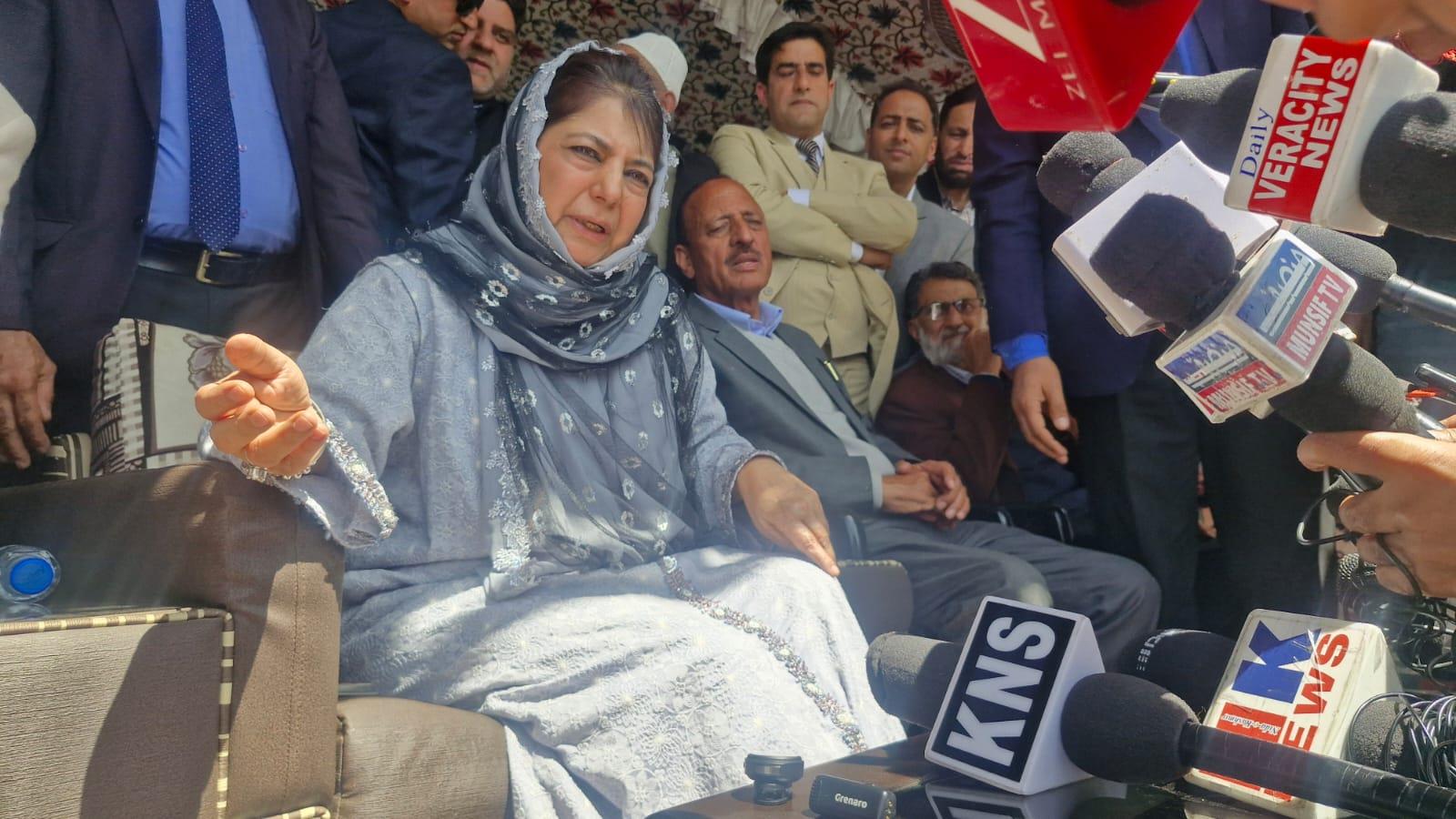
In a politically significant development, Mehbooba Mufti has welcomed remarks by a senior Rashtriya Swayamsevak Sangh (RSS) leader advocating dialogue with Pakistan, saying the statement validates what her party has argued for years — that peace in Jammu & Kashmir cannot be achieved through force alone.
The remarks have triggered renewed discussion around the future of Indo-Pak engagement, the stalled Kashmir peace process, and whether political space is reopening for diplomacy after years dominated by security-centric policies.
For Mehbooba Mufti and her party, the People’s Democratic Party (PDP), the message is clear: sustainable peace in Kashmir requires structured dialogue between New Delhi and Islamabad, accompanied by confidence-building measures, cross-border engagement, and political outreach to the people of the region.
The significance of the moment lies not only in the content of the RSS leader’s remarks but also in the symbolism. The RSS is widely regarded as the ideological parent of the BJP, and any public suggestion of engagement with Pakistan from within that ecosystem carries political weight.
Mehbooba Mufti Says Force Alone Cannot Solve Kashmir
Reacting to the RSS leader’s comments, Mehbooba Mufti reiterated that military operations, administrative control, and hardline measures may manage security situations temporarily, but they cannot permanently resolve the Kashmir issue.
According to her, every major breakthrough in the region’s history has emerged from dialogue rather than confrontation.
Mufti argued that engagement with Pakistan must go hand-in-hand with confidence-building measures (CBMs), including:
- Revival of cross-LoC trade
- Restoration of people-to-people contact
- Easier travel across divided regions of Kashmir
- Political outreach to stakeholders within Jammu & Kashmir
- Continued diplomatic engagement between India and Pakistan
She also described the RSS leader’s remarks as “encouraging,” suggesting that even ideological opponents are beginning to acknowledge the necessity of dialogue.
Political observers see this as an attempt by Mehbooba Mufti to reclaim political ground in Kashmir by positioning the PDP as the most consistent advocate of reconciliation and engagement.
Why the RSS Statement Matters Politically
The statement has attracted attention because calls for engagement with Pakistan from figures associated with the RSS are relatively rare in India’s current political climate.
Since the abrogation of Article 370 in 2019, the BJP-led central government has largely pursued a security-first policy in Jammu & Kashmir. The Centre has consistently emphasized counterterrorism operations, tighter administrative control, and infrastructure-led integration of the Union Territory.
Although backchannel diplomacy between India and Pakistan has occasionally surfaced in reports over the years, formal political dialogue has remained limited.
Against this backdrop, the RSS leader’s comments have created political curiosity for three reasons:
1. Rare Ideological Convergence
Mehbooba Mufti endorsing a statement linked to the RSS reflects an unusual convergence across sharply different political ideologies.
2. Renewed Debate on Kashmir Policy
The remarks have reopened discussion on whether military stability alone can deliver long-term peace in Kashmir.
3. Diplomatic Signaling
Even symbolic support for dialogue can be interpreted as a subtle signal favoring reduced regional tensions.
PDP vs NC: Competing Narratives on Dialogue Politics
Both the PDP and the Jammu and Kashmir National Conference (NC) publicly support dialogue with Pakistan. However, Mehbooba Mufti has increasingly attempted to differentiate the PDP by portraying it as more vocal and consistent on reconciliation efforts.
The PDP historically built much of its political identity around “healing touch” policies, soft borders, and engagement-based politics.
The NC, while also supporting talks, has traditionally focused more on constitutional restoration, autonomy, and statehood issues.
By welcoming the RSS leader’s remarks, Mehbooba Mufti appears to be reinforcing the PDP’s long-standing narrative that diplomacy, not confrontation, offers the only realistic pathway toward lasting stability.
A History of Indo-Pak Dialogue on Kashmir
The Kashmir issue has witnessed multiple phases of dialogue since 1947. Nearly every serious attempt at peace has involved negotiations, bilateral agreements, or confidence-building measures.
1947–48: The First Kashmir War and UN Intervention
The first India-Pakistan war over Kashmir led to United Nations intervention in 1948. The UN proposed a plebiscite to determine Kashmir’s future, but the conditions required for implementation were never fulfilled.
The issue subsequently evolved into one of the world’s longest-running geopolitical disputes.
1965 and 1971 Wars: Diplomacy After Conflict
The wars of 1965 and 1971 hardened positions on both sides but also produced major diplomatic agreements.
Tashkent Agreement (1966)
Brokered with Soviet mediation, the agreement aimed to restore diplomatic and economic relations after the 1965 war.
Simla Agreement (1972)
Signed between Indira Gandhi and Zulfikar Ali Bhutto, the accord established that Kashmir-related disputes would be addressed bilaterally between India and Pakistan.
The Simla framework continues to shape India’s official position on Kashmir diplomacy today.
Lahore Declaration and the Collapse of Trust
One of the most hopeful moments in Indo-Pak relations came in 1999 when Prime Minister Atal Bihari Vajpayee traveled to Lahore and signed the Lahore Declaration with Pakistani Prime Minister Nawaz Sharif.
The declaration emphasized peace, restraint, and dialogue.
However, optimism quickly collapsed after the Kargil conflict later that year, severely damaging trust between the two countries.
The episode became a defining example of how fragile Indo-Pak peace efforts can be.
The 2004–2007 Composite Dialogue: A Rare Period of Progress
Many analysts consider the 2004–2007 period the most productive phase of India-Pakistan engagement on Kashmir.
Under Prime Minister Manmohan Singh and Pakistani President Pervez Musharraf, both sides launched a structured composite dialogue process covering:
- Kashmir
- Trade
- Terrorism
- Cultural exchanges
- Visa liberalization
- Cross-border connectivity
This period saw landmark confidence-building measures, including:
Cross-LoC Bus Service (2005)
Families divided by the Line of Control were allowed limited travel access.
Cross-LoC Trade (2008)
Trade routes opened between divided regions of Kashmir, boosting local economies and symbolic trust-building.
For many Kashmiris, these measures represented a rare glimpse of normalization.
Musharraf’s Four-Point Formula: The Closest Kashmir Came to a Framework Deal
Among all diplomatic initiatives, General Pervez Musharraf’s “Four-Point Formula” remains one of the most discussed proposals for resolving the Kashmir dispute.
Though never formally adopted, many political analysts and regional leaders still regard it as the closest India and Pakistan came to a workable compromise.
The Four Components
1. Demilitarization
Gradual reduction of troop presence in sensitive areas to reduce public tensions.
2. Self-Governance
Enhanced autonomy for both sides of Kashmir without altering existing sovereignty arrangements.
3. Joint Management
Creation of cooperative mechanisms involving India, Pakistan, and Kashmiri representatives to oversee practical issues such as tourism, trade, water resources, and cultural ties.
4. Soft Borders
Easier movement of people and goods across the Line of Control.
The cross-LoC bus and trade initiatives were widely seen as early confidence-building steps inspired by this broader approach.
Why the Four-Point Formula Failed
Despite generating optimism, the proposal ultimately collapsed due to multiple factors.
Political Instability in Pakistan
Pervez Musharraf’s weakening political position and eventual exit from power disrupted continuity.
Terror Attacks
The 2008 Mumbai attacks sharply deteriorated relations between India and Pakistan, freezing momentum for dialogue.
Indian Security Concerns
Sections within India’s strategic establishment remained cautious about demilitarization and joint-management proposals.
As a result, the initiative faded without becoming an official agreement.
Why Mehbooba Mufti’s Statement Matters Today
Mehbooba Mufti’s endorsement of the RSS leader’s remarks is significant because it reconnects current political debate with earlier peace initiatives that once showed measurable results.
Her intervention attempts to revive a broader argument:
- Military measures may contain violence temporarily
- But long-term peace requires political engagement and trust-building
Supporters of dialogue argue that renewed engagement could:
- Reduce cross-border tensions
- Encourage economic revival in Kashmir
- Restore tourism and trade
- Reopen communication channels between divided families
- Create space for political reconciliation
Critics, however, maintain that dialogue cannot succeed without strong guarantees against terrorism and infiltration.
This tension between diplomacy and security continues to define India-Pakistan relations.
Can Dialogue Return to the Centre of Kashmir Politics?
The larger question now is whether political discourse in Kashmir is gradually shifting back toward engagement after years dominated by confrontation and polarization.
While no formal peace initiative currently appears imminent, Mehbooba Mufti’s remarks — combined with the RSS leader’s statement — have revived public conversation around an old but unresolved reality:
Every major opening in Kashmir’s modern history has emerged through dialogue.
Whether New Delhi and Islamabad are prepared to revisit that path remains uncertain. But the renewed discussion itself reflects how deeply the idea of negotiated peace still resonates across the region.
Timeline: Key Moments in Indo-Pak Kashmir Dialogue
| Year | Event | Impact |
|---|---|---|
| 1948 | UN plebiscite proposal | Never implemented |
| 1966 | Tashkent Agreement | Diplomatic reset after war |
| 1972 | Simla Agreement | Bilateral framework established |
| 1999 | Lahore Declaration | Kargil conflict derailed progress |
| 2005 | Cross-LoC bus service | Major CBM initiative |
| 2008 | Cross-LoC trade begins | Economic and symbolic opening |
| 2010s | Backchannel diplomacy | Stalled after terror attacks |
Key Takeaways
- Mehbooba Mufti welcomed an RSS leader’s call for dialogue with Pakistan.
- The PDP continues to advocate talks and confidence-building measures as the foundation for peace in Kashmir.
- The remarks have revived debate over diplomacy versus hardline security approaches.
- Historical peace efforts — from Simla to Musharraf’s four-point formula — demonstrate that dialogue has repeatedly shaped Kashmir’s political trajectory.
- Terror attacks, political instability, and mistrust have consistently undermined peace initiatives.
- The discussion around Indo-Pak engagement remains politically sensitive but strategically relevant.