Kashmir Mosques Expand Role Beyond Religion as Ulema Take Up Addiction, Suicide and Environment
By: Javid Amin | 16 September 2026
Srinagar: In Kashmir, the Friday sermon is being asked to do more than speak about faith.
A new initiative by the Mutahida Majlis-e-Ulema (MMU) seeks to put issues such as drug addiction, suicide and self-harm, youth distress, family problems, social-media misuse and environmental degradation directly into the community conversation.
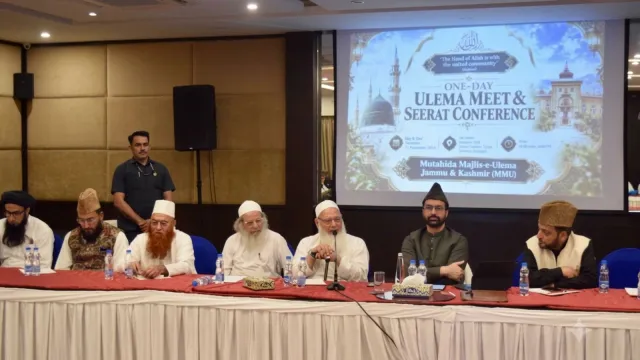
The decision was taken at a one-day Ulema Meet and Seerat Conference in Srinagar on September 15, chaired by Mirwaiz Umar Farooq. More than 70 ulema and mashaikh from Jammu and Kashmir and Ladakh participated in the gathering, which brought together religious scholars from different regions and traditions.
The initiative is significant not because Kashmir’s mosques have suddenly begun discussing social problems. Religious leaders, police officials and doctors have previously involved imams in campaigns against drug abuse. What is different now is the attempt to make such engagement coordinated and sustained, with common Friday themes and regular district-level meetings.
From the Mimbar to Community Problems
The MMU’s September resolutions describe a wide range of problems facing Kashmiri society.
Drug and substance abuse was one of the central concerns. The gathering also discussed suicides and self-harm, mental and emotional distress among young people, weakening family bonds, irresponsible social-media use and growing social alienation. Environmental degradation was included in the same resolution.
The proposal is practical in its design.
Participating mosques are expected to take up one common social issue on designated Fridays, allowing religious leaders across different areas to address the same concern at roughly the same time. The MMU has also resolved to hold regular district-level meetings involving ulema, imams, mosques and madrasas to identify local problems and discuss possible responses.
That represents a shift from isolated sermons or occasional awareness programmes towards an organised community-awareness campaign.
Mirwaiz Umar Farooq told The Indian Express that the increase in self-harm, emotional distress among young people and environmental degradation required a sustained social response rather than being left only to government agencies or occasional seminars. He also stressed an important limitation: the pulpit cannot replace doctors or counsellors, but it can help educate people, reduce stigma and encourage them to seek appropriate assistance.
Addiction Is Already Bringing Imams and Professionals Together
The focus on addiction is not entirely new.
In 2025, doctors at the government-run Institute of Mental Health and Neurosciences in Srinagar held discussions with imams from major mosques about drug abuse among young people. The purpose was to use the reach of religious leaders to improve awareness and encourage preventive and rehabilitative responses.
The connection became even more visible during Jammu and Kashmir’s 2026 anti-drug campaign. Reporting from May documented a combination of police enforcement and community outreach, including sermons warning young people about drug abuse.
There have also been district-level initiatives. In Baramulla in 2024, police organised a programme with imams from several mosques and proposed using Friday prayers to devote time to awareness about substance abuse.
The latest MMU resolution therefore builds on an existing pattern rather than creating it from scratch.
The difference is that the religious leadership now appears to be trying to connect these efforts across districts and make them part of a continuing programme.
Suicide and Self-Harm: A Delicate Change in Language
Perhaps the most sensitive part of the initiative concerns suicide and self-harm.
The MMU resolution explicitly argues that condemnation or silence cannot solve the problem. Instead, it calls for greater compassion towards people experiencing emotional distress, loneliness, anxiety and family pressure. It also asks religious institutions to help create spaces where people can speak about their problems without fear of stigma.
This is an important distinction.
A religious sermon can encourage families to notice warning signs, listen to distressed people and seek help. But severe depression, suicidal behaviour and other mental-health conditions can require clinical assessment and professional treatment.
The MMU’s own position acknowledges that distinction. It calls on ulema and mosque networks to guide people towards trained mental-health professionals where specialised care is required.
In other words, the proposed role is not to turn imams into mental-health professionals. It is to use a trusted community platform to reduce silence and stigma and encourage referral to appropriate care.
Environment Enters the Friday Sermon
The environmental component is equally notable.
The MMU has urged religious leaders to sensitise people about plastic and polythene use, littering and dumping waste into rivers, lakes and other water bodies. The resolutions also raise concerns about encroachment and damage to wetlands and specifically mention the condition and protection of Dal Lake, Wular Lake, Nigeen Lake and other water bodies.
The argument is framed in religious and community terms: protecting nature and shared resources is presented as a moral responsibility.
That gives environmental campaigns a different route into neighbourhoods.
Government departments can issue regulations and launch clean-up drives. Environmental groups can conduct awareness campaigns. Religious leaders, meanwhile, can address household behaviour directly through sermons and local community networks.
Whether that produces measurable changes in waste disposal, plastic consumption or protection of water bodies will depend on what happens beyond the sermon.
A Campaign Against Drugs Also Raises the Alcohol Question
The MMU’s discussion of addiction also moved into a politically sensitive area.
The resolution questioned the expansion of alcohol availability while authorities and civil society are simultaneously trying to combat drug and substance abuse among young people. The ulema argued that promoting or expanding liquor availability in the name of tourism could undermine efforts to address addiction.
This is an attributed position of the MMU, rather than an established finding that alcohol policy is causing the drug-abuse problem.
The distinction matters because drug dependence, alcohol use, prescription-drug misuse and other forms of substance use involve different patterns of risk and require different public-health responses.
Still, the issue shows how a social initiative by religious institutions can quickly intersect with wider questions of government policy, tourism and public morality.
The Unity Question
The September conference was not limited to social problems.
The MMU adopted a second resolution concerning unity within the Muslim Ummah, sectarian harmony and respect for differences of maslak. The participation of scholars from different parts of Jammu and Kashmir and Ladakh, including areas such as Jammu, Poonch, Rajouri, Kargil and Doda, was presented as part of that effort.
This is particularly relevant because the gathering brought together religious scholars across the Shia-Sunni divide.
The emphasis on unity gives the initiative a broader purpose. The MMU is not only asking mosques to address individual problems but also seeking greater coordination among religious institutions.
What Is Actually New in 2026?
It would be misleading to say that Kashmir’s mosques have only now begun addressing social issues.
There is documented evidence of religious leaders being involved in anti-drug awareness for years. The 2024 Baramulla initiative and the 2025 engagement between IMHANS doctors and imams are two examples.
What makes the September 2026 development different is the attempt to establish a region-wide structure.
The proposed model has three components:
Common Friday messaging: participating mosques will take up designated social issues.
Local coordination: district-level meetings involving ulema, imams, mosques and madrasas are planned.
Referral and support: religious institutions are encouraged to guide people towards appropriate professional help when problems go beyond religious or community counselling.
That last component could prove particularly important in areas such as mental health and addiction, where religious guidance alone cannot substitute for medical or psychological treatment.
The Mosque as a Community Institution
The broader idea is not entirely unfamiliar in Kashmir.
Mosques, shrines, khanqahs and imambargahs have long served functions beyond prayer, including education, charity, community gatherings and social communication.
Mirwaiz has also publicly argued that these institutions historically played roles in education, guidance, social reform and community cohesion. In May 2026, he called for mosques, khanqahs and imambargahs to be used more actively as centres of social reform and unity.
The September initiative gives that idea a more concrete organisational form.
Instead of asking religious institutions to respond only when a crisis becomes visible, the MMU is proposing regular engagement around recurring problems.
But Sermons Alone Cannot Solve Structural Problems
There is also a practical limit to what this model can achieve.
A sermon can warn about drugs, but addiction can involve availability of narcotics, trafficking networks, poverty, family circumstances, mental-health problems and access to rehabilitation.
A sermon can encourage someone experiencing suicidal thoughts to seek help, but effective suicide prevention also requires accessible mental-health services, trained professionals, crisis intervention and follow-up care.
Likewise, asking people not to throw plastic into Dal Lake cannot by itself resolve sewage, encroachment, waste-management or wetland-protection problems.
The religious institutions can influence behaviour and reduce stigma. Government agencies, healthcare professionals, schools, families, civil society organisations and environmental authorities still have separate responsibilities.
The MMU’s own resolution recognises this division by stressing professional mental-health assistance where specialised intervention is required.
A New Social Role for Kashmir’s Religious Networks?
The immediate test will be implementation.
Will the proposed common Friday sermons actually continue beyond the initial announcement? Will district meetings take place regularly? Will imams receive material prepared with doctors, psychologists, addiction specialists and environmental experts? Will people who disclose serious problems be connected to appropriate services?
Those questions will determine whether the initiative remains a series of sermons or develops into a functioning community-support network.
For now, the September 15 conference has clearly expanded the agenda.
Addiction, suicide and self-harm, youth distress, family problems, social-media misuse and environmental degradation have been formally placed alongside religious concerns in the MMU’s programme for community engagement.
In Kashmir, where the mosque remains one of the most accessible institutions at neighbourhood level, that gives religious leaders a potentially significant role in public awareness.
But the most effective version of that role may be one that connects faith with evidence-based care rather than presenting the mosque as a replacement for it.
The emerging model is therefore less about changing what a mosque is than about expanding what community institutions can do when religious guidance, professional expertise and local social action work together.