Statehood Resolution Exposes Unusual Institutional Fault Line
By: Javid Amin | 28 September 2026
Srinagar: Jammu and Kashmir’s statehood debate took an extraordinary institutional turn this week when the Union Territory’s top bureaucracy reportedly approached the Legislative Assembly Secretariat seeking to prevent the House from taking up a resolution demanding restoration of full statehood.
Chief Secretary Atal Dulloo and Law Secretary Achal Sethi reportedly sent separate communications to the Assembly Secretariat, arguing that the statehood question was sub judice and should therefore not be debated by the House. The letters were sent three days after Chief Minister Omar Abdullah moved the resolution, which had already been admitted by Speaker Abdul Rahim Rather.
What followed was unusual enough to overshadow parts of the statehood debate itself.
The Speaker questioned the propriety of bureaucrats approaching the Assembly Secretariat over legislative business. Omar Abdullah, who also holds the Law portfolio, said he had not been informed about the legal opinion before the Assembly Secretariat brought it to his attention.
And the Chief Minister used the episode to make a larger political argument: that the confrontation demonstrated the practical consequences of Jammu and Kashmir continuing to function as a Union Territory rather than a full-fledged state.
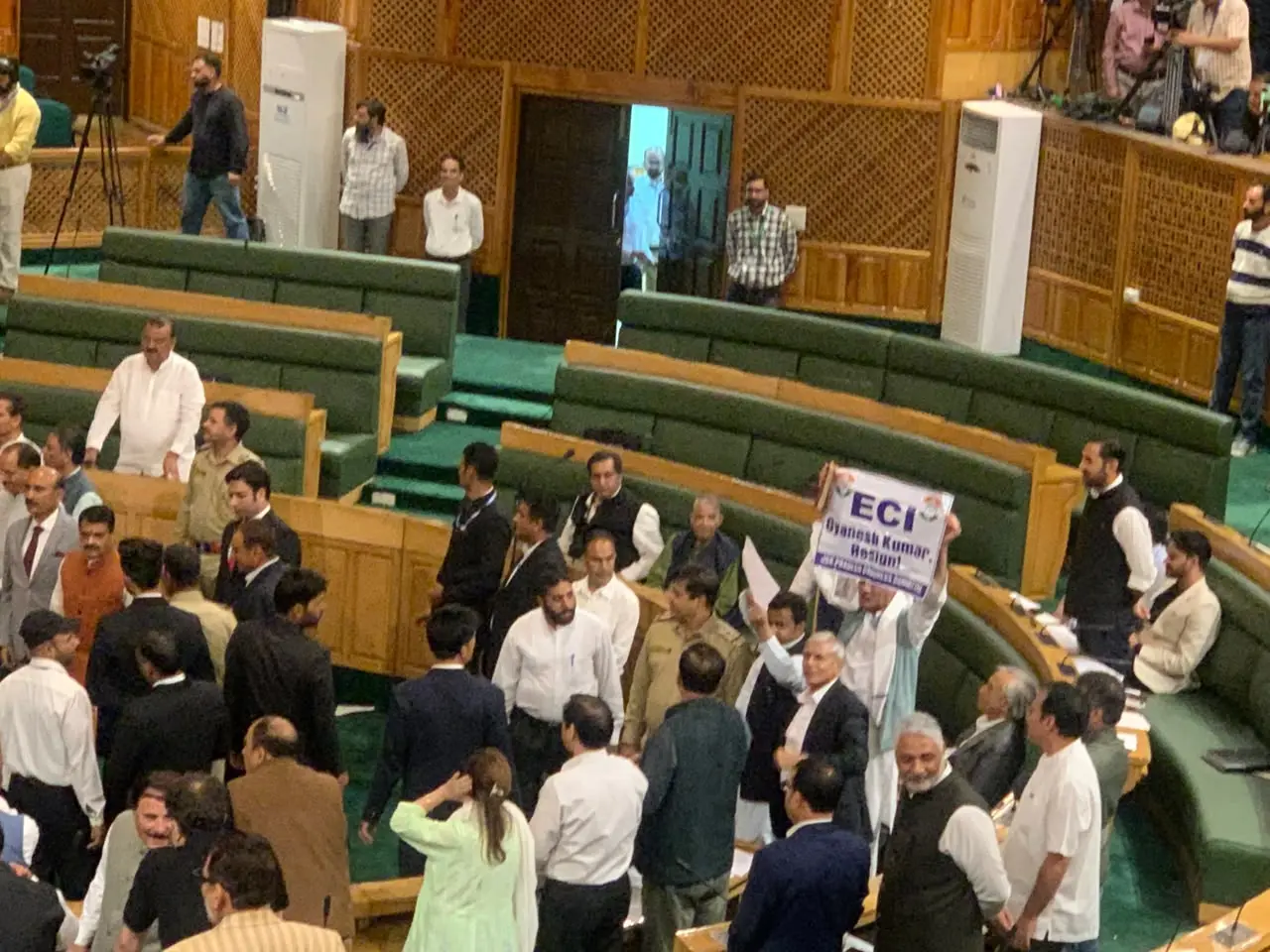
The Assembly nevertheless proceeded with the debate and on September 28 passed the resolution seeking restoration of full statehood, after BJP legislators walked out amid a heated confrontation over its wording and references to Jammu and Kashmir’s pre-2019 political status.
The resolution itself is political and non-binding. The more consequential question raised by the episode is institutional:
When an elected government, its Law Minister and the Legislative Assembly disagree with a legal view originating within the bureaucracy, who determines whether that view should affect the business of the House?
That question goes directly to the unusual constitutional arrangement under which J&K is currently governed.
The letters that changed the statehood debate
The controversy began with two communications from senior bureaucrats.
According to reports, Chief Secretary Atal Dulloo and Law Secretary Achal Sethi separately wrote to the Assembly Secretariat seeking that the statehood resolution not be taken up because the issue was considered sub judice.
The timing made the intervention particularly striking.
The Chief Minister had already moved the resolution.
The Speaker had admitted it.
The House had scheduled the matter for discussion.
The bureaucratic objections therefore arrived not at the stage of drafting a government proposal or advising a minister, but in connection with business already before the legislature.
That distinction is what transformed what might otherwise have been an ordinary legal disagreement into an institutional controversy.
Speaker Abdul Rahim Rather told NDTV that he was unaware of any precedent for the bureaucracy writing to the Assembly Secretariat in this manner to prevent House business, particularly without the approval of the concerned minister.
The Speaker’s reaction does not settle the legal question surrounding the letters. But it demonstrates how unusual the episode was perceived to be from inside the legislature itself.
Why Omar Abdullah’s reaction was so sharp
The controversy acquired another dimension because the Chief Minister also serves as J&K’s Law Minister.
Omar Abdullah told the House that he had not been aware of the communication before the Assembly Secretariat informed him.
That raised a question that went beyond the merits of the statehood resolution itself.
If the Law Department had reached an opinion about whether a major government-backed resolution could be discussed in the Assembly, why was the minister responsible for that department apparently not consulted or informed beforehand?
Omar framed the issue as evidence of the limitations imposed by the Union Territory structure.
In the Assembly, he questioned how a Chief Minister could move a resolution while senior officials in his administration could separately send an opinion to the Speaker opposing its consideration without his knowledge. He linked the episode directly to the absence of full statehood.
That argument is political, but the underlying administrative question is concrete.
It concerns the chain of responsibility between ministers and civil servants.
In India’s parliamentary system, senior civil servants provide advice, legal opinions and administrative assessments. Ministers, however, are politically accountable for the decisions of their departments.
The J&K episode has brought that relationship into unusually public view.
Was the bureaucracy actually trying to “stop” the Assembly?
This point requires some care.
The available reporting establishes that the two officials wrote to the Assembly Secretariat seeking that the resolution not be taken up because of their view that the matter was sub judice.
It does not establish from the public record who instructed them to send those communications, whether they were acting independently, or whether their letters represented a broader position within the administration.
Nor does the mere fact that the officials communicated with the Assembly establish that they intended to challenge the legislature’s constitutional authority.
They may have believed they were communicating a legal constraint.
That is precisely why the episode requires a distinction between the substance of the legal objection and the institutional route through which that objection was communicated.
The first is a question of law.
The second is a question of governance and legislative procedure.
Both deserve scrutiny, but they are not the same issue.
What does “sub judice” actually mean here?
The term sub judice is being used at the centre of the controversy, but it should not be treated as an automatic constitutional veto on legislative discussion.
The underlying idea is that certain matters pending before courts may be subject to restrictions on legislative discussion, particularly where parliamentary or Assembly rules specifically prohibit discussion of matters that could prejudice judicial proceedings.
The Jammu and Kashmir Reorganisation Act, 2019 itself contains specific restrictions on Assembly discussion—for example, Section 49 bars discussion concerning the conduct of Supreme Court or High Court judges in the discharge of their duties. Section 50 separately protects Assembly proceedings from being challenged merely on grounds of procedural irregularity.
The Act does not, in the provisions cited here, create a blanket rule stating that every matter touching a pending court case cannot be politically debated.
That does not mean the bureaucrats’ legal position was necessarily wrong; the precise court proceedings and Assembly rules relied upon in their letters would need to be examined before reaching such a conclusion.
And that is one of the unanswered questions in this controversy.
What exact case, proceeding or legal issue did the officials regard as making the statehood resolution sub judice?
The public reporting available so far has not fully answered that question.
The Assembly had already admitted the resolution
The sequence of events matters.
Omar Abdullah introduced the statehood resolution on September 25.
The resolution called upon the Government of India for the “immediate and urgent restoration of full statehood to Jammu and Kashmir.”
It also referred to earlier Assembly resolutions, including the June 2000 autonomy resolution and the November 2024 resolution.
That reference became a major point of confrontation with the BJP.
The BJP said it supported restoration of statehood but objected to references that, in its view, reopened the question of the pre-August 2019 constitutional arrangement. BJP MLAs entered the Well of the House, slogans were raised and proceedings were disrupted.
The Speaker nevertheless allowed the legislative process to continue.
By September 28, the House passed the statehood resolution amid a BJP walkout.
That sequence means the bureaucratic intervention ultimately failed to prevent the House from debating or adopting the resolution.
But its political significance did not disappear.
If anything, the controversy gave Omar Abdullah a new argument for statehood.
The constitutional backdrop: J&K is not governed like a full state
This is where the dispute becomes much larger than one Assembly resolution.
Under the Jammu and Kashmir Reorganisation Act, 2019, the Legislative Assembly of the Union Territory has powers to make laws on matters in the State List, except Public Order and Police, along with applicable Concurrent List matters. Parliament retains its legislative power over the Union Territory.
The Assembly therefore does not operate with precisely the same constitutional position as a state legislature.
This distinction has practical consequences.
Police and public order remain outside the Assembly’s legislative competence.
The Lieutenant Governor also occupies a constitutionally significant position under the UT framework.
And, unlike a full state, Jammu and Kashmir’s elected government operates within a structure in which the Union retains substantially greater authority.
Omar Abdullah is using that distinction to argue that the bureaucracy-versus-Assembly episode is not an isolated administrative disagreement.
His contention is that it is a demonstration of the structural limitations of Union Territory governance.
The Supreme Court’s 2023 judgment is crucial to the background
The statehood argument also has a significant judicial history.
In its December 2023 judgment on the Article 370 challenge, the Supreme Court recorded the Solicitor General’s submission that statehood would be restored to Jammu and Kashmir and described the Union Territory status as temporary.
The Court said it was not necessary to determine the validity of the reorganisation into the two Union Territories because of that undertaking, and directed that restoration of statehood should take place “at the earliest and as soon as possible.”
That passage has become central to the political argument in J&K.
Omar Abdullah and other leaders have repeatedly pointed to the Supreme Court judgment while asking why statehood has not yet been restored.
The BJP, meanwhile, has continued to say that statehood will be restored at an appropriate time.
This difference between “at the earliest and as soon as possible” and an undefined “right time” has become one of the central political tensions surrounding the issue.
Omar explicitly raised that question in the Assembly debate.
The irony of a Law Secretary advising against the Law Minister’s resolution
There is an obvious institutional irony at the centre of the controversy.
Omar Abdullah is both:
- Chief Minister;
- Law Minister; and
- the politician who moved the statehood resolution.
Yet, according to the reports, the Law Secretary sent an opinion to the Assembly Secretariat opposing consideration of that very resolution without the minister having seen it beforehand.
That does not mean a Law Secretary cannot provide an independent legal opinion.
Indeed, independent legal advice is an essential part of government.
But it raises a different question:
To whom is that legal advice formally tendered, and through what institutional channel should it reach the legislature?
That question could become important well beyond this particular resolution.
If bureaucratic legal opinions can be transmitted directly to the legislature on the admissibility of government-backed business without ministerial knowledge, the episode could establish an unusual precedent.
If, on the other hand, the officials were acting under a recognised procedural or legal mechanism, the government may need to explain that mechanism clearly.
The Assembly’s institutional autonomy is now part of the debate
The Jammu and Kashmir Reorganisation Act provides the Legislative Assembly with its own secretariat framework. Section 51 states that the Assembly shall have a separate secretariat staff, with recruitment and service conditions regulated by the Assembly through law, subject to the transitional provisions in the Act.
That separation makes the route of the bureaucratic communications particularly noteworthy.
The Assembly Secretariat is not simply another department of the executive government.
It services the legislature and functions under the authority of the Speaker in matters concerning House business.
This is why Rather’s objection was framed in institutional terms.
The question was not merely whether a legal opinion existed.
It was whether executive officials should communicate directly with the legislative secretariat in an effort to prevent scheduled House business from proceeding.
That is the institutional fault line that has now emerged.
The BJP’s position adds another layer to the dispute
The controversy should not be presented as a simple clash between the elected government and the bureaucracy.
The Assembly itself was divided over the substance of the resolution.
The BJP said it supported statehood but objected to language referring to the Assembly’s earlier autonomy resolution and the political status of Jammu and Kashmir before August 2019. BJP legislators described the resolution as unacceptable in its existing form and disrupted proceedings before walking out.
The final resolution was therefore passed without BJP participation in the vote.
This creates three distinct positions:
The NC government: statehood should be restored urgently and the Assembly should explicitly demand it.
The BJP: restoration of statehood can be supported, but references suggesting restoration of the pre-2019 constitutional arrangement are unacceptable.
The bureaucracy: according to the reported letters, the resolution should not be taken up because of legal concerns over its being sub judice.
These are different disputes and should not be collapsed into one.
The resolution itself cannot restore statehood
There is another important constitutional distinction.
The Assembly’s resolution is politically significant, but it does not itself restore statehood.
The present Union Territory structure was created through the Jammu and Kashmir Reorganisation Act enacted by Parliament.
Consequently, an Assembly resolution asking the Government of India to restore statehood is a political and representative demand. It does not by itself amend the Reorganisation Act or convert the Union Territory into a state.
That is why the dispute ultimately extends beyond the Assembly.
The Centre would have to initiate the constitutional and legislative process required for restoration.
The Assembly can express the elected representatives’ position.
It cannot unilaterally change the Union Territory’s legal status.
Why this confrontation matters beyond Omar Abdullah
It would be easy to interpret the episode simply as another confrontation between Omar Abdullah’s government and the Centre.
But the implications are broader.
Every Union Territory with an elected legislature operates within a different constitutional balance from a full state.
The J&K experience is particularly sensitive because the region was historically a state, was reorganised into two Union Territories in 2019 and only returned to an elected legislative government in 2024.
The elected administration therefore operates within a structure that combines democratic representation with substantial Union oversight.
That creates inevitable friction.
The question is whether that friction is resolved through established constitutional channels—or through ad hoc institutional interventions.
The present episode has placed that question directly on the Assembly floor.
What remains unanswered
Several questions now demand clearer answers.
Who authorised the letters?
The public reporting does not identify who instructed the Chief Secretary and Law Secretary to communicate with the Assembly Secretariat.
Omar Abdullah himself publicly questioned whose instructions led to the communication.
What exactly was the legal objection?
The officials reportedly argued that the matter was sub judice.
But the specific proceedings and legal provisions underlying that conclusion have not been fully disclosed in the reporting available so far.
Why was the Law Minister apparently not informed?
Omar says he learned about the communication only after the Assembly Secretariat informed him.
If confirmed, this raises questions about administrative procedure rather than merely political disagreement.
Does the precedent extend beyond statehood?
If executive officials can challenge the admissibility of Assembly business through direct communication with the legislative secretariat, future governments and Speakers may have to determine what institutional boundaries apply.
Will the Centre respond to the resolution?
The Assembly has now formally demanded restoration of statehood.
The next meaningful response will have to come from the Union government.
A new chapter in J&K’s statehood debate
For years, Jammu and Kashmir’s statehood argument has been framed primarily as a political dispute between Srinagar and New Delhi.
The events of the past few days have added a different dimension.
The dispute has moved inside the machinery of government itself.
An elected Chief Minister moved a resolution.
The Speaker admitted it.
Senior bureaucrats reportedly objected to its consideration.
The Chief Minister said he did not know about their communications.
The Speaker questioned the precedent.
The Assembly debated the resolution anyway.
And the House ultimately passed it amid an opposition walkout.
That sequence is significant because it exposes something that statistics and political speeches often obscure: the practical difference between governing a state and governing a Union Territory.
Jammu and Kashmir’s political leadership is asking for statehood partly on the grounds that elected representatives should have greater control over the administration for which they are politically accountable.
The bureaucracy, meanwhile, operates within the legal framework that currently exists.
Neither fact is inherently contradictory.
The tension arises when the boundaries between those two systems become contested in public.
The real statehood question may now be about accountability
The statehood resolution will eventually move beyond the Assembly.
Its political message has been delivered.
Its constitutional effect is limited.
But the bureaucratic controversy may have a longer life.
Because the central issue is no longer simply whether Jammu and Kashmir should be a state.
It is increasingly about who answers to whom while it remains a Union Territory.
An elected government is accountable to the legislature.
Civil servants advise ministers and implement government decisions within the law.
The Speaker controls the Assembly’s proceedings.
The Lieutenant Governor and Union government retain powers under the Reorganisation Act that do not exist in the same form in a full state.
The system works only when these institutions understand where one authority ends and another begins.
The latest confrontation has exposed a point where those boundaries appear to have become contested.
That is why the letters from two senior bureaucrats may ultimately prove more consequential to J&K’s governance debate than the wording of the statehood resolution itself.
The resolution asks New Delhi to restore statehood.
The controversy surrounding it has forced Jammu and Kashmir to confront a more immediate question:
Until that happens, who really controls the machinery of an elected government operating under Union Territory rules?
That question is now sitting at the heart of the Assembly’s statehood debate.