
Kashmir Fertility Crisis: How Smartphones and Digital Isolation May Be Lowering Birth Rates
By: Javid Amin | 18 May 2026
From Srinagar to Seoul, Experts Warn That Smartphones May Be Reshaping Human Relationships — and Lowering Birth Rates
A profound demographic transformation is quietly unfolding across the world — and increasingly in Kashmir as well.
Fertility rates are collapsing in country after country, marriages are happening later than ever, and younger generations are spending more time online while forming fewer long-term relationships offline. While economic stress, unemployment, housing costs, and changing gender roles remain major factors, a growing number of researchers now believe smartphones and digital isolation may be accelerating the global fertility decline.
The concern is no longer limited to technologically advanced societies like South Korea or China. Similar patterns are emerging across developing societies, including parts of India and Kashmir, where rising screen addiction, shrinking social interaction, delayed marriages, and increasing emotional isolation are beginning to reshape family structures.
In Kashmir — where fertility rates have already fallen sharply in recent years — experts say the digital revolution may now be interacting with financial pressures and social anxieties to create a deeper demographic challenge.
Kashmir’s Fertility Decline Mirrors a Global Pattern
Recent demographic trends suggest that Kashmir is entering a broader global fertility transition already visible across Europe, East Asia, Latin America, and parts of the Middle East.
The Total Fertility Rate (TFR) in Jammu and Kashmir has reportedly fallen near 1.4 children per woman — far below the replacement level of 2.1 required to maintain stable population growth.
Urban fertility rates are even lower, approaching levels now seen in some developed societies facing population decline.
Experts say several traditional explanations remain valid:
- Delayed marriages
- Unemployment and financial insecurity
- Expensive weddings and housing
- Lifestyle pressures
- Women prioritizing education and careers
- Rising reproductive health complications
But increasingly, researchers are examining whether digital isolation and smartphone dependency are intensifying all of these trends.
The “Smartphone Fertility Theory” Is Gaining Attention Worldwide
Researchers studying global fertility patterns have noticed a striking timeline.
Birth rates in many countries began falling sharply after 2007–2010 — the same period when smartphones, social media platforms, and high-speed 4G internet became widespread.
Sociologist Alice Evans has argued that smartphones are transforming human relationships by reducing real-world socialization and weakening the social pathways that traditionally led to marriage and family formation.
According to this theory:
- Young people socialize less physically
- Dating becomes more fragmented and unstable
- Online interaction replaces deeper emotional bonding
- Isolation increases despite digital connectivity
- Marriage rates decline
- Fertility rates eventually collapse
Researchers from the University of Cincinnati also found that fertility declines were often fastest in regions where high-speed mobile internet arrived earliest.
Kashmir’s Youth Are More Connected Digitally — But Often More Isolated Socially
The shift is increasingly visible in Kashmir’s urban and semi-urban society.
In cities like Srinagar, younger generations now spend large portions of daily life online:
- Social media scrolling
- Streaming entertainment
- Gaming
- Digital chatting
- Remote networking
- Online shopping and leisure
Sociologists say this transformation has altered how young Kashmiris build friendships, relationships, and social trust.
Traditional community-based interaction — neighborhood gatherings, cultural events, extended family engagement, and face-to-face socialization — has weakened in many urban environments.
Experts warn that digital engagement often creates the illusion of connection while reducing deeper interpersonal relationships necessary for stable marriages and family formation.
Delayed Marriages in Kashmir Are Increasing
Marriage patterns across Kashmir have changed significantly over the last two decades.
Earlier generations often married in their late teens or early twenties. Today, many men and women marry in their late twenties or even thirties.
Experts attribute this shift to multiple overlapping factors:
- Career uncertainty
- Financial instability
- Rising expectations in marriage
- Social anxiety
- Emotional disconnect
- Fear of unstable relationships
- Reduced real-world social interaction
Digital culture may be amplifying these delays by creating more individualistic lifestyles and reducing opportunities for traditional relationship-building.
For many young people, online engagement now consumes time once spent in community interaction and social bonding.
Global Fertility Collapse: The Numbers Are Alarming
The fertility decline is not limited to one culture or economic model.
East Asia
- South Korea: fertility near 0.7
- China: around 1.0
These highly digital societies now face severe population aging and workforce decline.
Latin America
- Mexico: approximately 1.55
- Colombia: near 1.06
South Asia
- Sri Lanka: nearly 1.37
Southeast Asia
- Thailand: below 1.0
Middle East & Africa
Even countries with traditionally high birth rates — such as Egypt — have witnessed rapid fertility decline despite lower female workforce participation compared to Western nations.
Nordic Countries
Countries once considered stable for family formation — including Sweden, Norway, and Finland — have also experienced major fertility declines in the smartphone era.
This has led researchers to believe the issue goes beyond economics alone.
Why Experts Think Smartphones Matter
Researchers caution that smartphones are not the sole cause of falling fertility. However, they may be accelerating broader social shifts already underway.
Reduced Face-to-Face Interaction
Young people increasingly communicate online rather than meeting physically.
Decline in Deep Relationships
Digital interactions are often shorter, faster, and emotionally shallower than in-person relationships.
Social Withdrawal
Heavy screen use can increase loneliness, anxiety, and emotional isolation.
Delayed Commitment
Online dating and social media may contribute to unstable relationship expectations and fear of long-term commitment.
Lifestyle Fragmentation
Entertainment, work, and social life are increasingly individualized and screen-centered.
Experts say these trends collectively reduce marriage formation and eventually lower birth rates.
Kashmir Faces a Unique Demographic Risk
Kashmir’s fertility decline is unfolding alongside:
- High unemployment
- Economic uncertainty
- Urbanization
- Housing pressures
- Mental health stress
- Social polarization
- Delayed financial independence
This combination could accelerate demographic aging much faster than expected.
If birth rates remain below replacement levels for decades, Kashmir could eventually face:
- Smaller workforce population
- Rising elderly dependency
- Pressure on healthcare systems
- Weakening joint-family support structures
- Economic slowdown
- Reduced long-term consumption and growth
Experts Say Traditional Pro-Natalist Policies May Not Be Enough
Globally, many governments have tried:
- Cash incentives
- Tax benefits
- Childcare subsidies
- Paid parental leave
Yet fertility rates in many developed countries continue falling.
Researchers now argue that financial incentives alone may fail if societies continue becoming socially fragmented and digitally isolated.
What Kashmir Can Learn From Global Trends
Experts say Kashmir still has an opportunity to act before fertility decline becomes irreversible.
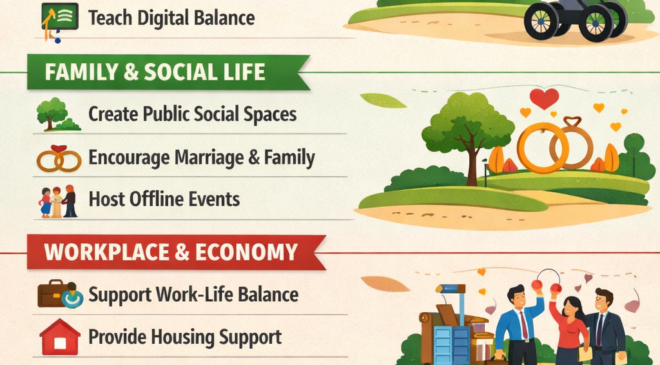
Rebuild Offline Social Culture
Community centers, sports clubs, libraries, and cultural spaces can encourage real-world interaction.
Encourage Youth Engagement
Educational institutions can promote debates, arts, sports, volunteering, and community participation instead of excessive digital dependence.
Promote Healthy Digital Habits
Awareness campaigns around screen addiction, social isolation, and mental health may help younger generations maintain healthier social lives.
Improve Economic Stability
Employment opportunities and housing affordability remain essential for encouraging marriage and family formation.
Strengthen Work-Life Balance
Family-friendly workplace policies could reduce stress around parenting and marriage.
Reproductive Health Awareness
Early screening and awareness regarding fertility health, PCOS, stress, and delayed pregnancies are becoming increasingly important.
Some Countries Are Already Responding
Countries are beginning to experiment with policies targeting digital overexposure.
Russia moved to restrict smartphone use in schools in 2024 as part of broader efforts to improve concentration and social interaction among students.
Other governments are debating:
- Social media regulations for minors
- Digital wellness campaigns
- Phone-free school environments
- Community-building initiatives
Experts say such measures aim not only to improve education and mental health but also to rebuild real-world human relationships.
Kashmir’s Fertility Crisis May Ultimately Be About Society, Not Just Biology
The emerging debate over smartphones and fertility is ultimately larger than technology itself.
Experts believe the deeper issue is the transformation of human relationships, community life, and social trust in the digital age.
In Kashmir, where traditional family structures once formed the foundation of society, the rapid transition toward isolated, screen-centered lifestyles may now be reshaping marriage, parenthood, and demographic stability.
The Valley’s falling fertility rates are therefore not simply a medical or economic issue — they may represent a broader social transformation unfolding quietly through smartphones, changing lifestyles, delayed relationships, and digital isolation.
And if current trends continue, the consequences may redefine Kashmir’s demographic future for generations.