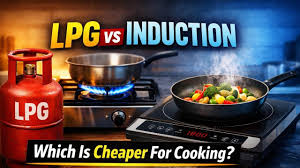
Induction vs LPG in India: Why Electric Cooking Is Becoming the Cheaper Choice for Urban Households
By: Javid Amin | 19 March 2026
As fuel prices rise, households rethink how they cook
With LPG prices staying high and global fuel markets facing uncertainty, Indian households — especially in urban areas — are beginning to rethink a basic daily activity: cooking.
For decades, LPG cylinders have been the backbone of Indian kitchens. But now, induction cooktops are emerging as a practical, cost-effective alternative, offering lower monthly expenses and higher energy efficiency.
The question many households are asking is simple:
Is induction cooking actually cheaper than LPG?
The answer is increasingly leaning toward yes — but with conditions.
The Efficiency Factor: Where Induction Wins Big
Less energy wasted, more heat delivered
The biggest advantage of induction cooking lies in its efficiency.
Traditional LPG stoves lose a large portion of heat to the surrounding air. In contrast, induction cooktops use electromagnetic technology to directly heat the cookware.
Efficiency Comparison
| Cooking Method | Efficiency |
|---|---|
| Induction Cooktop | 85–90% |
| LPG Gas Stove | 35–45% |
This means induction uses almost double the usable energy compared to LPG.
What it means for households:
Less energy wasted = lower overall cost for the same cooking work.
Monthly Cost Comparison: Real Savings Explained
Breaking down the actual numbers
Let’s look at what an average urban household spends.
LPG Costs
-
One cylinder (14.2 kg): ₹900–₹1,100
-
Average usage: ~1 cylinder/month
Monthly LPG expense: ₹900–₹1,000+
Induction Costs
Assuming:
-
Daily usage: 1.5–2 units (kWh)
-
Electricity tariff: ₹6–₹8/unit
Monthly electricity cost:
-
₹400–₹700 (depending on usage and tariff)
Final Comparison
| Cooking Mode | Monthly Cost |
|---|---|
| LPG | ₹900–₹1,000+ |
| Induction | ₹400–₹700 |
Average monthly savings: ₹200–₹500
For many households, this translates into ₹3,000–₹6,000 savings annually.
Why Urban India Is Shifting to Induction
A mix of economics and convenience
Several factors are driving the gradual shift toward electric cooking:
Rising LPG Prices
Frequent price revisions have made LPG less predictable for household budgeting.
Faster Cooking
Induction cooktops heat up instantly, reducing cooking time.
Safety
No open flame reduces fire risks, especially in compact urban kitchens.
Ease of Use
Digital controls and preset modes make cooking more precise.
But It’s Not a Perfect Replacement
The hidden limitations of induction cooking
Despite its advantages, induction cooking has some practical challenges.
Power Dependency
Induction cooktops require uninterrupted electricity.
In areas with frequent power cuts, LPG remains essential.
Initial Setup Cost
-
Induction cooktop: ₹2,000–₹5,000
-
Compatible utensils: ₹1,500–₹4,000
Total initial cost: ₹3,500–₹8,000
Cooking Limitations
Some traditional cooking methods — like making rotis directly on flame — are less effective on induction.
Kashmir Context: A Different Reality
Why full transition is still challenging
In regions like Kashmir, the shift to induction is more complex.
Electricity Reliability
Power outages, especially in winter, make full dependence on induction difficult.
Heating Needs
LPG provides ambient warmth — an added benefit during cold months.
Supply Psychology
Recent fuel panic buying shows households prefer having a reliable backup.
Conclusion for Kashmir:
Induction works best as a supplement, not a replacement.
The Hybrid Model: Smartest Way to Save
Combining LPG and induction for maximum efficiency
Instead of choosing one over the other, many households are adopting a hybrid approach.
Use Induction For:
-
Boiling water
-
Making tea
-
Cooking rice or dal
-
Reheating food
Use LPG For:
-
Rotis and frying
-
Heavy cooking
-
During power cuts
This strategy can reduce LPG consumption by 30–50% without sacrificing reliability.
Bigger Economic Trend
India’s slow shift toward electric cooking
With rising global fuel uncertainty — especially due to Middle East tensions — India is gradually exploring alternatives to traditional cooking fuels.
Electric cooking aligns with:
-
Energy diversification
-
Reduced import dependence
-
Urban sustainability goals
However, infrastructure challenges mean LPG will remain relevant for years.
What Should You Do?
A practical decision guide
Choose Induction if:
-
You live in an urban area
-
Electricity is stable
-
You want to reduce monthly expenses
Stick to LPG if:
-
Power cuts are frequent
-
You rely heavily on traditional cooking
-
You need a dependable backup
Final Verdict
Induction cooking is more efficient and often cheaper, but it is not a one-size-fits-all solution.
Best approach for most Indian households:
Use induction to cut costs, but keep LPG as a backup.
In a time of rising fuel prices and global uncertainty, smart energy choices inside the kitchen can make a real difference to household budgets.