“Article 370, Not Just Statehood”: Ruhullah Mehdi Sparks Debate on Kashmir’s Political Mandate
By: Javid Amin | 26 April 2026
A Bold Assertion from Within the Establishment
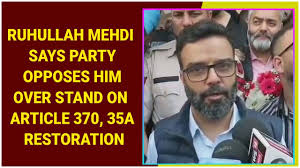
In a politically charged statement that has stirred debate across Jammu & Kashmir, Syed Aga Ruhullah Mehdi has declared that the restoration of Article 370—not merely the return of statehood—is the true mandate of the people.
His remarks stand out not only because of their content, but also because they come from within the ranks of the Jammu and Kashmir National Conference (NC), signaling possible internal tensions and a broader ideological churn in Kashmir politics.
Core Argument: “Statehood Is a Compromise, Not the Goal”
Mehdi’s central thesis is clear:
The people of Jammu & Kashmir did not vote solely for administrative restoration but for the return of constitutional safeguards that defined the region’s autonomy before 2019.
He argued:
- If statehood alone was the priority, voters could have supported the Bharatiya Janata Party (BJP), which has publicly committed to restoring it.
- The electoral mandate, according to him, was rooted in restoring dignity, identity, and constitutional protections tied to Article 370.
This framing redefines the political discourse—from governance delivery to constitutional legitimacy.
Criticism of Leadership: “A Shift Away from Core Promises”
In an unusually direct critique, Mehdi accused his own party’s leadership of diluting its original stance.
His Key Concerns:
- The NC has allegedly shifted focus from Article 370 restoration to statehood
- Even the demand for statehood, he claims, has lost urgency
- This shift represents a “betrayal” of public trust
Such internal dissent is significant, as it challenges the party’s official positioning and exposes ideological fault lines within one of Kashmir’s oldest political formations.
The 2019 Turning Point
The debate inevitably traces back to the abrogation of Article 370 in August 2019—a move that:
- Revoked Jammu & Kashmir’s special constitutional status
- Reorganized the state into two Union Territories: Jammu & Kashmir and Ladakh
Mehdi described this decision as a form of political disenfranchisement, arguing that it was imposed without the consent of the region’s elected representatives.
He also warned that such precedents could create anxieties in other regions, particularly in southern states, about federal balance and representation.
Statehood vs Article 370: A Political Divide
Mehdi’s Framing of the Debate:
| Aspect | Statehood | Article 370 Restoration |
|---|---|---|
| Political Backing | Supported by BJP | Opposed by BJP |
| Nature | Administrative status | Constitutional guarantee |
| Symbolism | Governance structure | Identity & autonomy |
| Electoral Mandate (Mehdi’s view) | Secondary | Primary demand |
| Impact | Limited autonomy | Full restoration of protections |
This comparison highlights how Mehdi is attempting to elevate the discourse from administrative restoration to constitutional rights.
Concerns Raised: Identity, Representation, and Trust
Loss of Identity
Mehdi framed the abrogation as an attempt to dilute the unique identity of Jammu & Kashmir, linking constitutional status with cultural and political dignity.
Gerrymandering and Representation
He raised concerns over:
- Delimitation exercises potentially altering political representation
- The possibility of communal or regional imbalances
- Legislative changes, including reservation policies, affecting minority representation
While these claims remain politically contested, they reflect a growing narrative of perceived marginalization.
Crisis of Trust
Perhaps the most significant takeaway from his remarks is the emphasis on trust:
- Voters expected a strong push for restoring constitutional guarantees
- A perceived shift toward “pragmatic” demands like statehood risks alienating core supporters
This trust deficit could have long-term implications for electoral politics in the region.
Wider Implications: Beyond Kashmir
For Jammu & Kashmir
- Intensifies debate on what constitutes the “real mandate”
- Exposes internal divisions within mainstream political parties
- Could reshape campaign narratives in future elections
For Ladakh
Although now a separate Union Territory, Ladakh continues to grapple with demands for autonomy and safeguards. Mehdi’s emphasis on constitutional protections resonates with ongoing debates in the region about representation and identity.
For Indian Federalism
Mehdi’s remarks indirectly touch upon a larger national question:
- How far can central authority reshape state structures without local consent?
- What balance should exist between national integration and regional autonomy?
These questions extend beyond Kashmir, feeding into broader federal debates across India.
Political Impact: A Narrative Shift in the Making?
Mehdi’s statement could trigger multiple political consequences:
داخل NC (Internal Dynamics)
- Potential ideological rifts within the party
- Pressure on leadership to clarify its stance
Opposition Strategy
- Other parties may leverage the issue to challenge NC’s credibility
Public Sentiment
- Reinforces emotional and identity-driven politics
- Could mobilize sections of the electorate around constitutional demands
Final Analysis: Reframing the Core Political Question
Ruhullah Mehdi’s intervention is not just a critique—it is an attempt to redefine the political question in Jammu & Kashmir.
Instead of asking “When will statehood return?”, he is asking a more fundamental question:
👉 “What kind of political and constitutional relationship should Jammu & Kashmir have with the Union?”
Whether this framing gains traction will depend on how strongly it resonates with voters and how other political actors respond.
But one thing is clear:
The debate over Kashmir’s future is no longer confined to governance—it has firmly returned to questions of identity, autonomy, and constitutional rights.