NEET-UG Re-Exam 2026 on June 21; NEET to Shift to Computer-Based Test from 2027
By: Javid Amin | 15 May 2026
NEET-UG Re-Exam on June 21: Major Reform Push Begins as Government Plans Computer-Based Medical Entrance Test
India’s largest medical entrance examination is heading toward one of its biggest transformations in recent years. Union Education Minister Dharmendra Pradhan has announced that the NEET-UG re-exam for affected candidates will be conducted on June 21, 2026, while also confirming that the National Eligibility cum Entrance Test (NEET) will transition to a fully computer-based format from 2027.
The announcement comes after widespread concerns over exam integrity, alleged irregularities, paper leak allegations, and growing pressure from students and parents demanding a more secure and transparent examination system.
The National Testing Agency (NTA), which conducts the examination, is expected to release fresh admit cards, revised instructions, and center guidelines ahead of the re-exam.
The move is being viewed as a major policy shift in India’s competitive examination ecosystem, especially because NEET remains the gateway to MBBS, BDS, AYUSH, and several allied medical courses across the country.
Why the NEET-UG Re-Exam Is Being Conducted
The decision to hold a re-exam follows controversies and complaints linked to examination irregularities reported during the earlier NEET-UG examination cycle.
Students and parents had raised concerns regarding:
- Alleged paper leaks
- Question paper handling issues
- Examination center discrepancies
- Concerns about fairness and normalization
- Demands for equal opportunity for affected candidates
In response, authorities initiated reviews and consultations before deciding to conduct a fresh examination for impacted candidates.
Education experts believe the re-exam aims to restore confidence in the examination system and reassure students that merit and fairness remain central to India’s medical admission process.
The announcement also signals the government’s intention to modernize national examinations and reduce vulnerabilities associated with traditional pen-and-paper tests.
NEET to Shift to Computer-Based Test (CBT) from 2027
One of the biggest highlights of the announcement is the confirmation that NEET-UG will move to a computer-based test (CBT) format starting in 2027.
Currently, NEET is conducted using an offline pen-and-paper mode, where candidates fill OMR sheets manually. Under the new system, students will answer questions digitally on computers at designated examination centers.
The government believes this transition will improve:
Transparency in Examination Process
Digital testing reduces manual handling of answer sheets and minimizes opportunities for tampering or logistical lapses.
Faster Evaluation and Results
Computer-based testing can speed up result processing, improve accuracy, and reduce administrative delays.
Enhanced Security Measures
CBT systems typically include encrypted question delivery, secure login systems, randomized question patterns, and centralized monitoring mechanisms.
Alignment with Other National Exams
The move brings NEET closer to examination models already used for exams such as:
- Joint Entrance Examination – Main
- CUET
- Several banking and recruitment examinations
Education policy analysts say the transition represents a long-term modernization effort that could reshape how India conducts high-stakes entrance examinations.
What Will Change for Students in CBT Mode?
Although the syllabus and question pattern are expected to remain largely unchanged initially, the examination experience itself will change significantly.
Key Changes Students Should Expect
Digital Answer Marking
Students will click answers on a computer screen instead of shading OMR bubbles.
On-Screen Navigation
Candidates will be able to switch between sections using navigation panels.
Timer-Based Monitoring
An on-screen clock will help students manage time during the exam.
Review and Mark-for-Later Options
CBT systems often allow candidates to review unanswered or doubtful questions before final submission.
Reduced Manual Errors
Mistakes caused by incorrect OMR bubbling may decrease substantially.
Experts, however, warn that students unfamiliar with digital exam environments may initially face adjustment challenges.
Concerns Around Digital Divide and Infrastructure
While many students welcomed the modernization move, concerns have also emerged regarding infrastructure readiness and equal digital access.
Challenges That May Need Attention
Rural Connectivity and Access
Students from remote or rural areas may require additional digital exposure and practice support.
Examination Center Capacity
Thousands of secure computer terminals will need to be arranged nationwide.
Technical Reliability
Authorities will need strong backup systems to avoid server failures or technical disruptions during the exam.
Training and Familiarization
Students appearing in 2027 may need extensive mock CBT sessions to become comfortable with the format.
Education experts argue that the success of CBT implementation will depend heavily on execution quality and early preparedness initiatives.
Step-by-Step Guide for Students Preparing for the June 21 NEET Re-Exam
The re-exam announcement has created anxiety among many students, especially those who were already mentally exhausted after the earlier examination cycle. Experts recommend focusing on structured revision instead of panic preparation.
1. Download Fresh Admit Card Carefully
Students should regularly monitor official NTA notifications and download updated admit cards immediately after release.
Check:
- Exam center details
- Reporting time
- ID proof requirements
- Revised instructions
Any discrepancy should be reported quickly.
2. Prioritize NCERT-Based Revision
For the limited preparation window, experts advise focusing heavily on NCERT concepts.
Biology
- Diagrams
- Terminologies
- Genetics
- Human physiology
- Ecology
Physics
- Formula revision
- Numericals
- Modern physics
- Electrostatics
- Mechanics
Chemistry
- Organic reaction mechanisms
- Named reactions
- Inorganic NCERT tables
- Physical chemistry formulas
Students are advised not to start entirely new topics at the last minute.
Smart Revision Strategy for the Final Weeks
Create Micro Revision Cycles
Instead of studying one subject for long hours, divide the day into smaller revision blocks.
Example:
- Biology: 2 hours
- Physics numericals: 90 minutes
- Chemistry revision: 2 hours
- Mock analysis: 1 hour
This helps improve retention and reduce fatigue.
Focus on Weak Areas — But Strategically
Students should identify high-weightage weak chapters rather than attempting to cover everything.
Priority should be given to:
- Frequently repeated NEET topics
- Conceptual chapters
- Mistake-prone sections
Importance of Mock Tests Before the Re-Exam
Experts consider mock testing one of the most effective tools for improving scores in the final phase.
Benefits of Mock Tests
- Improves time management
- Builds exam stamina
- Helps identify repeated mistakes
- Reduces anxiety
- Strengthens confidence
Students should simulate real examination conditions while attempting mocks.
Avoid excessive mock tests without proper analysis. Reviewing mistakes is often more valuable than simply attempting more papers.
How Students Can Prepare for the CBT Format from Now
Even though the CBT transition begins from 2027, experts recommend early adaptation.
Practice Online Mock Tests
Students should start solving computer-based mock exams regularly to become familiar with digital interfaces.
Learn Basic Exam Navigation
Important skills include:
- Switching between sections
- Marking questions for review
- Changing answers
- Managing on-screen timers
Improve Digital Comfort
Simple habits can help:
- Using a mouse efficiently
- Reading long questions on screens
- Managing screen fatigue
- Avoiding accidental clicks
The earlier students adapt, the easier the eventual transition will become.
Stress Management Is Equally Important
The uncertainty surrounding the examination cycle has increased mental pressure on aspirants.
Education counselors recommend:
- Maintaining proper sleep schedules
- Taking short breaks during study hours
- Avoiding excessive social media speculation
- Staying hydrated
- Practicing breathing exercises or meditation
Students should avoid comparing preparation levels constantly with peers online, as this often increases anxiety rather than productivity.
What Institutions and Coaching Centers Must Prepare For
The CBT transition will not impact students alone. Schools, coaching institutes, and testing agencies will also need significant upgrades.
Likely Institutional Changes
Digital Infrastructure Expansion
Computer labs and secure systems will become increasingly important.
CBT-Focused Training
Coaching institutes may redesign mock test ecosystems around online interfaces.
Technical Support Teams
Examination centers will require trained technical staff during exams.
Cybersecurity Measures
Stronger digital security systems will become critical to prevent hacking or leaks.
Experts say India’s examination ecosystem may witness a large technological overhaul over the next two years.
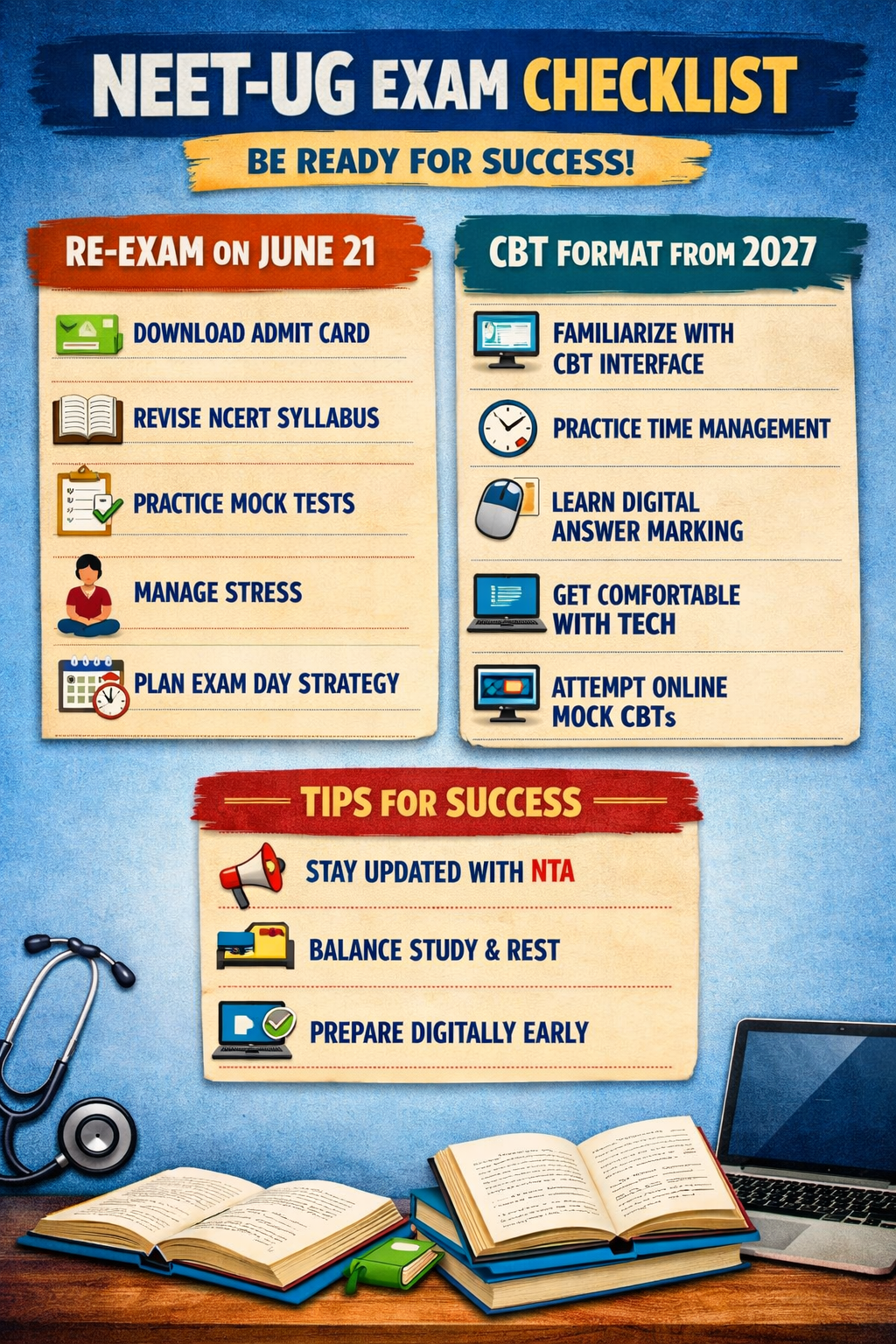
NEET‑UG 2026 Preparation Checklist
Re‑Exam on June 21
- Download Admit Card
- Revise NCERT Syllabus
- Practice Mock Tests
- Manage Stress
- Plan Exam Day Strategy
Computer‑Based Test (CBT) 2027
- Familiarize with CBT Interface
- Practice Time Management
- Learn Digital Answer Marking
- Get Comfortable with Tech
- Attempt Online Mock CBTs
Tips for Success
- Stay Updated with NTA
- Balance Study & Rest
- Prepare Digitally Early
A Turning Point for India’s Competitive Examination System
The NEET reform announcement marks more than just a procedural change. It reflects a broader policy direction toward digitization, accountability, and examination security.
For millions of medical aspirants, the immediate focus remains the June 21 re-exam. But for future batches, the transition to CBT could fundamentally reshape preparation methods, coaching patterns, and examination experiences.
The coming months will likely determine how smoothly India can balance technological modernization with accessibility and fairness for students across urban and rural regions alike.
One thing is clear: NEET is entering a new era, and students preparing early for that transition may hold a significant advantage.