Mehraj Malik Questions Omar Abdullah on Article 370 Promise After Release from Jail
By: Javid Amin | 28 April 2026
A Confrontation That Reflects Growing Political Friction
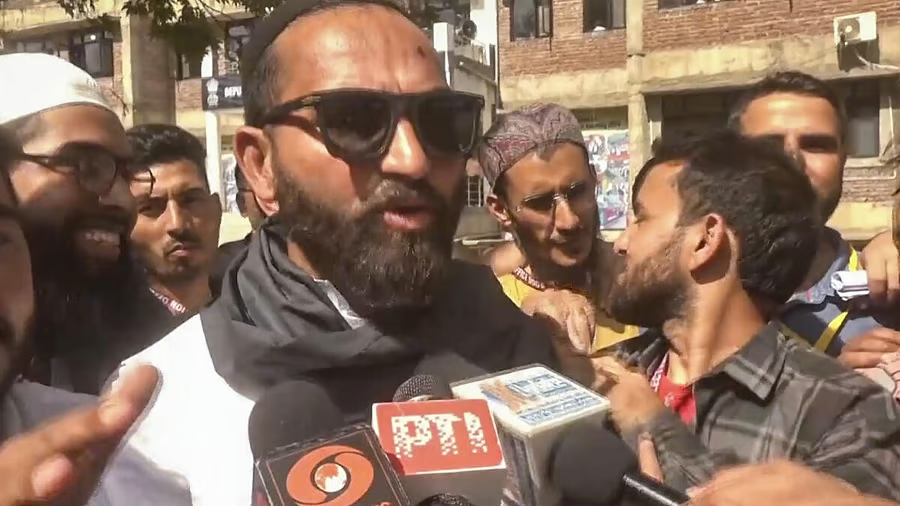
Freshly released from jail, Mehraj Malik has reignited the political debate in Jammu & Kashmir by directly questioning Omar Abdullah over his promise to restore Article 370.
Speaking on April 28, 2026, Malik accused the government of relying on “tweets” instead of delivering tangible results—turning what was a symbolic issue into a sharp test of governance and credibility.
What Triggered the Remarks
Malik’s statement came shortly after his release from District Jail Kathua, where he had spent around eight months in detention.
Key Highlights from His Statement:
- Questioned Omar Abdullah’s commitment to restoring Article 370
- Criticized the government for making “big promises” without action
- Asserted that leadership requires decisions, not social media messaging
His remarks immediately drew attention, not just for their content but for their timing—coming at a moment when political narratives in J&K are increasingly centered on delivery versus rhetoric.
Beyond Article 370: A Wider Governance Attack
While Article 370 was the focal point, Malik broadened his criticism to include governance issues:
- Employment Concerns: Failure to regularize casual laborers
- Electricity Promises: No visible progress on free power commitments
- Economic Pressure: Allegations of unchecked toll tax practices
By expanding the scope, Malik attempted to frame the issue as not just constitutional, but also administrative—linking identity politics with everyday governance failures.
Direct Political Target: Omar Abdullah
Malik’s remarks were not abstract—they were aimed squarely at Omar Abdullah’s leadership.
His Core Argument:
- Promises on Article 370 remain unfulfilled
- Public communication has replaced concrete action
- Leadership must move from symbolism to execution
This direct confrontation signals a shift from traditional opposition vs ruling party dynamics to intra-opposition rivalry, where parties compete to claim credibility on key issues.
Ground Response: Optics of Support
Following his release, Malik received a high-energy استقبال (welcome) from supporters:
- Drums and celebratory processions
- Garlands and slogans
- Visible grassroots enthusiasm
These optics are politically significant—they reinforce Malik’s attempt to position himself as a ground-connected leader in contrast to what he portrays as distant governance.
Article 370: The Core Political Flashpoint
The debate inevitably circles back to the 2019 abrogation of Article 370, which:
- Revoked Jammu & Kashmir’s special constitutional status
- Reorganized the region into Union Territories
Why It Still Matters:
- Seen by many as a symbol of identity and autonomy
- Remains central to opposition narratives
- Acts as a litmus test for political credibility
Malik’s criticism taps into a broader frustration:
promises of restoration have not translated into visible progress.
Party Positions: A Divided Opposition Landscape
Jammu and Kashmir National Conference (NC)
- Advocates restoration through legal and political means
- Critics say efforts remain largely rhetorical
People’s Democratic Party (PDP)
- Strongly pushes restoration as a matter of dignity
- Often accuses NC of inconsistency
Aam Aadmi Party (AAP)
- Uses Article 370 as an accountability benchmark
- Positions itself as demanding action, not symbolism
Bharatiya Janata Party (BJP)
- Firmly opposes restoration
- Frames abrogation as a step toward integration and development
Political Implications: A New Contest Taking Shape
1. Intra-Opposition Rivalry Intensifies
Malik’s remarks highlight growing competition between AAP and NC for political space in J&K.
2. Credibility Battle Over Promises
The focus is shifting from what was promised to what has been delivered.
3. Youth and Grassroots Appeal
By emphasizing action and local issues, Malik is attempting to connect with younger and economically affected voters.
4. Narrative Shift
The debate is evolving:
- From constitutional ideology → to governance accountability
- From symbolic politics → to measurable outcomes
Why This Moment Matters
This episode is more than a political exchange—it reflects a deeper transition in J&K politics:
- Voters are increasingly demanding results over rhetoric
- Opposition unity is weakening, giving rise to multi-cornered contests
- Article 370 remains central, but its political utility is being redefined
Final Analysis: From Promise to Performance
Mehraj Malik’s challenge to Omar Abdullah captures a critical shift in political discourse:
The question is no longer just whether Article 370 should be restored, but what leaders are doing about it in practical terms.
By framing the issue as one of accountability rather than ideology, Malik is attempting to redraw the political battlefield in Jammu & Kashmir.
Whether this strategy resonates with voters will depend on one key factor:
who can convincingly bridge the gap between promise and performance.