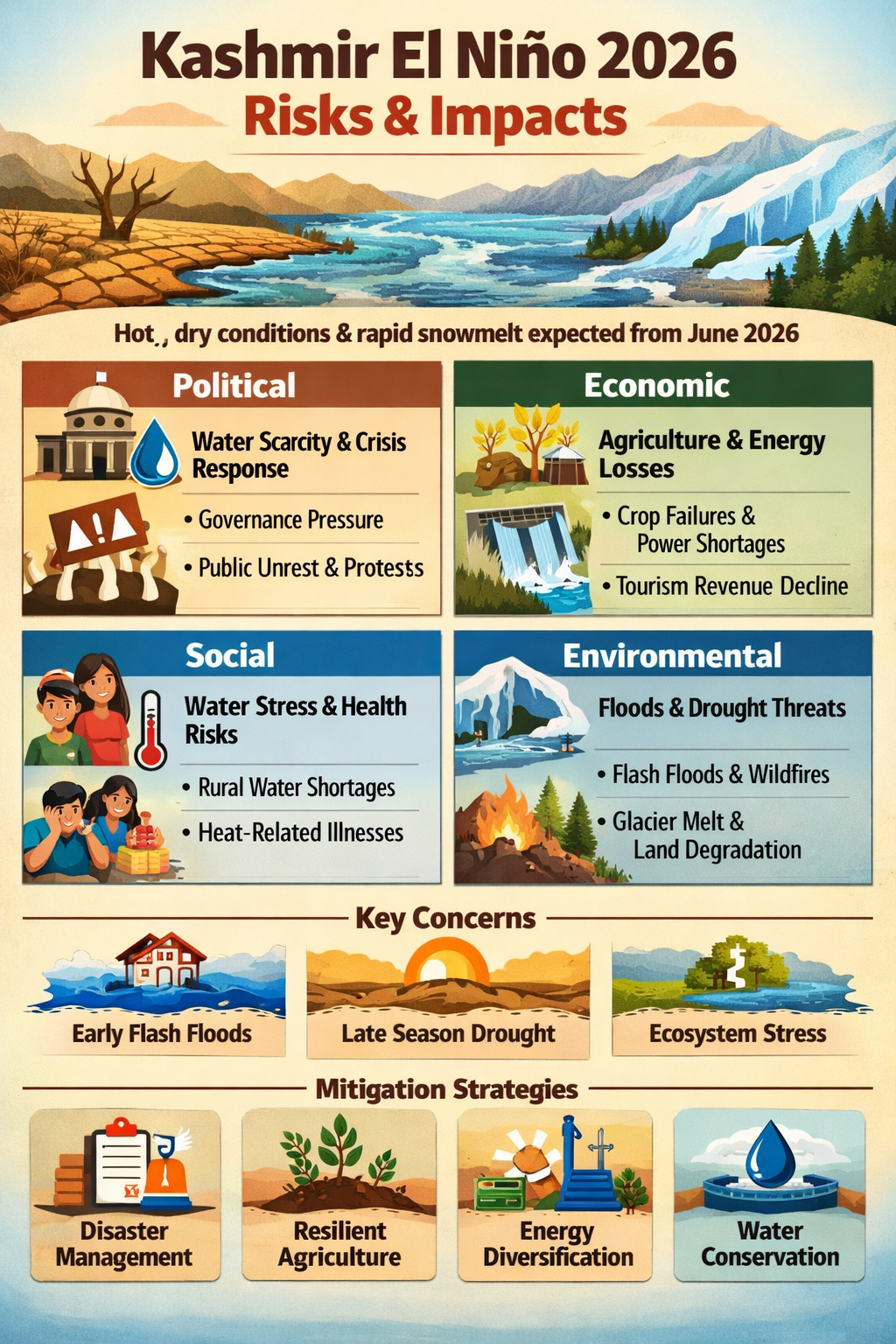
El Niño 2026 Impact on Kashmir | Heatwave, Weak Monsoon, Flood & Drought Risks
By: Javid Amin | 27 April 2026
Kashmir Faces Climate Double Blow in 2026: Early Flood Risk, Late-Season Drought
Kashmir is heading toward a climate stress test in 2026, as a strengthening El Niño is expected to disrupt the region’s delicate weather balance.
According to projections aligned with the India Meteorological Department, India’s monsoon may drop to around 92% of the long-period average (LPA)—a “below normal” scenario. While Kashmir receives only a small share of monsoon rainfall, the timing and distribution of precipitation are critical—and this is where risks sharply increase.
The result: a dangerous sequence of early-season flooding followed by late-season water shortages.
El Niño 2026: What the Forecast Says for Kashmir
- Timing: El Niño likely strengthens by June–July, peaks in late monsoon
- Rainfall: India at ~92% of LPA; Kashmir vulnerable due to uneven rainfall
- Temperature: Above-normal heat expected across summer months
- Cryosphere Impact: Faster snow and glacier melt at higher altitudes
Why Kashmir Is Uniquely Exposed
Unlike plains, Kashmir’s hydrology depends heavily on:
- Snowpack and glacier melt
- Spring rainfall patterns
- Short, variable monsoon window (~17% annual rainfall)
Even small disruptions can destabilize river flows and agriculture cycles.
Major Risks: From Flash Floods to Water Scarcity
1. Early Season (June–July): Flood Threat Rises
- Rapid snowmelt increases river discharge
- Rainfall over snow (rain-on-snow events) intensifies runoff
This combination can trigger:
- Flash floods
- Landslides and slope instability
- Sudden surges in rivers like the Jhelum basin
2. Mid to Late Season (August–September): Drought-Like Stress
- Snow reserves deplete faster
- Monsoon rainfall remains below average and uneven
Result:
- Reduced river flows
- Irrigation shortages
- Drinking water stress in rural and urban areas
Agriculture at Risk: Kashmir’s Backbone Under Pressure
Agriculture and horticulture—key to Kashmir’s economy—face multi-layered risks:
Crop-Level Impact
- Paddy & maize: Require consistent water → vulnerable to erratic rainfall
- Apple orchards: Sensitive to heat stress and moisture imbalance
- Sowing cycles: Likely disrupted due to unpredictable rainfall timing
Even short dry spells during critical growth phases can reduce yields significantly, potentially triggering food price inflation.
Water Resources & Hydropower: A Fragile Balance
Kashmir’s water system is timing-sensitive rather than volume-dependent.
Key Concerns
- Early high flows → water wasted as runoff
- Late-season drop → reservoir stress
- Reduced discharge → lower hydropower generation
Hydropower, a major energy source in J&K, could see production dips, increasing reliance on external power and raising costs.
Environmental Stress: Forest Fires, Soil Loss & Biodiversity Impact
The environmental fallout could be long-lasting:
- Forest fire risk rises during prolonged dry spells
- Soil erosion increases due to erratic heavy rainfall
- Habitat stress affects alpine and forest ecosystems
- Accelerated glacier retreat impacts long-term water security
Risk–Impact Matrix: Kashmir Under El Niño 2026
| Category | Key Risks | Likely Impact |
|---|---|---|
| Political | Water scarcity, disaster response pressure | Governance strain, public dissatisfaction |
| Economic | Crop loss, hydropower decline, tourism disruption | Inflation, revenue loss |
| Social | Water stress, heat health risks, displacement | Vulnerability, possible unrest |
| Environmental | Glacier melt, floods, drought cycles | Ecosystem degradation |
Uncertainties That Could Change the Outlook
Indian Ocean Dipole (IOD)
A positive IOD phase can:
- Enhance rainfall over India
- Partially offset El Niño effects
Snowpack Buffer
Good snowfall in early 2026 may:
- Temporarily support river flows
- Delay severe water stress
Forecast Evolution
More accurate projections expected by:
- Mid-May to June 2026, as ENSO signals stabilize
Action Plan: What Kashmir Must Do Now
1. Water Governance
- Build storage and rainwater harvesting systems
- Regulate irrigation usage
- Prepare late-season contingency plans
2. Climate-Smart Agriculture
- Promote drought-resistant crop varieties
- Adopt staggered sowing strategies
- Improve micro-irrigation systems
3. Disaster Preparedness
- Strengthen flood early warning systems
- Stabilize landslide-prone slopes
- Enhance wildfire response capacity
4. Energy Diversification
- Reduce reliance on hydropower
- Expand solar and alternative energy sources
Expert Perspective: A Warning Signal, Not Just a Seasonal Shift
El Niño is not new—but its intensifying impacts combined with climate change are making outcomes more extreme and less predictable.
For Kashmir, the concern is not just less rain, but when and how it falls.
➡️ Too much, too early → floods
➡️ Too little, later → drought
This “hydrological imbalance” is what makes 2026 particularly risky.
Key Takeaways
- Hotter-than-normal summer likely from June 2026
- Below-average rainfall (~92% LPA) expected
- Early flood risk due to rapid snowmelt
- Late-season water shortages and drought stress
- Agriculture, hydropower, and environment all at risk
Bottom Line
Kashmir’s 2026 climate outlook is a dual-threat scenario—floods first, drought later.
Managing this will require precision planning, strong governance, and community awareness. With early action, the region can cushion the worst impacts—but delays could amplify economic and environmental losses.