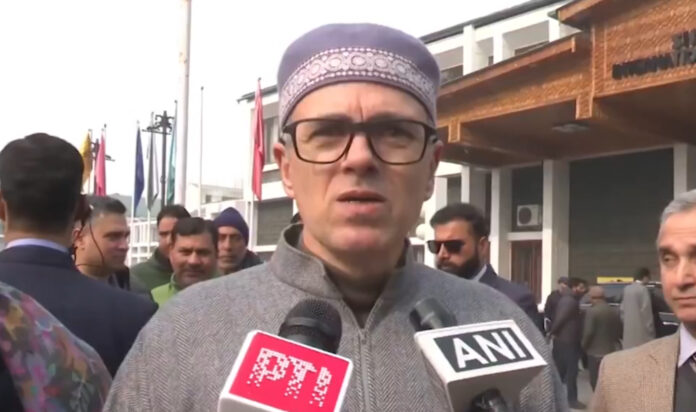
Omar Abdullah dismissed the renaming of Raj Bhavan as mere symbolism, quoting Shakespeare’s famous line “What’s in a name? A rose by any other name would smell as sweet,” to stress that governance matters more than nomenclature.
When Names Change, But Will Governance?
Across India, governor residences once known as “Raj Bhavan” are being rechristened “Lok Bhavan.” The shift, directed by the Union Ministry of Home Affairs (MHA), is presented as part of a larger push towards a more “people-centric” and post-colonial sensibility for public institutions.
In Jammu & Kashmir, the renaming has been implemented: the erstwhile Raj Bhavan is now officially Lok Bhavan.
But for the region’s Chief Minister, Omar Abdullah, the symbolic change is far less important than what lies behind the walls. He insists — quoting a famous line often attributed to William Shakespeare — that what truly matters to the public is not the name, but the substance: “people are not bothered about the names; they look at our work.”
This article delves into the renaming, the reactions, and more importantly — why, in Kashmir today, such symbolism only shines if matched by effective governance.
The National Wave: Why Raj Bhavan Became Lok Bhavan
01. The MHA Directive & Nationwide Rebranding
On 25 November 2025, the Union Home Affairs Ministry issued a directive to all states and Union Territories to rename their governor or lieutenant-governor residences. “Raj Bhavan” was to be replaced by “Lok Bhavan,” and “Raj Niwas” by “Lok Niwas” — a move intended to shed colonial connotations and promote a more democratic, people-centric identity for public institutions.
In the days that followed, several states acted swiftly: from West Bengal (first to implement) to Kerala, Jharkhand, Bihar, Punjab, Rajasthan, Maharashtra, and more — all replacing “Raj Bhavan” signs with “Lok Bhavan,” updating stationery, letterheads, official correspondence, and gate-boards accordingly.
Proponents say the change has symbolic weight: it signals that these residences are not relics of princely or colonial rule, but belong to the people — a home of the people, for the people. In some states, governors have invoked national unity, democratic spirit, and respect for people’s sovereignty while unveiling the new boards.
02. Jammu & Kashmir Follows Suit: Raj Bhavan → Lok Bhavan
On 2 December 2025, the Union Territory of Jammu & Kashmir officially adopted the renaming: both the Srinagar (summer) and Jammu (winter) Raj Bhavans will now be referred to as Lok Bhavan, with immediate effect for all official and administrative use.
The formal notification, issued by the Secretary to the Lieutenant Governor, makes clear that henceforward “Raj Bhavan, Jammu and Kashmir” will only be called “Lok Bhavan, Jammu and Kashmir.”
The premise: align J&K with the nationwide move, cast governor’s residences as public institutions, and remove vestiges of colonial-era nomenclature.
Omar Abdullah’s Response: Substance Over Symbolism
01. “Name-Change Won’t Help — It’s the Work That Matters”
Responding to the renaming, Chief Minister Omar Abdullah was quick to inject realism. He emphasized:
“Name change is fine, but there should be a change in the functioning as well. People are not bothered about the names; they look at our work.”
Omar invoked a line reminiscent of Shakespeare’s famous reflection: that “a rose by any other name would smell as sweet.” For him, a building’s name is inconsequential unless it translates into visible change in governance — electricity, public services, basic amenities.
He argued that citizens care less about letters on a gate and more about functional delivery: uninterrupted power supply in winter, responsive administration, welfare measures, and timely public service.
In a region already confronting fragile trust in governance, the message is clear: symbolic gestures may catch headlines — but without substance, they risk being dismissed as empty optics.
02. What This Reaction Signals: A Subtext of Disillusionment
Omar Abdullah’s reaction is more than a rhetorical stance. For many Kashmiris, decades of political uncertainty, governance vacuums, and constitutional upheaval (post-2019 developments) have sown skepticism: about promises, about administration, about whether public institutions will deliver real change.
In that sense, the renaming evokes mixed feelings: on one hand, a chance to redefine institutional identity; on the other, a reminder of past disappointments. Abdullah appears aware of this emotional undercurrent — and signals that unless governance improves, name change may neither heal wounds nor restore trust.
What Renaming Achieves — And What It Doesn’t
01. The Symbolic Value: Breaking With the Past
-
Shedding colonial legacy: For many, “Raj Bhavan” evokes memories of princely states or colonial-era governance — titles rooted in feudal or imperial history. “Lok Bhavan,” by contrast, emphasizes “Lok” (people), rebranding the residence as a people’s house. This resonates with democratic ideals and can signal a break from old symbols.
-
Nationwide uniformity: With states across India adopting the new nomenclature almost simultaneously, there is visible coherence — signifying that these changes are part of a broader institutional reimagining rather than isolated or partisan gestures.
-
Political messaging: For ruling governments, the renaming offers a chance to claim moral high ground — to show sensitivity to democratic symbolism, cultural correctness, and public identity. In times when institutional legitimacy is under scrutiny, symbolism can help restore a measure of moral authority.
02. The Limits of Symbolism: Why Names Don’t Guarantee Change
However, several critical limitations become evident — especially in a sensitive polity like J&K:
-
No automatic improvement in services: A new name does not ensure better electricity supply, faster public services, or effective welfare implementation. Without administrative will and capacity, the same old challenges persist under a new signboard.
-
Risk of cynicism: Frequent name changes — from Rajpath to Kartavya Path, Rashtrapati Bhavan’s halls to more “Indianised” labels — in recent years have fueled criticism of “symbolic politics.” Many citizens view them as cosmetic and sometimes cynical gestures, aimed at optics rather than outcomes.
-
Messaging fatigue: In a society that has witnessed repeated political changes, demotions from statehood, and governance failure, repeated symbolic interventions may trigger public indifference. Unless followed by concrete delivery, names may come to seem irrelevant, even irritating — a distraction from real issues.
-
Potential for distraction: Focus on renaming can overshadow urgent governance questions — electricity shortage, unemployment, education, healthcare. Politicians may use symbolism to divert public attention from structural deficits.
Omar Abdullah’s reaction — to call out the gap between nomenclature and governance — captures precisely this tension.
In Kashmir’s Context, Renaming Has Larger Resonance — But Also Larger Risks
01. Why Kashmir’s Sensitivity Adds Weight to the Debate
In J&K, where identity, autonomy, and historical grievances remain potent, institutional names carry symbolic weight. For many — Raj Bhavan may be more than just a residence; it may recall monarchy, privilege, or feudal legacies. Renaming it “Lok Bhavan” could be read as an attempt to democratise the image, to re-root power in “the people.”
Given decades of political upheaval — dissolution of statehood in 2019, implementation of UT-status, constitutional reconfigurations — any institutional reform carries emotional resonance. The renaming could symbolically signal a break with the past, a subtle restoration of dignity oriented towards the people rather than princely legacy.
02. But in A Region Where Governance Has Often Fallen Short, Symbolism Is Vulnerable
Yet — and this is perhaps the critical challenge — many in Kashmir have grown wary of gestures. In past years, citizens have seen political declarations, resolutions, high-profile rhetoric about special status, autonomy, rights — but often little in terms of consistent, tangible improvement in their daily lives.
For them, a new name on a gate is unlikely to mean shelter from power cuts, better roads, more jobs, reliable public services. Without delivery, the same old disillusionment may deepen.
Omar Abdullah’s message acknowledges this — implicitly warning both his government and his critics that unless names are backed by action, they remain hollow husks.
What Needs to Happen: Beyond Name Boards, Towards People-Centric Governance
If the renaming of Raj Bhavan to Lok Bhavan is to be more than a symbolic exercise, it must be accompanied by substantive reforms. Here is a road map, especially relevant for J&K:
-
Administrative transparency & public outreach: Lok Bhavan (and all top institutions) must function with transparency — open to public grievances, accessible, efficient. Gate-boards must be matched by open doors.
-
Prioritise basic services: Electricity supply (especially critical in Kashmir winters), heating, clean water, timely welfare benefits — delivering in these basic public-service domains will rebuild public faith far more than any name change.
-
Local governance and decentralisation: Empower local bodies and ensure governance issues are addressed at grassroots level. Symbolism from the top must trickle down to local administration.
-
Consistent communication & accountability: Officials must communicate achievements and challenges honestly; citizens must see clear accountability, not just rhetoric.
-
Policy over optics: Names, plaques, sign-boards must not distract from long-term structural policies — jobs, education, healthcare, infrastructure. These deliver real impact.
If such steps are taken — Lok Bhavan can start to mean more than a name.
What Omar Abdullah’s Response Reflects: Growing Public Frustration — And A Testing Time for J&K Governance
By publicly dismissing the name change as cosmetic, Omar Abdullah has tapped into a deep vein of public sentiment in J&K. Among the people — especially youth — there is growing impatience: with broken promises, with protracted decision-making, with symbolic politics that seems to sideline real issues.
For the ruling establishment, this dissent signals danger: symbolic moves may create headlines — but they don’t win public trust. The pressure is now on to show tangible results.
If the government fails to deliver — in electricity, basic services, welfare — the renaming may backfire: rather than being seen as progressive, it may be seen as tone-deaf, a distraction from governance failures.
In a region where identity, dignity, and daily hardship intersect, the stakes are high.
Bottom-Line: Symbolism or Substance — What Truly Matters in J&K
The nationwide rebranding of Raj Bhavans as Lok Bhavans represents a shift — in language, identity, and symbolism. It attempts to reframe public institutions as belonging to the people, shedding colonial-era associations.
Yet, as Chief Minister Omar Abdullah emphasised, “names won’t matter” unless backed by action. In Jammu & Kashmir — a region that has seen upheaval, uncertainty, and high expectations — symbolic gestures carry little weight if they are not matched by governance that provides electricity, services, welfare, and hope.
Today, Lok Bhavan may stand — but the real test lies elsewhere: in functioning institutions, meaningful delivery, and restoring people’s faith. If those succeed, the name change will mean something. If not — it will join a long list of hollow gestures.