A Political Flashpoint in Kashmir
By: Javid Amin | 06 February 2026
Amid rising public frustration over employment and reservation policy in Jammu & Kashmir (J&K), Sajad Gani Lone, president of the Jammu & Kashmir Peoples Conference (JKPC), has emerged as a vocal critic of both the National Conference (NC) and the People’s Democratic Party (PDP).
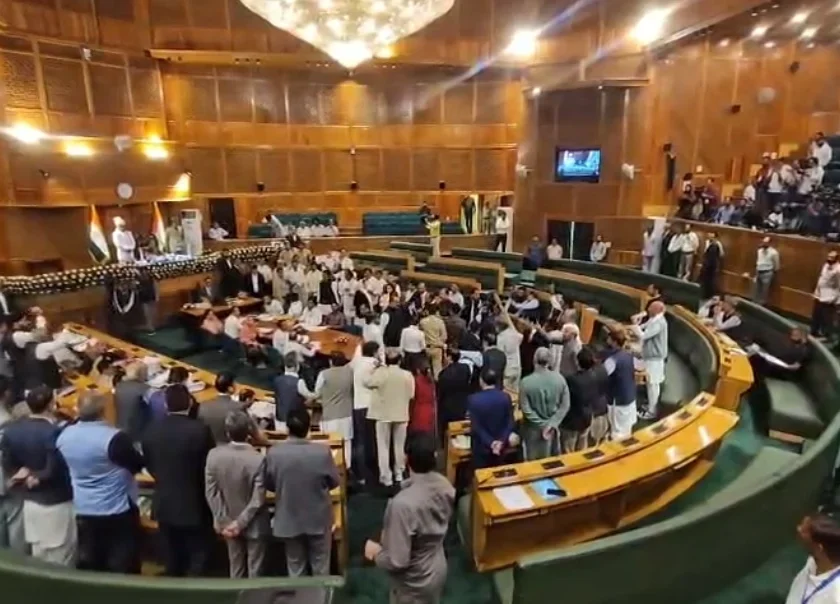
In legislative sessions and public statements, Lone has asserted that neither NC nor PDP has meaningfully acknowledged what he describes as an injustice against Kashmiri youth in job opportunities and reservation allocations. Instead, he accuses them of complicity in a system that diminishes open merit and disadvantages Kashmiri-speaking candidates.
This feature explores the claims, the data, the political responses, and why this issue is resonating in the Valley and beyond.
Background — Jobs, Reservations & Kashmir’s Democratic Promise
What Are Reservations?
In India, reservations refer to affirmative action policies intended to improve representation for socially and economically disadvantaged groups in government jobs, education and legislative bodies.
In J&K, reservation policy has been shaped over decades — by the 2004 Reservation Act and subsequent rules — and significantly restructured after the abrogation of Article 370 and federal changes in 2019.
Reservations in J&K are now structured across categories such as:
-
Scheduled Castes (SC)
-
Scheduled Tribes (ST)
-
Economically Weaker Sections (EWS)
-
Residents of Backward Areas (RBA)
-
Other special classifications
The combined effect has resulted in reservation quotas exceeding 60% in many recruitment and education categories — which by definition leaves approximately 30–40% seats for open merit (general category competition).
Political Stakes in Jammu & Kashmir
Jobs and reservation equity are not just administrative issues in J&K — they are politically charged, tied to:
-
Regional identity and opportunity distribution
-
Legacy of Article 370 negotiations
-
Socio-economic aspirations of youth
-
Political legitimacy of parties in both Jammu and Kashmir regions
In this climate, the narrative around merit, fairness and opportunity has become a core political issue, with competing interpretations and strong emotions on all sides.
Sajad Lone’s Central Claim
Who Is Sajad Gani Lone?
Sajad Lone is a seasoned politician and president of the Jammu & Kashmir Peoples Conference (JKPC). He has served as a minister in past coalition governments and represents Handwara in the J&K Assembly.
Lone has repeatedly articulated a criticism of the reservation and recruitment framework as disproportionately disadvantaging Kashmiri candidates — particularly those in the open merit category.
The Core Accusation: Systemic Disadvantage
Lone argues that:
-
Reservation rules are “rigged against Kashmiri-speaking populations” — especially in politically sensitive categories like SC, ST and EWS.
-
Some categories are structurally biased, evident from official certificate distribution data, where Jammu region overwhelmingly dominates disproportionate shares.
-
The imbalance has real consequences for job opportunities, career growth and representation in government services.
He has framed this as more than a policy disagreement — but as a generational crisis for Kashmiri youth. Lone warned that unresolved issues around reservation and unemployment may trigger a political and social crisis potentially “bigger” than the fallout from the controversial 1987 elections — a watershed moment in Kashmir’s modern history.
Specific Grievances Lone Highlights
Disparities in Reservation Certificates
Lone cites government responses to his Assembly questions showing:
-
All 67,112 SC certificates issued over a two-year period went to the Jammu region, with none issued to Kashmir.
-
ST certificates overwhelmingly skewed toward Jammu: ~85% for Jammu vs ~15% for Kashmir.
-
EWS certificates similarly disproportionate.
This statistical disparity forms the core of his argument that regional representation is unbalanced.
NC and PDP — What Have They Said?
National Conference (NC) Response
The NC — a major political force in J&K — has not explicitly endorsed Lone’s claim that there is systemic injustice against Kashmiris in jobs and reservations.
In public response to Lone’s criticisms:
-
NC leaders have sometimes framed the issue as administrative imbalance, rather than deliberate political bias.
-
NC has pointed to ongoing bureaucratic processes to review reservations and promised audits and corrective measures — but without outright admission of injustice.
-
NC leaders in some cases have criticized Lone for opposition tactics rather than engaged with the core claim.
People’s Democratic Party (PDP) Stance
PDP has occasionally echoed concerns over the recent reservation policy and its impacts, particularly highlighting the pressure on open merit students.
However:
-
PDP has not openly agreed with Lone’s characterization that the unfairness is being actively upheld by NC or PDP.
-
PDP leaders have also blamed the current implementation delays for hurting students’ prospects.
Both parties have thus kept a guarded public position, emphasizing process over confrontation — but neither has fully embraced Lone’s critique of injustice nor framed it as they agree systemic exclusion is occurring.
Broader Political Context
Reservation & Open Merit Debate
Across Jammu & Kashmir, there are multiple trends compounding this political narrative:
-
Open Merit Candidates Feeling Squeezed: Many aspirants from the general category argue fewer seats remain available in competitive recruitment due to high reservation coverage — exacerbated by lack of transparency in data sharing.
-
Student and Youth Protests: Open Merit Students Associations have protested and taken disputes to court over what they describe as discriminatory outcomes — highlighting the emotional context driving these debates.
-
Government Engagement: The J&K cabinet set up a sub-committee to review reservations, but delays in its report have frustrated both youth and opposition parties.
In this charged environment, Lone’s remarks resonate with a public that feels disconnected from decision-making — particularly in the aftermath of 2019’s constitutional changes.
What Data Tells Us
Official Figures on Reservation Certificate Distribution
While stakeholders disagree on interpretation, government figures shared in legislative responses (upon Lone’s questions) show marked regional disparities:
| Category | Jammu | Kashmir |
|---|---|---|
| SC Certificates | 67,112 | 0 |
| ST Certificates | 459,493 | 79,813 |
| EWS Certificates | 27,420 | 2,273 |
| RBA Certificates | Higher shares but still skewed toward Jammu when adjusted for population | Lower |
These figures indicate a structural skew in award and utilization of reservation categories — a central point Lone emphasizes.
Reserve vs Open Merit Space
-
Reservation coverage ~60% of jobs/education placements
-
Open Merit ~30–40% available
-
But because reserved candidates can sometimes compete in open merit as well, actual competition pressure on genuine open-merit aspirants increases.
Political Reactions & Public Sentiment
NC and PDP Rebuttals
NC and PDP have responded to Lone’s statements in various forums. Some NC voices argue the issue is more about implementation than discrimination per se, while PDP leaders have emphasized the need to respect constitutional mandates and due process before drawing conclusions.
Youth and Community Voices
Public discourse beyond political circles reflects:
-
Deep frustration among Kashmiri aspirants over perceived job scarcity.
-
Calls for transparency and data accountability in recruitment strategies.
-
Concerns about social disempowerment if trends continue unaddressed.
Implications — Politics, Social Equity & Stability
Political Legitimacy
In a region where political identity and democratic representation are already contested, perceptions of jobs injustice can have far-reaching consequences:
-
Young voters may feel disillusioned with mainstream parties
-
Smaller regional parties could gain traction
-
Demand for granular policy reform may rise
Social Stability
Lone’s warning that unresolved grievances might escalate into larger unrest echoes historical tensions in the Valley — most notably the crisis that followed the disputed 1987 elections, which contributed to decades of conflict.
Conclusion: So Do NC or PDP Agree There Is Injustice?
Short answer:
No — according to Sajad Lone, neither the National Conference nor the People’s Democratic Party acknowledges the injustice being done to Kashmiris in matters of jobs and reservation. Instead, he accuses them of complicity in policies that systematically disadvantage Kashmiri youth and diminish open merit opportunities.
Longer view:
While NC and PDP may recognize some administrative imbalance or support the sub-committee review process, they have not publicly endorsed Lone’s core assertion that the current system is inherently unjust. Their responses focus on bureaucratic review rather than direct admission of structural inequity.
In contrast, Lone — backed by data and spirited political commentary — frames the issue as central to Kashmir’s future, urging immediate transparency, rationalization of quotas, and urgent policy reform.