‘We Live Off This Land’: Shopian, Pulwama Farmers Protest Rail Line Through Kashmir Orchards
By: Javid Amin | 28 December 2025
A Slogan Rooted in Survival
“We live off this land.”
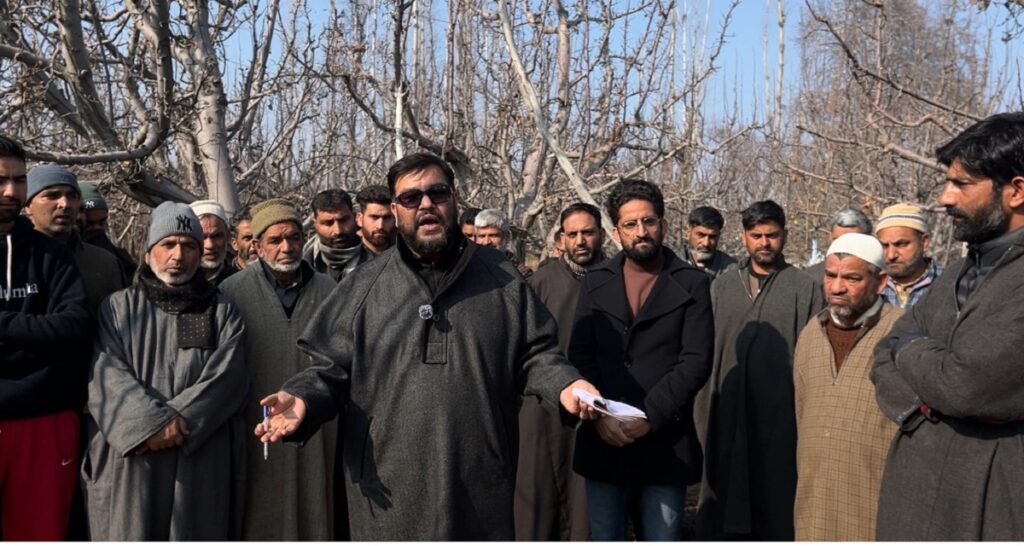
In the apple-rich districts of Shopian and Pulwama, this phrase is not a political slogan or a protest chant borrowed from elsewhere. It is a statement of fact—spoken quietly in orchards, repeated at village meetings, and now raised collectively against a proposed railway line cutting through South Kashmir’s orchard belt.
As survey teams and preliminary plans advance, farmers across these districts say the project threatens their only source of income, their generational inheritance, and a way of life that defines rural Kashmir.
What the administration calls connectivity and development, farmers see as dispossession wrapped in progress.
Why These Orchards Matter: More Than Just Trees
Apple Orchards as Economic Backbone
South Kashmir’s orchard belt is the heart of the Valley’s horticulture economy:
-
Apples contribute the largest share of agricultural income in Kashmir
-
Thousands of families depend entirely on orchard earnings
-
Ancillary livelihoods include packing, transport, cold storage, and trade
For many households in Shopian and Pulwama:
-
Orchard income accounts for 70–90% of annual earnings
-
There is no alternative land, skill base, or safety net
Losing orchard land is not a setback—it is an economic dead end.
On the Ground: What Farmers Are Saying
“You Can’t Replant a Life”
Farmers argue that compensation cannot replace what is being taken.
“An apple tree takes years to grow. You cut it once, and the loss is permanent,”
— Grower, Shopian
Many orchards have:
-
Trees planted by grandparents
-
Varieties adapted to specific micro-climates
-
Productivity built over decades
Cash compensation, they say, cannot recreate time, soil, and knowledge.
Youth Anxiety: The Fear of a Future Without Roots
Young people in orchard families express a different kind of fear.
“Our parents survived on apples. If orchards go, what do we do?”
— Youth from Pulwama
Their concerns include:
-
Loss of inherited livelihoods
-
Limited non-farm employment in rural Kashmir
-
Risk of forced migration or unemployment
For many rural youth, orchards are not backwardness—they are the last remaining economic anchor.
Local Traders and the Apple Supply Chain
Beyond the Farmer
Traders warn that orchard disruption affects the entire ecosystem:
-
Transporters
-
Packaging units
-
Commission agents
-
Cold storage operators
Any fragmentation of orchard land could:
-
Reduce output
-
Disrupt supply chains
-
Weaken Kashmir’s bargaining power in national markets
At a time when the apple industry is already under pressure from imports, price volatility, and rising costs, farmers see the rail line as another destabilising force.
Community Elders: Orchards as Cultural Identity
Elders frame the resistance not just in economic terms, but cultural ones.
“These orchards are our identity. You remove them, and villages lose their meaning,”
— Community elder, Shopian
In Kashmir:
-
Orchards shape settlement patterns
-
Agricultural cycles define social life
-
Land inheritance is deeply tied to dignity
For many, the rail project feels like erasing a living landscape, not merely acquiring land.
Administration’s Stand: Development and Connectivity
Officials argue that the railway line is a public good, promising:
-
Better connectivity
-
Faster movement of goods and people
-
Integration of South Kashmir with broader economic networks
From the administration’s perspective:
-
Infrastructure is essential for long-term growth
-
Land acquisition is legally permissible
-
Rehabilitation and compensation packages will be offered
The rail line is framed as modernisation, not displacement.
The Trust Deficit: Where the Conflict Deepens
The sharpest divide lies not in the idea of development—but in trust.
Farmers’ Fears
-
Compensation may be delayed or inadequate
-
Rehabilitation promises may remain on paper
-
Once land is acquired, voices will be ignored
Administrative Assurances
-
Officials insist safeguards will be built in
-
Claim consultations will continue
-
Emphasise national importance of rail connectivity
Past experiences of land acquisition in Kashmir, however, have left many farmers deeply sceptical.
A Familiar Development Dilemma
The Shopian–Pulwama protest reflects a broader pattern seen across India:
-
Infrastructure projects pitched against agrarian livelihoods
-
“Public good” versus private survival
-
Short-term growth metrics versus long-term social stability
In Kashmir, this dilemma is sharper because:
-
Land is limited
-
Employment options are scarce
-
Agriculture remains the most reliable livelihood
Economic Stakes: What Happens If Orchards Shrink
Potential Consequences
-
Decline in apple production
-
Loss of rural incomes
-
Increased dependency on external support
-
Deepening inequality between urban and rural Kashmir
Economists warn that weakening the apple sector could destabilise Kashmir’s rural economy, with ripple effects far beyond the affected villages.
Political Undercurrents
The issue is rapidly gaining political traction:
-
Opposition parties are amplifying farmer voices
-
The rail project is being framed as anti-farmer
-
Orchard loss is emerging as an emotive symbol
As protests grow, the rail line risks becoming a flashpoint, not a flagship project.
Is There a Middle Path? What Experts Suggest
Policy analysts argue the conflict is not inevitable.
Possible Alternatives
-
Rerouting to avoid dense orchard clusters
-
Using government or barren land where possible
-
Minimising land footprint through engineering solutions
-
Transparent, binding rehabilitation plans
Meaningful consultation, they stress, is not a procedural formality but a necessity.
What the Protest Is Really Saying
The resistance in Shopian and Pulwama is not anti-rail or anti-development.
It is a demand for:
-
Development with dignity
-
Growth without erasure
-
Connectivity without dispossession
The phrase “We live off this land” captures a fundamental truth: when land goes, life goes with it.
FAQs
Q1: Are farmers opposing all development?
No. They oppose development that destroys their only livelihood.
Q2: Will compensation solve the problem?
Farmers argue compensation cannot replace long-term income and generational assets.
Q3: Why is this protest significant?
It reflects deeper tensions between infrastructure growth and agrarian survival in Kashmir.
Q4: Can the rail project be modified?
Experts say rerouting and safeguards are possible if political will exists.
Conclusion: An Orchard-Deep Question About Kashmir’s Future
The protest against the rail line in Shopian and Pulwama is not just about land acquisition. It is about how Kashmir’s future is imagined—and who gets to decide.
For farmers, orchards are not obstacles to progress; they are the progress that already exists. Any development that ignores this reality risks deepening alienation rather than delivering prosperity.
As Kashmir stands at the crossroads of modernisation and preservation, one message from its orchard belt rings clear:
Development that uproots livelihoods cannot be called development at all.