Trump Claims He Ended Eight Wars, Stopped India–Pakistan Conflict | Fact-Check & Global Context
By: Javid Amin | 12 January 2026
A Familiar Claim, Repeated with Renewed Force
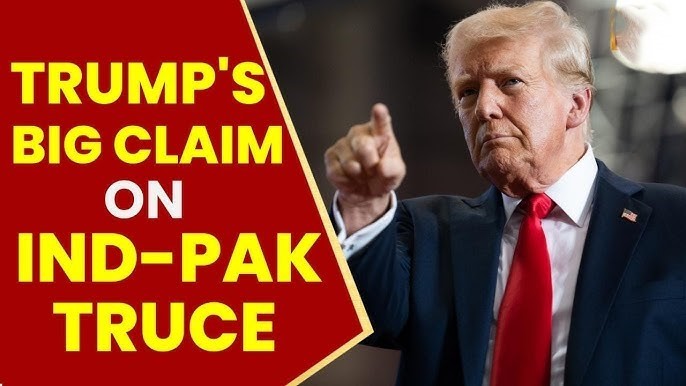
Donald Trump has never been subtle about how he views his own presidency. From domestic policy to global diplomacy, the former U.S. president has consistently portrayed himself as a dealmaker without precedent. In recent interviews and campaign-style remarks, Trump has revived one of his most sweeping foreign policy assertions: that he “ended eight wars” during his time in office and personally stopped a major military confrontation between India and Pakistan.
“I ended eight wars,” Trump said in one such statement. “India and Pakistan were going at it. Eight planes were shot down. That was one of eight. We ended eight strong wars.”
He has paired these remarks with pointed criticism of the Nobel Committee, arguing that while former President Barack Obama received the Nobel Peace Prize in 2009, his own record of conflict de-escalation has gone unrecognized.
These claims, dramatic in tone and expansive in scope, raise important questions. What exactly are the “eight wars” Trump says he ended? What role, if any, did the United States play during the 2019 India–Pakistan crisis following the Pulwama terror attack? And how do these claims square with the official positions of the governments involved—particularly India, which has repeatedly and unequivocally rejected third-party mediation in its disputes with Pakistan?
This article examines Trump’s assertions in detail, cross-verifies them against established facts and diplomatic records, and places them within the broader context of international politics, U.S. foreign policy traditions, and South Asia’s volatile security landscape.
Trump’s Assertion: “I Ended Eight Wars”
Trump’s claim that he ended “eight wars” is not new. He has made variations of this statement repeatedly since leaving office, often in interviews, rallies, and media appearances. However, he has rarely specified which conflicts he considers to be among these eight.
What Trump Means by ‘Ending Wars’
In Trump’s framing, “ending wars” does not necessarily mean formal peace treaties or the conclusion of armed conflicts through comprehensive diplomatic agreements. Rather, his definition often includes:
-
Avoiding direct U.S. military involvement
-
Reducing troop deployments
-
Negotiating ceasefires or normalization agreements
-
Preventing escalation between rival states
This looser definition allows Trump to include a range of diplomatic developments under the umbrella of “ending wars,” even when the underlying conflicts remain unresolved or merely frozen.
Examples Often Cited by Trump and His Allies
Supporters of Trump’s foreign policy record frequently point to:
-
The Abraham Accords between Israel and several Arab states
-
Talks with North Korea, including meetings with Kim Jong Un
-
Negotiations with the Taliban that preceded the U.S. withdrawal from Afghanistan
-
Reduced U.S. military presence in Iraq and Syria
-
De-escalation efforts involving Serbia and Kosovo
However, critics argue that none of these situations constitute the clear “ending” of wars in the traditional sense. Many of these conflicts either predated Trump, continued after his presidency, or remain unresolved today.
The India–Pakistan Claim: What Trump Says He Stopped
Among Trump’s most controversial assertions is his claim that he stopped India and Pakistan from sliding into full-scale war.
According to Trump:
-
India and Pakistan were on the brink of a major military confrontation
-
Aircraft had already been shot down
-
U.S. intervention, led by him personally, prevented further escalation
This claim directly references events surrounding the 2019 Pulwama–Balakot crisis, one of the most dangerous moments in South Asian geopolitics in recent decades.
The Pulwama–Balakot Crisis Explained
The Pulwama Terror Attack
On February 14, 2019, a suicide bomber affiliated with the Pakistan-based militant group Jaish-e-Mohammed attacked a convoy of Indian paramilitary forces in Pulwama district, Jammu and Kashmir. Forty Indian personnel were killed, making it one of the deadliest attacks in the region in decades.
India squarely blamed Pakistan for harboring and supporting the group responsible for the attack. Pakistan denied direct involvement.
India’s Balakot Airstrikes
On February 26, 2019, India conducted airstrikes on what it described as a Jaish-e-Mohammed training camp in Balakot, deep inside Pakistan’s Khyber Pakhtunkhwa province. This marked the first time since 1971 that Indian aircraft had crossed the international border to strike targets inside Pakistan.
India described the strikes as a “pre-emptive, non-military” action aimed at preventing future terror attacks.
Pakistan’s Response and the Aerial Engagement
The following day, Pakistan launched air operations across the Line of Control. During the ensuing aerial engagement:
-
An Indian MiG-21 aircraft was shot down
-
Its pilot, Wing Commander Abhinandan Varthaman, was captured by Pakistan
-
Pakistan claimed to have shot down additional Indian aircraft, which India denied
Pakistan returned the captured pilot within days, a move widely interpreted as an effort to de-escalate tensions.
Did the United States Intervene?
U.S. Diplomatic Engagement
During the crisis, the United States, along with several other major powers, urged restraint on both sides. Then–Secretary of State Mike Pompeo confirmed that he had spoken with officials in both India and Pakistan to encourage de-escalation.
This kind of diplomatic outreach is standard practice during international crises, particularly between nuclear-armed states.
India’s Firm Rejection of Mediation Claims
India has consistently and unequivocally rejected Trump’s claim that he personally mediated or stopped the conflict.
New Delhi’s position is rooted in long-standing policy:
-
All disputes with Pakistan must be resolved bilaterally
-
Third-party mediation is neither sought nor accepted
-
De-escalation decisions during the crisis were sovereign choices
Indian officials have repeatedly clarified that while international partners urged restraint, no external power dictated India’s actions.
The “Eight Planes” Claim: A Factual Gap
Trump’s statement that “eight planes were shot down” during the crisis has no basis in publicly verified facts.
Documented outcomes of the aerial engagement include:
-
One confirmed Indian aircraft shot down
-
Conflicting claims by Pakistan about additional aircraft
-
No independent evidence supporting the loss of eight aircraft
Military analysts and independent observers have noted that such exaggerated figures undermine the credibility of Trump’s broader narrative.
Why India Pushes Back So Strongly
Sovereignty and Strategic Autonomy
India’s rejection of mediation claims is not merely semantic. It reflects a core principle of Indian foreign policy: strategic autonomy.
Accepting third-party intervention in disputes with Pakistan would:
-
Undermine India’s stated diplomatic position
-
Internationalize bilateral issues
-
Set precedents India has long resisted
The Shimla Agreement and Bilateralism
India frequently cites the 1972 Shimla Agreement, under which India and Pakistan committed to resolving disputes bilaterally. This framework remains central to India’s diplomatic posture.
Trump and the Nobel Peace Prize Narrative
Trump has repeatedly expressed frustration over not receiving the Nobel Peace Prize, often contrasting himself with Barack Obama.
Obama’s Nobel: A Political Benchmark
Obama received the Nobel Peace Prize in 2009, early in his presidency, a decision that was controversial even at the time. Critics argued it was awarded more for aspiration than achievement.
Trump has used this controversy to bolster his own argument:
-
He claims tangible results
-
He portrays himself as a dealmaker, not a theorist
-
He frames the Nobel Committee as politically biased
The Political Utility of the Nobel Argument
For Trump, the Nobel narrative serves several purposes:
-
Reinforces his self-image as a peacemaker
-
Appeals to voters skeptical of military intervention
-
Positions him as an outsider unfairly treated by global elites
Assessing the ‘Eight Wars’ Claim
A closer examination suggests that Trump’s claim blends:
-
Partial de-escalations
-
Ongoing negotiations
-
Symbolic agreements
-
Avoidance of new conflicts
While it is true that Trump did not start major new wars involving U.S. troops, it is equally true that many global conflicts persisted during and after his presidency.
Observers’ View: Rhetoric vs. Record
Foreign policy experts generally agree on several points:
-
The U.S. did urge restraint during the India–Pakistan crisis
-
Trump did not personally broker a settlement
-
De-escalation resulted primarily from decisions taken in New Delhi and Islamabad
-
Claims of “ending wars” are overstated when measured against conventional definitions
Risks of Oversimplified Narratives
Diplomatic Sensitivity
Statements suggesting U.S. mediation where none was accepted can:
-
Complicate diplomatic relationships
-
Offend partner nations
-
Create historical distortions
Credibility Concerns
Repeated exaggeration risks eroding trust, particularly among international audiences accustomed to precise diplomatic language.
Why This Matters Now
Trump’s renewed claims come at a time when:
-
Global conflicts are intensifying
-
U.S. foreign policy is under scrutiny
-
South Asia remains a nuclear flashpoint
-
Political narratives increasingly shape voter perception
Understanding the difference between political storytelling and documented diplomacy is critical—not just for historians, but for policymakers and citizens alike.
Conclusion: A Claim That Reveals More Than It Resolves
Donald Trump’s assertion that he “ended eight wars” and stopped India and Pakistan from “going at it” is less a definitive account of diplomatic history and more a reflection of his political style.
While the United States did play a role in urging restraint during the 2019 Pulwama–Balakot crisis, there is no credible evidence that Trump personally mediated or settled the conflict. India’s consistent rejection of third-party intervention remains a central, non-negotiable element of its foreign policy.
Ultimately, Trump’s narrative underscores how modern political leadership often blurs the line between diplomacy and branding. The reality of international conflict resolution—complex, incremental, and often imperfect—rarely fits neatly into campaign slogans or award justifications.
In the realm of global politics, preventing war is as important as ending it. But history demands precision, not hyperbole. And on that count, Trump’s sweeping claims remain contested, incomplete, and firmly challenged by the facts.