NLU Debate Reignites Regional Divide in Jammu and Kashmir: Education, Equity and the Politics of Place
By: Javid Amin | 19 January 2026
When a University Becomes a Political Flashpoint
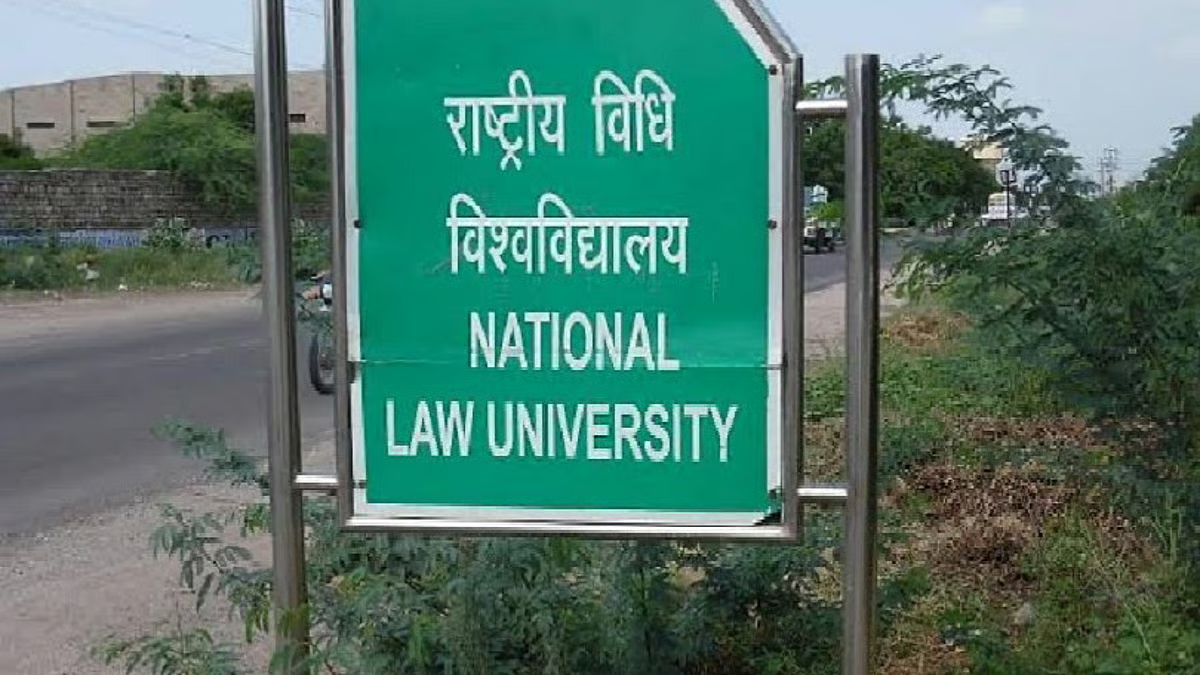
The proposal to establish a National Law University (NLU) in Jammu and Kashmir should, by any objective measure, have been a moment of collective optimism. NLUs are among India’s most prestigious educational institutions, shaping future judges, policymakers, constitutional lawyers, and legal scholars. For a region long plagued by conflict, educational migration, and limited access to elite institutions, an NLU promised opportunity, retention of talent, and intellectual capital.
Instead, the proposal has reignited deep-seated regional divisions, transforming what could have been a shared achievement into yet another flashpoint in Jammu and Kashmir’s complex internal politics.
Protests in Jammu, led by law students and supported by social and political groups, demanding that the NLU be established in their region, have been met with sharp rebuttals from Kashmir, where many argue that Jammu already hosts a disproportionate share of premier national institutions. What followed was a familiar pattern: allegations of discrimination, counter-allegations of selective outrage, and a public debate increasingly shaped by identity, history, and mistrust rather than policy.
The Immediate Trigger: Protests and Competing Claims
Jammu’s Demand: “Equitable Development, Not Rivalry”
In recent weeks, Jammu has witnessed sustained protests by law students, civil society groups, and regional organisations, all demanding that the proposed National Law University be located in the Jammu region.
Protesters argue that:
-
Jammu has historically suffered administrative and political marginalisation
-
Decision-making in the erstwhile state and current Union Territory has been Kashmir-centric
-
Locating the NLU in Jammu would ensure balanced regional development
For many protesters, the demand is framed not as opposition to Kashmir, but as a correction of what they describe as structural imbalance. Placards, speeches, and social media campaigns consistently emphasise the language of “equity” and “fair share.”
Yet, the emotive force of the protests suggests that the issue runs deeper than one university.
Kashmir’s Counter-Argument: “Selective Outrage and Short Memory”
From Kashmir, the response has been swift and pointed.
Political leaders, commentators, and students have countered the Jammu demand by listing a series of elite institutions already located in Jammu, including:
-
Indian Institute of Technology (IIT) Jammu
-
Indian Institute of Management (IIM) Jammu
-
Major AIIMS-linked medical infrastructure
-
Several centrally funded research and training institutes
Their argument is simple:
When these institutions were established in Jammu, there was no sustained outcry about regional balance. Now, when Kashmir is being considered for a premier institution like an NLU, cries of discrimination suddenly dominate the discourse.
For many in the Valley, the NLU debate reflects selective regionalism—support for central institutions when they benefit one region, and resistance when they are proposed elsewhere.
A Pattern Repeats: The SMVDIME Medical College Controversy
The NLU debate did not emerge in isolation. It followed closely on the heels of another deeply contentious episode: the revocation of the Letter of Permission (LoP) for MBBS courses at the Shri Mata Vaishno Devi Institute of Medical Excellence (SMVDIME).
What Happened at SMVDIME
SMVDIME, a medical institution linked to a prominent Hindu shrine, became the centre of controversy when:
-
A large proportion of MBBS seats were allotted to students from Kashmir
-
Protests erupted in Jammu, alleging bias and unfair distribution
-
Following demonstrations, the National Medical Commission (NMC) conducted an inspection
-
The NMC subsequently withdrew permission to run the MBBS course, citing deficiencies
While the NMC cited technical non-compliance, the timing and political atmosphere surrounding the decision deepened regional resentment.
For many in Jammu, the episode reinforced the belief that the region is repeatedly short-changed. For Kashmiris, it raised concerns that street pressure and communal narratives can influence regulatory outcomes.
The NLU controversy is now widely seen as part of this continuum of grievance and reaction.
Regional Fault Lines: A History That Shapes the Present
Jammu and Kashmir: Different Histories, Different Anxieties
Jammu and Kashmir has never been a monolith. The Muslim-majority Kashmir Valley and Hindu-majority Jammu have distinct:
-
Historical trajectories
-
Political cultures
-
Demographic compositions
-
Economic priorities
These differences have often produced competing narratives of victimhood and neglect.
The Shadow of 2008: Amarnath Land Agitation
Any discussion of regional polarisation inevitably recalls the 2008 Amarnath land agitation, when the transfer of land to the Shri Amarnath Shrine Board sparked massive protests in Kashmir and counter-mobilisation in Jammu.
That episode:
-
Deepened communal and regional mistrust
-
Hardened political identities
-
Demonstrated how administrative decisions could quickly acquire religious and regional overtones
The current NLU debate echoes many of those dynamics, albeit in the domain of education rather than land or religion.
Education as Identity Politics
Why Institutions Matter More Than Infrastructure
In conflict-affected or politically sensitive regions, educational institutions are not just centres of learning. They become:
-
Symbols of recognition and inclusion
-
Markers of state investment and trust
-
Tools for shaping regional narratives
An NLU, with its national stature, carries symbolic capital far beyond classrooms and hostels.
Migration Anxiety: A Shared Concern
Ironically, both Jammu and Kashmir share a common problem: educational migration. Thousands of students leave the Union Territory every year for:
-
Law
-
Medicine
-
Engineering
-
Management
The NLU was meant to stem this outflow. Yet, the debate over its location risks undermining that very objective.
The Forgotten Regions Speak Up: Chenab and Pir Panjal
As the Jammu–Kashmir binary dominates headlines, voices from Rajouri, Poonch, Doda, and Kishtwar have added a new dimension to the debate.
Residents and activists from these regions argue that:
-
Both Jammu and Kashmir often monopolise attention and resources
-
Chenab Valley and Pir Panjal areas suffer from chronic underdevelopment
-
If equity is the goal, the NLU should be located in one of these neglected regions
Their intervention exposes a deeper truth: regional imbalance is not binary, but layered and complex.
Social Media and the Politics of Amplification
From Policy Debate to Polarisation
Social media has played a decisive role in escalating the NLU controversy. Claims, counter-claims, selective data points, and emotionally charged narratives have travelled faster than verified information.
What could have remained a policy discussion has increasingly become:
-
A contest of regional pride
-
A proxy for older grievances
-
A space for political mobilisation
In this environment, nuance struggles to survive.
Political Parties and the Incentive to Divide
Political actors across the spectrum have weighed in—often amplifying regional narratives rather than moderating them.
-
Some parties in Jammu foreground historical neglect
-
Some leaders in Kashmir emphasise institutional imbalance
-
Others exploit the issue to consolidate vote banks
Consensus-building, in such an atmosphere, becomes politically unrewarding.
Policy Parameters vs Sentiment: What Should Decide the NLU Location?
From a governance perspective, the location of a National Law University should ideally be determined by:
-
Accessibility and connectivity
-
Availability of land and infrastructure
-
Academic ecosystem and faculty attraction
-
Long-term sustainability
Many in Kashmir argue that merit-based criteria, not regional pressure, should guide the decision. Jammu protesters counter that policy neutrality has historically masked bias.
This clash between procedural rationality and emotional legitimacy lies at the heart of the controversy.
What Is at Stake If Polarisation Continues
1. Loss of Opportunity
The longer the dispute drags on, the greater the risk that:
-
The project gets delayed
-
Funding priorities shift
-
J&K loses out altogether
2. Deepening Regional Alienation
Each round of accusation entrenches suspicion, making future cooperation harder.
3. Educational Vision Gets Overshadowed
Instead of debating curriculum, legal research, or judicial reform, the conversation remains stuck on geography.
A Way Forward: From Zero-Sum to Shared Gain
For the NLU to serve its intended purpose, stakeholders may need to:
-
De-escalate rhetoric
-
Agree on transparent, published criteria
-
Consider regional campuses, outreach centres, or complementary institutions
-
Frame the university as a Union Territory asset, not a regional trophy
Educational institutions thrive in environments of stability and consensus, not perpetual contestation.
Conclusion: A Mirror to J&K’s Unresolved Questions
The NLU debate is not really about a law university alone. It is about:
-
Who feels heard
-
Who feels left behind
-
Who defines fairness in a divided landscape
As Jammu and Kashmir navigates its future as a Union Territory, decisions like these will test whether governance can rise above regional anxieties or remain captive to them.
If polarisation continues, the greatest casualty may not be one region or the other—but the very idea that education can unite where politics has long divided.