Attack on Ayatollah Khamenei Means Full-Scale War, Iran’s President Warns US After Trump’s Regime-Change Remarks
By: Javid Amin | 19 January 2026
A Red Line Drawn in Public
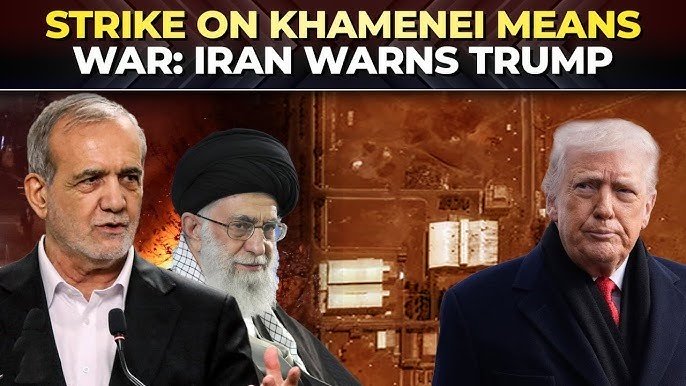
Tensions between Iran and the United States escalated sharply after Iranian President Masoud Pezeshkian issued a stark warning that any attack on Supreme Leader Ayatollah Ali Khamenei would result in an “all-out war” with the United States.
The warning followed remarks by U.S. President Donald Trump, who suggested that it was “time to look for new leadership in Iran,” a statement that Tehran interpreted as explicit regime-change rhetoric.
The exchange comes at a moment of extraordinary volatility:
-
Iran is facing nationwide protests driven by economic collapse.
-
The United States has intensified sanctions and trade threats.
-
Regional tensions involving Israel, Iran, and U.S. allies are already near a breaking point.
Iran’s message was unambiguous: Ayatollah Khamenei’s safety is a red line equivalent to the survival of the Iranian state itself.
What Donald Trump Said
In an interview with Politico, President Trump stated that it was “time to look for new leadership in Iran,” a remark that echoed earlier U.S. policy debates over regime change but was unusually direct in tone.
While Trump did not explicitly call for military action, Iranian officials viewed the statement as:
-
A challenge to Iran’s political system
-
An implied threat against its leadership
-
Part of a broader pressure campaign involving sanctions and tariffs
Trump’s comments followed his recent announcement of a 25% tariff on any country trading with Iran, further tightening economic pressure on Tehran.
Iran’s Response: ‘Attack on Our Leader Means War’
President Masoud Pezeshkian responded swiftly, posting a strongly worded message on X (formerly Twitter).
Pezeshkian’s Warning
“Any attack on our great leader will be tantamount to an all-out war against the Iranian nation.”
He stressed that:
-
Ayatollah Khamenei is not merely a political figure but a symbol of Iranian sovereignty
-
Any attempt to target or undermine him would be treated as an assault on Iran itself
-
Iran would respond collectively, not symbolically
This language reflects Iran’s long-standing doctrine that the Supreme Leader’s authority is inseparable from the state, making personal threats equivalent to acts of war.
Khamenei’s Central Role in Iran’s System
Ayatollah Ali Khamenei, Iran’s Supreme Leader since 1989, holds:
-
Ultimate authority over the military and Revolutionary Guards
-
Final say in foreign policy
-
Religious legitimacy within Iran’s theocratic framework
For Tehran, threats against Khamenei are viewed not as political criticism but as existential challenges, comparable to threats against territorial integrity.
Iranian officials have repeatedly warned that:
-
Assassination or targeting of top leadership would provoke immediate retaliation
-
Such action would likely expand conflict beyond Iran’s borders
Economic Crisis and Blame on Washington
Pezeshkian also used the moment to place Iran’s internal unrest within an external framework.
Key Claims
-
Sanctions as the root cause:
He blamed “inhumane U.S. sanctions” for inflation, unemployment, and currency collapse. -
Economic warfare:
Iran framed sanctions as a form of collective punishment rather than diplomacy. -
Externalising unrest:
Officials suggested that foreign pressure has exacerbated public anger, even as protests continue domestically.
While independent analysts acknowledge that sanctions have severely damaged Iran’s economy, they also point to structural mismanagement and corruption as contributing factors.
Iran’s Protests: A Dangerous Backdrop
Since late December 2025, Iran has witnessed:
-
Widespread protests across major cities
-
Demonstrations initially triggered by rising prices and unemployment
-
Increasingly political slogans targeting the system itself
Human rights groups estimate:
-
Hundreds to thousands killed
-
Thousands arrested
-
A near-total internet blackout imposed by authorities
The leadership fears that external pressure combined with internal unrest could create conditions similar to past uprisings in the region.
Why Trump’s Words Matter to Tehran
Iran’s reaction underscores a long-standing sensitivity to regime-change rhetoric, shaped by:
-
The 1953 CIA-backed coup against Prime Minister Mohammad Mossadegh
-
Decades of hostility following the 1979 Islamic Revolution
-
The U.S. assassination of General Qassem Soleimani in 2020
From Tehran’s perspective:
-
Calls for “new leadership” are not rhetorical flourishes
-
They signal intent, even if indirect
-
They justify deterrent warnings at the highest level
Strategic Messaging and Deterrence
Analysts interpret Pezeshkian’s warning as:
-
A deterrent against covert or overt action
-
A message to U.S. allies, including Israel
-
A signal to domestic audiences that leadership will not yield under pressure
Iran’s strategy has long relied on raising the cost of escalation, making clear that limited actions could spiral into broader conflict.
State of US–Iran Relations
The United States and Iran have had:
-
No formal diplomatic relations since 1980
-
Periodic indirect talks through intermediaries
-
Repeated cycles of escalation and de-escalation
The current phase is marked by:
-
Heightened sanctions
-
Military posturing
-
Public threats rather than quiet diplomacy
Any miscalculation now carries significantly higher risks than in previous years.
Global Implications
Risk of Wider Conflict
-
A direct confrontation could involve Israel, Gulf states, and U.S. allies.
-
Energy markets would likely be disrupted.
-
Shipping routes in the Strait of Hormuz could be affected.
Impact on Global Diplomacy
-
Countries like India, China, and the EU are caught between sanctions and strategic interests.
-
Calls for restraint from the UN and global powers are growing.
Key Takeaways
-
Iran has drawn a clear red line around Ayatollah Khamenei’s safety.
-
Trump’s regime-change rhetoric has sharply escalated tensions.
-
Tehran frames sanctions and unrest as part of U.S. hostility.
-
The situation combines domestic instability with external confrontation.
-
Any misstep could trigger a conflict with global consequences.
Conclusion: A Dangerous Moment in a Fragile Region
President Masoud Pezeshkian’s warning marks one of the clearest and most direct threats issued by Iran’s leadership in recent years. By equating an attack on Ayatollah Khamenei with an all-out war, Tehran has attempted to shut down any ambiguity about its red lines.
As protests rage at home and pressure mounts abroad, Iran’s leadership appears determined to signal strength—both to its own population and to its adversaries.
Whether this exchange remains rhetorical or becomes something far more dangerous will depend on decisions taken in Washington, Tehran, and beyond in the days ahead.