PDP Protests in Jammu Against NC Government, Demands Omar Abdullah’s Resignation Over “Failure on All Fronts”
By: Javid Amin | 17 December 2025
Streets of Jammu Turn Political Battleground
The streets of Jammu witnessed renewed political heat as the Peoples Democratic Party (PDP) launched a sharp offensive against the National Conference (NC) government, accusing it of “complete failure on all fronts” and demanding the resignation of Chief Minister Omar Abdullah.
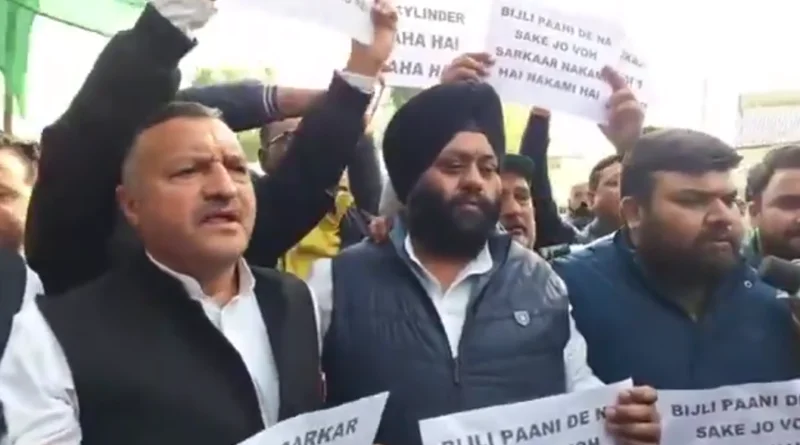
Led by PDP’s Jammu General Secretary Rajinder Singh Manhas, the protest unfolded outside the party headquarters, with workers raising slogans, carrying placards, and openly challenging the credibility and performance of the ruling dispensation.
While protests are not new to Jammu & Kashmir’s political culture, the timing, tone, and intensity of this demonstration signal a deeper political churn—one that goes beyond routine opposition rhetoric and taps into public frustration, governance fatigue, and sharpening inter-party rivalry.
This mega-feature explores what triggered the protest, the allegations raised, their political weight, and why this confrontation matters for the future of Jammu & Kashmir.
Backdrop: A Long-Standing Rivalry Between PDP and NC
The PDP–NC rivalry has shaped Jammu & Kashmir politics for over two decades. Though both parties claim to represent regional aspirations, their governance styles, political narratives, and voter bases often clash.
Historically:
-
The National Conference has positioned itself as the traditional mass party with institutional depth.
-
The PDP has projected itself as a reformist, accountability-driven alternative, particularly vocal during opposition phases.
The current protest reflects this ideological and political competition, intensified by public expectations from the NC government and PDP’s attempt to reclaim political relevance, particularly in the Jammu region, where electoral dynamics remain fluid.
The Protest in Detail: What Happened on the Ground
On the day of the protest, PDP workers assembled outside the party’s Jammu headquarters, creating a scene of disciplined but vocal dissent.
Key Visuals and Actions
-
Placards accusing the NC of “betraying public trust”
-
Slogans demanding Omar Abdullah’s resignation
-
Leaders addressing media and supporters
-
Strong emphasis on governance failures rather than symbolic issues
Unlike spontaneous protests, this demonstration was structured and message-driven, indicating careful political planning rather than emotional reaction.
Core Demand: Why PDP Is Calling for Omar Abdullah’s Resignation
At the heart of the protest lies a direct political challenge—the call for Chief Minister Omar Abdullah to step down.
PDP’s Argument
According to PDP leaders:
-
Omar Abdullah has “lost control over governance”
-
His administration has failed to deliver on poll promises
-
The government is disconnected from ground realities
-
Leadership accountability must be enforced
In Indian political culture, demanding a sitting Chief Minister’s resignation is a high-stakes move, often reserved for moments when opposition parties sense political vulnerability or public dissatisfaction.
Allegation One: “Failure on All Fronts” – What Does It Mean?
The phrase “failure on all fronts” formed the backbone of PDP’s protest narrative. While broad, it reflects multi-layered grievances.
Governance and Administration
PDP leaders alleged:
-
Weak administrative control
-
Delays in decision-making
-
Poor coordination between departments
-
Lack of visible reforms
Development and Infrastructure
The protest highlighted:
-
Stalled development projects
-
Delayed public works
-
Uneven development between regions
-
Lack of transparency in implementation
Public Services and Daily Life
According to PDP claims:
-
People face hardships in everyday governance
-
Basic civic services remain inconsistent
-
Grievance redressal mechanisms are ineffective
By framing the issue as systemic rather than isolated, PDP aimed to question the very legitimacy of the NC’s governance model.
Allegation Two: Betrayal of Poll Promises
One of the most politically potent accusations levelled by the PDP was that the NC has failed to honour its election commitments.
Why Poll Promises Matter
In Jammu & Kashmir’s politically sensitive environment:
-
Election promises carry heightened emotional weight
-
Public trust hinges on visible delivery
-
Unfulfilled assurances often translate into political anger
PDP leaders accused the NC of:
-
Over-promising during elections
-
Under-delivering after assuming power
-
Failing to communicate timelines or constraints
This narrative positions PDP as a custodian of voter accountability, a role opposition parties traditionally seek to occupy.
Allegation Three: Public Suffering and Growing Discontent
A recurring theme in the protest speeches was “public suffering”.
Ground-Level Sentiment
PDP leaders claimed that:
-
Ordinary citizens are struggling with governance gaps
-
Economic pressures remain unaddressed
-
Youth aspirations are unmet
-
People feel unheard by the ruling leadership
While such claims are part of political rhetoric, they resonate strongly in a region where public patience with governance delays is limited.
Diversion Tactics: The Sports Selection Controversy Angle
One of the sharper accusations made by PDP was that the NC is deliberately diverting attention from governance failures by engaging in controversial or emotionally charged side issues, including matters related to sports selections.
Political Strategy Behind the Claim
According to PDP:
-
Non-core issues are amplified to deflect scrutiny
-
Governance questions are sidelined
-
Public discourse is redirected away from accountability
Such allegations are common in adversarial politics but are effective when public trust in institutions is already fragile.
Leadership Spotlight: Rajinder Singh Manhas and PDP’s Jammu Strategy
The protest was led by Rajinder Singh Manhas, PDP’s Jammu General Secretary, underscoring the party’s intent to reassert itself in the Jammu region.
Why Jammu Matters Politically
-
Jammu’s electorate is diverse and issue-driven
-
Regional balance remains a sensitive topic
-
Parties seek to consolidate influence beyond traditional strongholds
By leading the protest from Jammu, PDP signalled that:
-
It intends to remain a serious political contender
-
It will challenge NC not just in Kashmir but across regions
-
Regional grievances will be politically articulated
NC’s Position: Silence, Strategy, or Confidence?
At the time of the protest, the NC leadership did not immediately respond to the resignation demand.
Possible Interpretations
-
Strategic silence to avoid escalation
-
Confidence in governance record
-
Focus on administrative priorities
-
Avoiding legitimising opposition narratives
In politics, silence can be as calculated as speech, especially when protests are designed to provoke reaction.
Political Optics: Why This Protest Is Symbolically Important
Beyond slogans and placards, the protest carries symbolic weight.
Key Political Signals
-
Rising opposition assertiveness
-
Attempt to shape public narrative early
-
Testing public response to accountability discourse
-
Setting the tone for future confrontations
Such protests often serve as political barometers, measuring public mood and media traction.
Media, Messaging, and Narrative Control
The PDP’s protest was also a media strategy.
Key Messaging Techniques
-
Simple, repeatable slogans
-
Focus on leadership accountability
-
Emphasis on broken promises
-
Projection of PDP as people-centric
In the age of rapid news cycles, narrative clarity matters as much as policy depth.
What This Means for Jammu & Kashmir Politics
This confrontation reflects a larger political undercurrent:
-
Opposition parties are sharpening their messaging
-
Governance delivery is becoming central to political debate
-
Leadership accountability is being foregrounded
-
Regional politics remain highly competitive
As political temperatures rise, public scrutiny of governance will intensify, placing pressure on the ruling party to demonstrate results rather than rhetoric.
Looking Ahead: Escalation or Engagement?
Key questions moving forward include:
-
Will PDP sustain street-level agitation?
-
Will NC respond with counter-narratives or reforms?
-
How will public sentiment evolve?
-
Will this confrontation shape electoral alignments?
The answers will determine whether this protest becomes a turning point or a passing political episode.
Bottom-Line: A Protest That Reflects Deeper Political Undercurrents
The PDP’s protest in Jammu is more than a routine opposition exercise. It reflects deep political rivalry, rising accountability demands, and the struggle to define governance success in Jammu & Kashmir.
By demanding Omar Abdullah’s resignation, the PDP has raised the stakes, positioning itself as a watchdog while forcing the NC to confront questions of delivery, perception, and leadership.
As Jammu & Kashmir’s political landscape continues to evolve, such moments of confrontation often shape narratives long before ballots are cast.