Massive Resentment Over Non-Restoration of Statehood in J&K: Civil Society Flags ‘Overwhelming Public Anger’
By: Javid Amin | 12 December 2025
More than six years after the historic changes of August 5, 2019, the political climate in Jammu & Kashmir remains fraught with uncertainty, unfulfilled promises, and widening distrust between the people and the political establishment. The recent statement by a prominent civil society group — calling public resentment over the non-restoration of statehood “massive and overwhelming” — has once again placed the spotlight on a long-pending constitutional and emotional demand.
This is not merely a matter of administrative restructuring. In the Valley, in Jammu, and across smaller towns and rural belts, statehood symbolizes dignity, political agency, and the restoration of a compact between citizens and the Indian Union. The delay in reversing J&K’s downgraded status has created a complex mixture of frustration, alienation, and political skepticism. At the center of this growing turbulence is a governance model characterized by dual authority — an elected Chief Minister and a centrally appointed Lieutenant Governor — a structure civil society groups increasingly describe as dysfunctional.
This mega-feature examines the roots of that resentment, the political promises that remain unfulfilled, the perception of a governance disconnect, and the consequences of eroding trust in mainstream parties. It also explores what the current public mood means for the Union government, the ruling coalition in J&K, and the region’s long-term relationship with New Delhi.
The Promise and the Delay: Why Statehood Has Become the Core of Public Psychology
01. The 2019 Shock and Its Aftermath
For generations, statehood was not an aspiration in Jammu & Kashmir — it was a lived reality. The abrupt transition to a Union Territory (UT) in 2019 remains one of the most emotionally charged events in recent political history. While many accepted Article 370’s abrogation as irreversible, the shift to UT status created a perception of collective disempowerment.
The continued delay in restoring statehood has therefore intensified public disillusionment. Civil society leaders state that people feel robbed of political stature and increasingly question why J&K remains without an exclusive state government when even other conflict-torn regions have regained normal political rights.
02. Statehood as Identity, Not Bureaucracy
To many residents, statehood is not merely a shift in power from Raj Bhavan to Civil Secretariat. It represents:
-
Dignity: A marker of parity with other Indian states.
-
Stability: Assurance that political will matters more than bureaucratic oversight.
-
Recognition: A symbolic acknowledgement of J&K’s history and complexity.
-
Guardrails: A structure where elected leadership, not appointed administration, shapes policy.
This dual layer of administrative and emotional significance explains why the delay feels not technical but personal and political.
03. Election Promises That Became Moving Goalposts
Political parties — national and regional — made statehood a central theme in their campaigns for Parliament and Assembly elections. Yet each year since 2019 has seen:
-
shifting timelines,
-
vague assurances,
-
and policy ambiguity.
This has snowballed into what civil society terms a credibility crisis. Even those who supported post-2019 changes now ask: If normalcy has returned, why hasn’t statehood?
Civil Society’s Warning: “Massive and Overwhelming Resentment”
01. A Ground Pulse Across Communities
The civil society group’s statement is notable because it does not limit resentment to any one region, ideology, or community. It describes it as “massive and overwhelming” across the board. This reflects a crucial evolution:
-
In Jammu, resentment stems from feeling politically sidelined after years of alignment with BJP’s national narrative.
-
In Kashmir, resentment mixes with fear of continued central dominance.
-
In districts like Kishtwar, Rajouri, and Poonch, people express anxiety over uncertain governance and development delays.
This cross-regional convergence is rare — and politically significant.
02. Youth Disillusionment: The Most Alarming Element
Young people across J&K increasingly question:
-
why their vote does not translate into local control,
-
why policy decisions remain slow or unclear,
-
why development projects get caught in bureaucratic bottlenecks,
-
why elected MLAs and the CM must still navigate around the LG’s administrative veto points.
The civil society group warns that youth frustration is the most combustible element, capable of shaping the next cycle of political upheavals.
03. The Resentment Is No Longer Silent
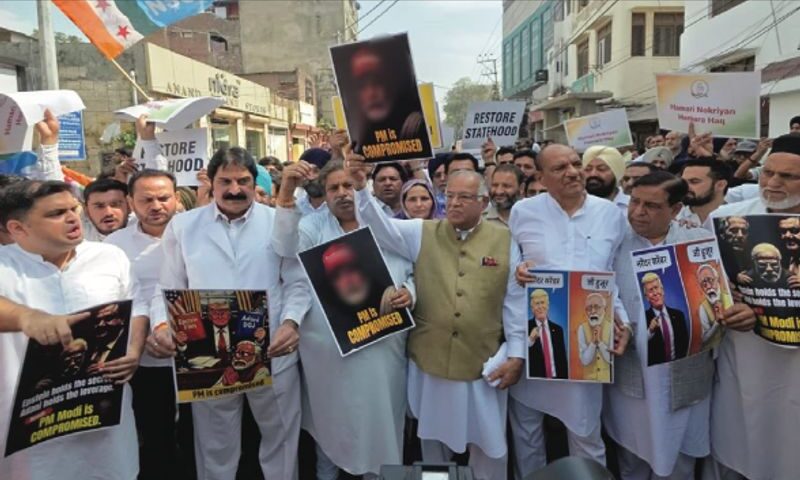
The statement reflects not only the existence of resentment but also the declining fear of expressing it openly. This marks a shift from the years immediately after 2019, when the public mood was subdued. Today, civil society organizations feel confident enough to:
-
demand a clear timeline,
-
question the dual governance model,
-
and challenge political leaders on accountability.
Governance Paralysis: A Dual Power Structure That Isn’t Working
01. The CM–LG Disconnect
One of the most persistent criticisms across J&K is the friction between the elected Chief Minister and the Lieutenant Governor — a structural tension built into the UT model. The civil society group’s statement aligns with growing voices from political leadership pointing to a governance breakdown at the highest level.
This model creates:
-
overlapping jurisdictions,
-
confusion in administrative chains of command,
-
veto points that slow decision-making,
-
and ambiguity about who holds ultimate authority.
02. Impact on Development and Welfare Schemes
The dual authority model has caused delays in:
-
infrastructure projects,
-
welfare disbursements,
-
social schemes,
-
appointment processes,
-
and district-level governance decisions.
Officials often wait for clearance from both power centers, slowing the flow of public service delivery. Civil society groups argue that reverting to statehood would streamline governance and return decision-making authority to elected representatives.
03. The Psychological Cost of Perceived Disempowerment
Residents describe the CM–LG tension as:
-
politically unnecessary,
-
administratively unhealthy,
-
and emotionally demoralizing.
For a region that has lived through decades of central-state friction, the continuation of such tension — even after elections — undermines public trust.
The Crisis of Political Credibility
01. Repeated Assurances, No Roadmap
Every mainstream party has, at some point, issued statements supporting the restoration of statehood. However:
-
no timeline,
-
no legal process,
-
and no formal roadmap
has been announced.
This ambiguity is now interpreted as political evasion. Civil society leaders argue that the public no longer accepts general assurances — it demands substantive commitments.
02. Weakening Trust in Mainstream Parties
The erosion of trust is multidirectional:
-
The ruling coalition faces criticism for delays.
-
The opposition faces criticism for inaction or inconsistency.
-
Youth feel alienated from all political formations.
The civil society group believes this could eventually lead to political realignment, with new actors emerging and old parties losing their traditional vote banks.
03. Consequences for Governance Legitimacy
Without statehood, even well-intentioned policies appear:
-
imposed,
-
externally driven,
-
and insufficiently representative.
The legitimacy gap continues to widen as people question whether their political agency has real value.
Restoration of Statehood: The Emotional and Political Imperative
01. Why Statehood Is Seen as Dignity Restoration
Civil society members emphasize that the pre-2019 political structure, despite its flaws, gave people a sense of ownership over governance. The UT model — reserved typically for smaller territories or national capitals — feels ill-suited to a region with a complex political identity.
02. Impact on Federalism Debates Across India
The issue goes beyond J&K. The delay has become a national talking point in discussions on:
-
federalism,
-
constitutional guarantees,
-
regional autonomy,
-
and political trust-building.
Legal scholars warn that keeping a major Indian region in perpetual UT status creates a constitutional anomaly.
03. Economic Stakeholders Also Demand Clarity
Business groups, traders, and industrial associations have begun articulating concerns about:
-
policy unpredictability,
-
administrative delays,
-
and difficulty securing long-term investments.
They assert that statehood would create bureaucratic continuity and political accountability, essentials for economic growth.
Potential for Political Mobilization and Regional Unrest
01. A Brewing Movement?
Civil society groups warn that prolonged delay may trigger:
-
widespread protests,
-
coordinated civic mobilization,
-
or silent internal resentment that manifests during elections.
Given J&K’s complex socio-political fabric, even non-violent mobilization can reshape power equations.
02. Risk of Government–Public Trust Breakdown
If assurances on statehood remain vague, the gap between public expectations and administrative reality could widen, undermining trust not only in the Union government but also in local political elites.
03. Implications for Regional Stability
While the security situation has improved in many respects, political uncertainty can indirectly:
-
deepen alienation,
-
empower fringe narratives,
-
and weaken confidence in democratic institutions.
Civil society members emphasize that the current resentment is not separatist — it is constitutional, rights-based, and democratic. Ignoring it, they caution, can have consequences.
A Clear Call From Civil Society: Give a Roadmap, Not Rhetoric
01. What Citizens Want
The civil society group outlines three demands:
-
A formal, time-bound roadmap for the restoration of statehood.
-
Clarification of administrative powers, ending CM–LG ambiguity.
-
A credible communication strategy explaining timelines and constitutional steps.
They argue that even a defined timeline — six months, one year, or two years — would restore public confidence.
02. What Happens If the Delay Continues?
If statehood remains suspended:
-
distrust will deepen,
-
politics will polarize further,
-
and governance inefficiencies will expand.
The statement warns that J&K cannot afford prolonged ambiguity.
Bottom-Line: A Crisis That Must Be Addressed Before It Becomes Irreversible
The civil society declaration does not emerge in isolation. It is the reflection of accumulated grievances:
-
a governance model widely seen as dysfunctional,
-
political assurances that increasingly appear hollow,
-
an erosion of public trust across communities,
-
and a deep emotional yearning for restored dignity and agency.
Calling the resentment “massive and overwhelming” is not rhetorical exaggeration. It is an assessment of the public pulse — sober, urgent, and grounded in everyday sentiment.
The ball now rests with New Delhi. The restoration of statehood is not just a constitutional correction. It is a political necessity, a psychological balm, and a federal imperative. Without it, the sense of alienation risks becoming entrenched — and no region, least of all one as sensitive as Jammu & Kashmir, can afford that trajectory.