J&K Records 86% Rain Deficit | Shrinking Rivers, Rising Fire Risk, Water Crisis
By: Javid Amin | 10 December 2025
A Region Parched as Rain Refuses to Come
Jammu and Kashmir (J&K) is witnessing a distressing environmental and humanitarian signal: an acute rainfall shortfall that has plunged the region into a precarious situation. Between November 1 and December 9, 2025, the Union Territory recorded a mere 6.1 mm of rain, against an expected 43.1 mm, marking a staggering 85.8% deficit.
This prolonged dry spell — persisting since around November 5 — is not just a statistic. It is already reshaping river flows, crippling water bodies, threatening agriculture and livelihoods, and elevating the risk of forest and grassland fires. For ordinary residents, farmers and environmental stakeholders, the implications are deeply unsettling.
In this feature, we explore what led to this deficit, its cascading consequences, and what it may mean for the future of this fragile Himalayan region.
The Numbers: Grasping the Magnitude of the Deficit
Record Rainfall Shortfall
-
In the critical period from Nov 1 to Dec 9, 2025, J&K received only 6.1 mm rainfall against a normal expectation of 43.1 mm — an 85.8% shortfall.
-
The dryness has persisted since around Nov 5, as most parts of the region have registered little to no precipitation.
-
District-wise data show severe deficits across both Kashmir and Jammu divisions: many districts saw rainfall levels drop well below 20–30% of normal.
Long-Term Decline: Not an Isolated Year
While the current deficit is especially severe, it is part of a broader downward trend:
-
The year 2024 was recorded as the driest in nearly 50 years, with J&K receiving just 870.9 mm of rainfall vs the normal average of around 1,232.3 mm, marking a 29% overall shortfall.
-
This marked the fifth consecutive year of below-normal precipitation, underscoring a pattern rather than an anomaly.
-
Earlier in 2025, between January and February, J&K recorded only 29.8 mm of rain against an expected 175.8 mm — an 83% deficit.
These data points suggest that the current dry spell is part of an alarming multi-year climatic trend — one that is exacerbating water stress, ecological fragility, and human vulnerability across the region.
On-the-Ground Consequences: Shrinking Water Bodies, Dry Rivers, Rising Risks
Rivers and Springs Running Low
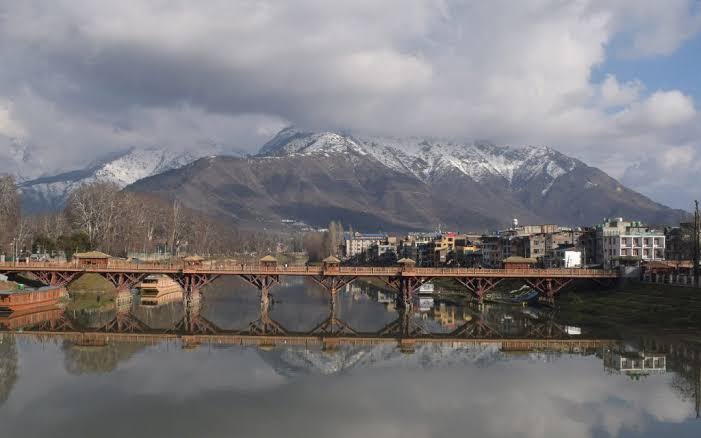
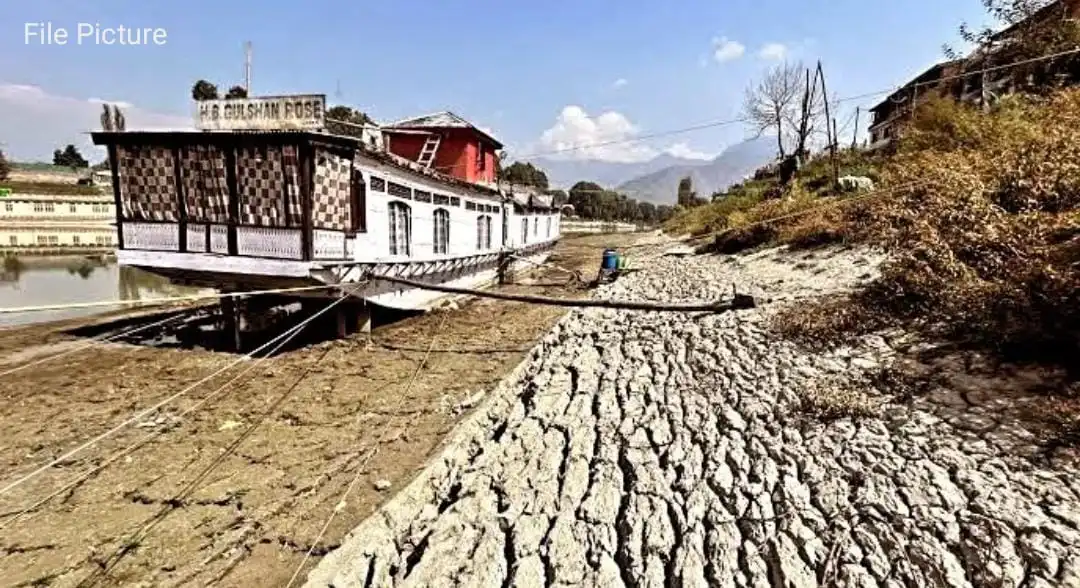
The dryness has translated directly into falling water levels across rivers, springs, and streams — lifelines for the valley’s agriculture, drinking water, and ecology.
-
The water level of the Jhelum River at Sangam has dipped to –0.59 ft, below the zero-gauge (or “zero-flow”) level.
-
Independent weather experts note that not just Jhelum, but its tributaries and numerous natural springs and catchments are flowing unusually low or drying — a consequence of absence of any meaningful western disturbances, rain or snowfall for over 40 days.
-
The overall consequence: natural recharge of rivers and underground springs has nearly stalled, meaning diminished water supply for both agriculture and domestic use.
Officials have begun responding: in some areas, water-tankers are being deployed to meet drinking water needs.
Agricultural Distress and Risk to Irrigation
The water shortage is already beginning to hurt agriculture — especially for crops and orchards dependent on stable water supply.
-
With low rivers, streams and springs, soil moisture is dropping, making irrigation increasingly difficult. Farmers now face crop stress and decreased yield potential.
-
The problem is aggravated because many irrigation channels depend on seasonal rivers and snowmelt, both weakened by continuing dryness and lack of snowfall.
-
Particularly vulnerable are water-intensive crops; experts earlier had warned growers to shift toward drought-resistant crops (like millets, pulses, corn) and reduce reliance on paddy fields.
-
The region’s horticulture sector — especially the famed apple orchards — stands at risk. Without adequate water and proper “chilling hours” due to weak snow, fruit yields could plummet.
Ecology, Wetlands and Wildlife Under Stress
Beyond human usage, J&K’s ecology — its wetlands, springs, streams, migratory bird habitats, and unique Himalayan flora — is under serious stress.
-
Reduced river and stream flows curtail replenishment of wetlands and riparian zones that are critical for birds, amphibians, and freshwater species. This fundamentally undermines the ecological balance.
-
Springs and small water-bodies that sustain villages and wildlife are drying, potentially pushing vulnerable species toward distress or displacement.
-
The long-term decline in snowfall and precipitation — part of a multi-year trend — threatens the overall resilience of the Himalayan watershed system.
Rising Threat: Fire Risk, Public Safety, and Ecosystem Fragility
As water levels drop and vegetation dries, the risk of wildfires — in forests, grasslands, and wastelands — has surged.
-
The absence of moisture and prolonged surface dry-out, combined with warming daytime temperatures, create ideal conditions for wildfires.
-
Environmental observers and weather experts have raised alarms about increased fire vulnerability across many parts of J&K.
-
Beyond immediate damage to forests, fire outbreaks can accelerate soil degradation, destroy undergrowth, disturb wildlife habitats, and release stored carbon — contributing further to climate stress in this delicate Himalayan ecosystem.
Public safety is also a concern: dry vegetation, unchecked fire risk, and reduced water access combine to create a volatile situation, especially in rural and forest-adjacent communities.
Human Impact: Drinking Water, Daily Life, and Livelihoods
For residents across Kashmir and Jammu divisions, the dry spell translates into real, everyday hardship:
-
Water for drinking, cooking, sanitation — long taken for granted — is becoming uncertain. Authorities, where possible, are resorting to tankers.
-
Agricultural incomes — from paddy fields, apple orchards, horticulture — are under pressure, threatening livelihoods of thousands of farmers and laborers.
-
In the absence of snow and rain, winters remain cold but dry, making life harsher; cold waves still persist, but without snow cover many homes and ecosystems are more exposed. (This is implicit in current conditions and consistent with historical dry-winter reports.)
-
For communities dependent on rivers, springs, and seasonal water flows, the uncertainty over water availability looms large — a source of anxiety and potential displacement for some.
Why This Matters — And What It Signals for the Future
A Growing Agricultural Crisis
The ongoing water shortage threatens to push agriculture — historically the backbone of Kashmir’s economy — into existential crisis. With irrigation sources dwindling, crop failures and reduced yields could become the norm. Farmers may be forced to abandon traditional water-intensive crops, leading to long-term shifts in cropping patterns, income, and even demographics.
Ecological Imbalance and Loss of Biodiversity
J&K’s unique Himalayan ecology depends on seasonal precipitation, snowmelt, and stable water flows. As rain and snow decline, lakes, wetlands, riparian belts shrink, affecting migratory birds, aquatic life, plant biodiversity, and ecosystem services like groundwater recharge. Over time, this could degrade the Himalayan watershed, impacting not only local but downstream communities as well.
Public Safety, Fire Hazards and Disaster Risks
With vegetation drying and water levels dropping, the risk of forest fires — already elevated — could turn into a recurring disaster. Fires threaten not only forests, but human settlements, wildlife, soil stability, and air quality. In a region where community living, remote villages, and fragile infrastructure are the norm, such disasters can be catastrophic.
Climate Change Alarm — A Warning for Himalayan Resilience
The current deficit is not a one-off aberration. It aligns with a multi-year trend of declining precipitation, reduced snowfall, and shrinking glacial recharge. This suggests that climate change is already reshaping Himalayan weather patterns — a reality that demands urgent adaptation, resilience planning, and sustainable water and land management.
What’s Causing It — And Could It Have Been Avoided?
Role of Weak Western Disturbances & Snowfall Shortfall
Experts point out that the recent dry spell is linked to the absence of strong western disturbances — weather systems that typically bring winter precipitation (rain at lower elevations, snow in higher reaches) to the Western Himalayas. With such systems failing to deliver, the region missed out on critical recharge from rain and snow.
Over recent years, the pattern has repeated. “Snowless winters” have become increasingly common — directly impacting glaciers, springs, rivers and overall water security.
A Multi-Year Trend: Declining Precipitation & Changing Weather Patterns
The fact that J&K has recorded below-normal rainfall for five consecutive years — culminating in 2024 being the driest in half a century — suggests systemic change rather than a short-term fluctuation.
Climate scientists, local experts, and environmentalists argue this is symptomatic of broader shifts: global warming, glacial retreat, altered atmospheric circulation, and changing monsoon and winter patterns — all combining to undermine traditional hydrological cycles.
Inadequate Water-Management and Reliance on Natural Rainfall
Historically, Kashmir has depended heavily on natural precipitation — rain and snow — to replenish rivers, springs, reservoirs. But with changing patterns, this model is proving unsustainable. There is limited infrastructure for water storage, rain-water harvesting, groundwater recharge, or drought-resilient irrigation. Experts warn that without structural shifts in water management, the valley remains dangerously exposed.
Voices from the Ground — Real People, Real Struggle
Journalists, independent weather observers, farm-workers and environmental groups in Kashmir have begun raising alarm bells:
-
A weather expert told media that “springs and natural catchments are flowing at unusually low heights or have dried up,” and with “no major wet spell expected over the next 10–15 days, water levels are likely to fall further.”
-
Local authorities, while deploying tankers to mitigate drinking water shortage, candidly acknowledge the possibility of crisis if dryness persists and no long-term measures are adopted.
-
Farmers and horticulturists fear for the upcoming planting and fruiting seasons — especially for water-intensive crops and orchards, including paddy and apples.
These voices reflect not just environmental alarm, but human anxiety: about livelihoods, food security, ecological identity, and a future that seems increasingly uncertain.
What Needs to Be Done — Toward Resilience, Adaptation, and Sustainable Future
Given the breadth and depth of the crisis, the road forward must be multi-pronged. Here are some critical steps that authorities, communities, and stakeholders should consider urgently:
1. Water-Harvesting & Storage Infrastructure at Scale
-
Develop and retrofit rain-water harvesting systems — on rooftops, community buildings, and public infrastructure.
-
Build check-dams, recharge wells and recharge bunds to capture and store whatever precipitation does come.
-
Renovate, desilt and maintain traditional springs, kuls (water channels), nala (streams) to maximize local water retention.
2. Promote Drought-Resilient Agriculture & Crop Diversification
-
Encourage cultivation of drought-tolerant crops — millets, pulses, coarse grains — instead of paddy or highly water-intensive crops.
-
Provide incentives (subsidies, technical support) for farmers willing to convert to horticulture or agro-forestry, which are less water-intensive and better suited to the evolving climate.
-
Establish effective micro-irrigation systems (drip, sprinkler) to maximize water use efficiency.
3. Forest & Land Management to Reduce Fire Risk
-
Launch forest-floor clearance drives — removing dry undergrowth, dead vegetation — to reduce wildfire fuel.
-
Create community fire-watch groups during dry spells; equip them with firefighting tools and early-warning systems.
-
Regulate and monitor activities like grazing, wood gathering, and construction in forest-adjacent zones — to prevent accidental fire triggers.
4. Strengthen Monitoring, Forecasting & Early Warning Systems
-
Invest in weather-forecasting infrastructure; closely monitor moisture levels, snowpack, groundwater, river flow.
-
Develop a real-time water-level & groundwater monitoring network, publicly accessible, to track stress points and respond early.
-
Establish community awareness campaigns about water conservation, fire risk, and climate adaptation — empowering local populations to act proactively.
5. Policy, Governance & Long-Term Climate Strategy
-
The regional government must treat this as a climate-resilience and water-security crisis, not just a transient weather event. Long-term policy should include water-resource planning, ecosystem restoration, and climate-sensitive land use zoning.
-
Collaborate with national agencies, climate-research institutes and international bodies to assess long-term glacial health, hydrological cycles and ecosystem vulnerability.
-
Support research into climate change impacts on Himalayan hydrology, biodiversity, and human livelihoods — and use findings to inform adaptation strategies.
The Larger Picture — What This Means for the Himalayas, India, and Climate Discourse
The crisis unfolding in J&K is not just a local environmental challenge — it is a microcosm of the broader crisis confronting the Himalayan region:
-
The Himalayas feed many of India’s great rivers. If snow, glacial recharge and precipitation patterns are disrupted, water security across northern India — for agriculture, rivers, hydropower — could be severely impacted.
-
The ecological fragility of mountain ecosystems means loss of biodiversity, collapse of traditional livelihoods, and increased disaster risk (fires, landslides, flash floods) — affecting not only J&K, but the entire Himalayan belt.
-
The J&K deficit may well be a signal of accelerating climate change — one that requires urgent integration of climate resilience into regional planning, development policies, and community life.
-
For policymakers, conservationists, and civil society, this is a moment to rethink human-environment relationships: to move from exploitation and short-term use toward sustainable stewardship, regeneration, and adaptation.
Conclusion — Jammu & Kashmir at a Crossroads
The 86% rainfall deficit recorded in early December 2025 is more than a weather anomaly. It is a warning: of shrinking rivers, drying springs, threatened livelihoods, vulnerable ecosystems, and rising disasters. The cascading impacts — on agriculture, water supply, ecology, daily life — are already visible.
But this need not become a full-blown calamity. With timely action, long-term planning, community engagement and climate-sensitive policy, J&K can begin a transition — toward sustainable water management, resilient agriculture, ecological preservation, and a future better equipped to withstand climatic uncertainty.
What happens now will determine whether the valley’s rivers shrink further — or whether the people, forests, and mountains of Kashmir rise again, adapting and enduring even in the face of change.