Kashmir Saffron Revival: How Red Gold Is Beating Climate Change and Boosting Profits
By: Javid Amin | 16 February 2026
A Crop That Refused to Disappear
For over a decade, Kashmir’s saffron fields stood as a warning symbol of climate vulnerability. Shrinking acreage, erratic snowfall, soil degradation, and urban encroachment had pushed the Valley’s most iconic crop toward decline. Experts predicted a slow death for the centuries-old tradition.
Instead, the opposite is unfolding.
Against the backdrop of abnormal winters, precipitation deficits, and warming trends across the Himalayas, Kashmir’s saffron industry is staging a rare agricultural comeback. Output is rising. Profits are improving. Cultivation zones are expanding. Farmers who once abandoned fields are returning.
In a climate-stressed region, saffron has become an unlikely model of resilience.
The Science Behind a Fragile Crop
Saffron is not an ordinary crop. It is a high-risk botanical investment that thrives only under precise climatic choreography.
It needs:
-
cold dormancy in winter
-
dry flowering in autumn
-
measured soil moisture
-
alkaline soil balance
-
controlled irrigation
-
minimal fungal exposure
Even small weather deviations can disrupt flowering cycles. Too much rain rots corms. Too little moisture stunts growth. Warmer winters alter dormancy patterns.
For years, Kashmir’s changing weather destabilized this delicate balance.
Yet growers adapted faster than expected.
The Policy Intervention That Changed the Game
The turning point came with the National Saffron Mission, a large-scale government intervention aimed at modernizing cultivation and reversing decades of neglect.
With investments of approximately ₹267 crore, the mission targeted structural weaknesses that climate change had exposed.
Nearly 2,600 hectares of saffron land have been rejuvenated across key belts including Pulwama, Budgam, Srinagar, and Kishtwar.
The intervention wasn’t cosmetic. It rewired the production system.
Key reforms included:
-
sprinkler-based irrigation networks
-
soil rejuvenation programs
-
high-quality corm distribution
-
scientific crop spacing
-
modern drying and storage facilities
-
branding and GI protection support
These measures reduced dependence on snowfall and unpredictable rainfall — historically saffron’s biggest vulnerability.
Farmers gained control over water timing instead of waiting for nature.
Pulwama: The Epicenter of the Revival
The saffron plateau of Pulwama has long been the spiritual and economic heart of the crop. Generations of families have cultivated saffron there, treating it as both livelihood and inheritance.
Today, those fields are active again.
Growers report healthier flowering cycles and improved yields compared to the stagnation years. Many households that had migrated to wage labor are reinvesting in saffron plots.
This is not just an agricultural shift. It is a social return.
Saffron fields anchor rural identity. When they decline, communities fragment. When they revive, villages stabilize.
Profitability Returns to the Fields
Kashmiri saffron commands premium global status because of its chemical profile — especially crocin concentration, which determines color intensity and quality.
Unlike bulk-producing regions that compete on price, Kashmir competes on purity and rarity.
As yields stabilize, growers are seeing stronger margins. Market confidence has improved. Export buyers continue to value the Valley’s brand reputation.
For many farmers, saffron once again outperforms alternative crops in long-term profitability.
The economics are shifting from survival back to investment.
Farmers Become Climate Strategists
One of the most striking developments is behavioral change among growers.
Traditional farming relied heavily on inherited seasonal patterns. Today’s saffron farmers operate more like field scientists.
Adaptation strategies include:
-
micro-irrigation scheduling
-
soil moisture analytics
-
climate forecast integration
-
improved drainage engineering
-
disease-resistant corm selection
-
harvest timing optimization
Instead of reacting to climate shocks, farmers are building buffers into cultivation.
This shift represents a quiet revolution in Himalayan agriculture: knowledge-driven farming replacing weather dependence.
A Ripple Effect Across the Rural Economy
Saffron’s revival extends beyond farm income. It activates an entire micro-economy:
-
seasonal harvesting labor
-
processing and packaging units
-
rural logistics
-
agri-tourism during flowering
-
export handling
-
branding enterprises
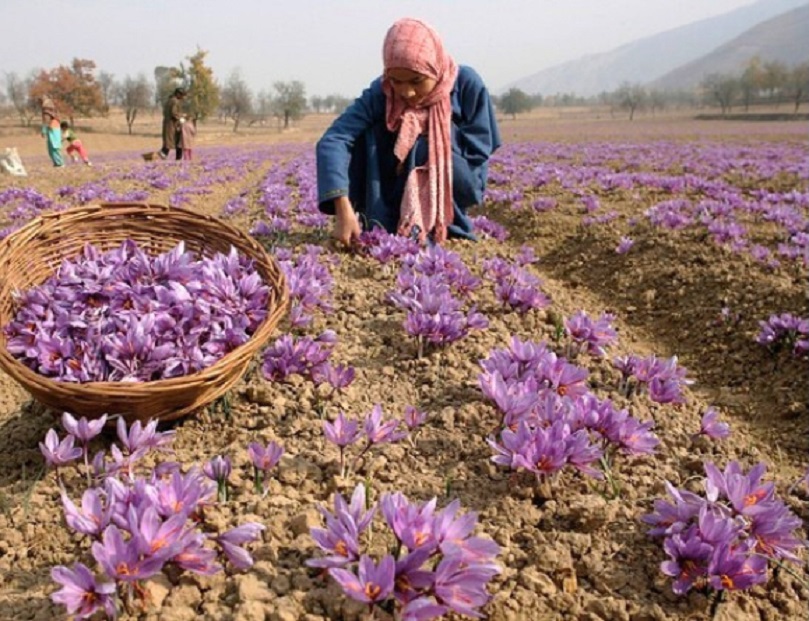
During the flowering season, fields draw photographers, travelers, researchers, and traders. The saffron bloom has become a cultural and economic event.
Each gram harvested circulates money through multiple layers of rural society.
The crop functions as a regional economic multiplier.
Climate Risk Has Not Disappeared
The success story remains fragile.
Climate volatility continues to threaten the Himalayas. Winters are warming. Snowfall patterns are unpredictable. Precipitation deficits are recurring. Soil moisture cycles are shifting.
Saffron’s gains depend on sustained adaptation.
Farmers warn that irrigation infrastructure must expand. Storage facilities need upgrades. Quality enforcement must protect against counterfeit products entering the market. Export channels require modernization.
Without continuous support, resilience could stall.
This revival is not self-sustaining yet.
The Global Battle Against Fake Saffron
Another silent threat comes from counterfeit saffron flooding markets. Cheap dyed substitutes undercut prices and dilute brand trust.
Authentic Kashmiri saffron relies on:
-
geographic indication protection
-
chemical fingerprint verification
-
traceability certification
-
controlled export branding
Maintaining authenticity is as critical as increasing yield. Profit depends not just on production, but on protecting reputation.
Red gold survives on credibility.
Lessons for Climate Agriculture
Kashmir’s saffron recovery offers a blueprint for climate adaptation worldwide.
It demonstrates that:
-
targeted policy investment matters
-
farmer education accelerates resilience
-
irrigation independence reduces climate risk
-
branding can preserve economic value
-
tradition can coexist with technology
Many crops collapse under climate pressure. Saffron shows adaptation is possible when systems evolve.
This is not nostalgia agriculture. It is engineered resilience.
A Symbol Larger Than a Crop
Saffron occupies a unique emotional space in Kashmir. It represents patience, precision, and endurance. Each stigma is harvested by hand. Each gram contains hours of human effort.
Its survival mirrors the Valley’s broader negotiation with climate uncertainty.
In a landscape where winters are warming and snow is no longer guaranteed, saffron’s revival sends a powerful signal: adaptation is not surrender. It is transformation.
The fields of red gold are no longer relics of a fading past.
They are laboratories for the future of Himalayan farming.