BJP Legislator’s Remark on Kashmiris Sparks Uproar; PDP’s Waheed Para Hits Back
By: Javid Amin | 13 February 2026
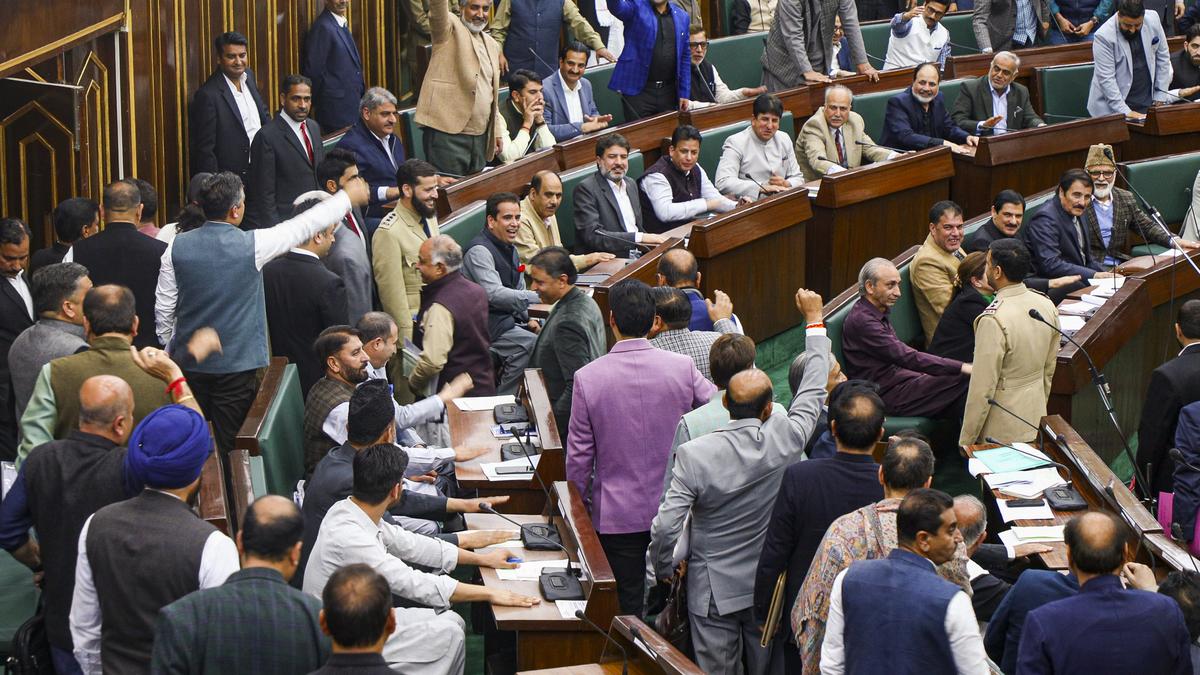
What began as a routine Question Hour intervention in the Jammu and Kashmir Legislative Assembly quickly spiralled into a politically charged confrontation after BJP MLA Vikram Randhawa alleged that “residents of Kashmir are illegally occupying land in Jammu.”
The remark, made in the context of encroachments on land belonging to the Jammu Development Authority (JDA), triggered immediate protests from opposition benches. Legislators accused Randhawa of injecting regional identity into what they described as a governance and land management issue.
The Speaker was forced to intervene repeatedly as slogans and counter-allegations echoed through the House.
What Randhawa Said — And Why It Sparked Anger
During Question Hour, Randhawa claimed that encroachments on JDA land in parts of Jammu city were being carried out by people from the Kashmir Valley. He alleged that:
-
Illegal settlements had mushroomed on JDA land.
-
Authorities were not acting firmly.
-
The issue had demographic implications.
He demanded stronger enforcement and sought a detailed list of encroachers in his constituency.
While land encroachment has been debated in the Assembly before, it was the regional framing of the issue that sparked uproar. Opposition members objected that linking encroachment to “Kashmiris” risked portraying a governance lapse as a regional conflict.
Waheed Para’s Sharp Rebuttal
Leading the counterattack was PDP legislator Waheed Para, who condemned the remark as “divisive and dangerous.”
Para argued:
“This is not about Kashmiris or Jammu residents; it is about the failure of institutions to protect public land. Targeting one community only fuels polarization.”
He stressed that encroachment is fundamentally an administrative and institutional issue — involving land records, planning authorities, and enforcement agencies — not an identity-based matter.
Para further warned that framing land disputes in regional terms could:
-
Deepen mistrust between Jammu and Kashmir divisions.
-
Reinforce narratives of demographic anxiety.
-
Undermine fragile political reconciliation efforts.
His intervention was supported by other opposition members, who accused the BJP legislator of politicising a sensitive issue.
Government’s Official Position: Law, Not Identity
Responding on behalf of the government, ministers reiterated that encroachments exist across various tehsils in Jammu, including Bahu and Jammu South. They clarified that:
-
Evictions are being conducted under the Jammu and Kashmir Public Premises (Eviction of Unauthorised Occupants) Act.
-
Multiple anti-encroachment drives have been conducted since January 2025.
-
Land has been retrieved from unauthorized occupants irrespective of regional identity.
Officials emphasised that enforcement is based on documented land records and legal procedure — not on the background of occupants.
The government maintained that:
“Encroachment is an administrative matter governed by law. It should not be communalised or regionalised.”
Reactions from Other Political Parties
National Conference (NC)
Members of the ruling Jammu & Kashmir National Conference criticised the BJP MLA’s statement, arguing that land retrieval must remain neutral and evidence-based.
NC legislators said that governance failures over decades had allowed encroachments to accumulate, and selective blame was counterproductive.
Congress
Congress members echoed similar concerns, stating that public land protection should be a bipartisan effort. They warned that:
-
Polarising narratives weaken administrative credibility.
-
Urban planning lapses cannot be attributed to migration patterns alone.
Apni Party
Representatives of the Jammu and Kashmir Apni Party urged caution, calling for a transparent white paper on land encroachments across both divisions to depoliticise the issue.
Ground Reaction: Voices from Jammu and Kashmir
In Jammu
Local traders and civil society representatives in Jammu expressed mixed reactions:
-
Some residents supported stricter enforcement against illegal occupation of public land.
-
Others criticised political rhetoric, saying it distracts from systemic failures in urban planning and monitoring.
A senior advocate in Jammu noted that encroachments have accumulated over decades due to weak land administration and inconsistent enforcement — and cannot be attributed to any single community.
In Kashmir
In Srinagar and other Valley districts, civil society voices viewed the remark with concern. Activists warned that regionalised rhetoric could undo confidence-building efforts.
Several youth leaders argued that economic mobility between Jammu and Kashmir is natural and legal, and that painting migration as encroachment could create social friction.
The Larger Context: Why Land Is Politically Sensitive in J&K
Land disputes in Jammu & Kashmir carry layered implications:
-
Urban Expansion: Jammu city has expanded rapidly over the past two decades, increasing pressure on public land.
-
Migration Patterns: Seasonal and economic migration between divisions has long been part of the region’s socio-economic fabric.
-
Post-2019 Political Climate: Since reorganisation into a Union Territory, identity and regional narratives have become more pronounced in political debates.
-
Demolition Drives: Recent anti-encroachment campaigns have drawn both support and criticism across the region.
When these factors intersect, land issues often transcend administrative boundaries and enter political discourse.
Legal Framework and Administrative Challenge
The Public Premises Act empowers authorities to evict unauthorised occupants from government land. However, practical challenges include:
-
Outdated land records.
-
Prolonged litigation.
-
Humanitarian considerations in cases of long-standing settlements.
-
Coordination gaps between municipal bodies and revenue departments.
Experts argue that without digitised land mapping and transparent reporting, encroachment disputes will continue to invite political controversy.
Political Optics and Narrative Battles
For the BJP, highlighting encroachment may align with its emphasis on strict law enforcement and demographic vigilance.
For the PDP and other regional parties, countering identity-based framing is central to maintaining political positioning in the Valley.
Thus, what appears to be a dispute over land management becomes a contest over narrative and perception.
A Fragile Balance
The Assembly episode underscores a delicate balance:
-
Governance must be firm and rule-based.
-
Political discourse must avoid framing administrative issues as regional conflict.
In a region where identity politics has historically influenced public debate, the tone adopted inside the legislature carries significance beyond the Assembly walls.
Conclusion: Beyond the Uproar
The clash between Vikram Randhawa and Waheed Para reveals more than a disagreement over land encroachment.
It reflects:
-
Competing political narratives.
-
Deep regional sensitivities.
-
The challenge of enforcing urban planning laws in a politically charged environment.
While the government insists that encroachment drives are legal and administrative, opposition leaders warn that associating them with regional identity risks inflaming tensions.
As Jammu & Kashmir navigates a complex political transition, legislative rhetoric — especially on sensitive matters like land and identity — will continue to shape public perception.
The immediate uproar may have subsided, but the underlying debate over governance, regional balance, and political responsibility remains very much alive.