Kashmir Faces Deepening Precipitation Deficit as Government Activates Climate Adaptation Plan
By: Javid Amin | 12 February 2026
20 Agriculture Measures and 15 Water Actions Proposed After Two Years of Snowfall Shortfall
A Winter That Didn’t Come — Twice
In Kashmir, winter is infrastructure.
It fills rivers without pumps. It stores water without reservoirs. It irrigates orchards without pipelines. Snow is the valley’s oldest engineering system — and for two consecutive years, that system has failed to recharge.
Across the higher catchments feeding the Kashmir Division, snowfall has remained persistently and substantially below normal, forcing policymakers to confront a reality that scientists have warned about for over a decade: the Himalayan climate buffer is weakening.
According to data from the India Meteorological Department, the Union Territory of Jammu and Kashmir recorded:
-
50.11% precipitation deficit (Oct 2024 – Feb 2025)
-
54.33% precipitation deficit (Oct 2025 – Feb 2026)
Two winters. Two deficits exceeding half of normal accumulation.
In hydrological terms, that is not fluctuation. It is a structural warning.
Snow as Currency
Most regions measure wealth in GDP. Kashmir measures it in snowpack.
Every centimeter of winter accumulation is future drinking water, irrigation supply, hydropower energy, and ecological stability. Snow melts slowly, feeding rivers through spring and summer. When snowfall collapses, the valley doesn’t just lose scenery — it loses stored capital.
Officials inside the Jammu and Kashmir Disaster Management Department describe the current situation as a “multi-sector vulnerability event.” That phrase carries weight: it means agriculture, power, urban supply, and ecosystems are simultaneously exposed.
This is not a drought yet.
But it is the precondition for one.
The Catchment Anxiety
The real fear is not visible in cities. It lies in the mountains — in the catchment zones where snowfall feeds glaciers, springs, and rivers.
When those high-altitude basins underperform, the deficit propagates downstream months later.
Officials confirm continuous monitoring of:
-
Snow accumulation zones
-
Glacier-fed streams
-
Spring recharge levels
-
River discharge timing
-
Soil moisture reserves
The anxiety is temporal. Snowfall deficits do not hurt immediately. They hurt later, when rivers should still be flowing but aren’t.
This delay masks urgency.
By the time the public feels the shortage, the cause is already months old.
Legislative Alarm Bells
The crisis moved from environmental discussion to legislative scrutiny after lawmakers demanded clarity on the implications of snow failure.
Questions raised inside the assembly focused on cascading risks:
-
Can orchards survive late-summer water stress?
-
Will hydropower output decline?
-
Are wetlands shrinking?
-
Will drinking water systems remain stable?
-
What happens to rural employment?
The government’s response was unusually direct: a coordinated climate adaptation architecture is now being formalized.
That admission alone marks a turning point. It signals that snowfall variability is no longer treated as seasonal inconvenience — but as governance challenge.
Agriculture: Designing Survival
Kashmir’s agriculture evolved around predictable winter recharge. Apples, saffron, rice, and horticulture systems assume stable meltwater timing. When that clock breaks, farmers absorb the shock.
The Agriculture Production Department is now pushing 20 adaptation strategies that read less like reform — and more like survival engineering:
-
Micro-irrigation grids to reduce water loss
-
Crop shifts toward drought-tolerant varieties
-
Precision irrigation scheduling
-
Climate-smart orcharding
-
Agroforestry integration
-
Soil moisture conservation
-
Rain capture systems at farm scale
-
District contingency crop plans
-
Seasonal planting calendar redesign
-
Climate advisory networks
-
Farmer training in water efficiency
-
Seed resilience research
-
Heat-tolerant vegetable cultivation
-
Orchard canopy management
-
Integrated watershed farming
-
Insurance-linked climate buffers
-
Adaptive fertilization strategies
-
Irrigation infrastructure modernization
-
Community reservoir systems
-
Localized climate forecasting support
These are not incremental improvements. They are a blueprint for farming under uncertainty.
The Water Sector’s Quiet Panic
If agriculture is visible risk, water management is invisible panic.
The proposed 15 water-sector actions target hydrological stability:
-
Catchment rehabilitation
-
Spring rejuvenation
-
Wetland revival
-
Glacier observation networks
-
Urban leak reduction
-
Smart metering
-
Aquifer recharge
-
Rainwater capture
-
Basin-scale management
-
Reservoir optimization
-
River flow modeling
-
Climate-adaptive storage
-
Community water banks
-
Urban conservation policy
-
Flood-drought balancing infrastructure
Water officials privately acknowledge the core problem: Kashmir’s water system was built for a climate that may no longer exist.
Adaptation is an attempt to redesign infrastructure for a moving baseline.
The Forest Buffer
Reforestation is being deployed as climate armor.
More than 2.21 crore saplings planted in two years represent a strategic attempt to stabilize watersheds. Forests regulate snow retention, reduce runoff velocity, anchor soil, and moderate microclimates.
In mountain hydrology, trees are reservoirs disguised as ecosystems.
The Forest Department’s work is not cosmetic. It is hydrological engineering through ecology.
The Revised Climate Blueprint
The updated State Action Plan on Climate Change — currently in advanced draft — represents the first district-level climate vulnerability mapping exercise of its scale in the region.
Instead of general climate policy, the new framework identifies:
-
Sector-specific stress drivers
-
District risk hierarchies
-
Inter-department response chains
-
Mitigation-adaptation linkages
This is a shift from reactive governance to anticipatory governance.
Kashmir is preparing not for one bad winter — but for a future defined by variability.
A Himalayan Climate Hotspot
Scientists classify the western Himalayas as a warming hotspot. Elevation amplifies temperature shifts. Snow-albedo feedback loops accelerate melt cycles. Moisture transport patterns are becoming erratic.
This doesn’t mean Kashmir will become a desert.
It means predictability is eroding.
And mountain economies run on predictability.
The Emotional Geography of Snow Loss
For residents, snowfall is memory architecture. It shapes childhood, festivals, agriculture, and tourism. When winters shrink, it feels like cultural erosion.
People sense change before statistics confirm it.
That intuition — that winters are weakening — has now entered official language.
When governments begin planning around perception, perception has become evidence.
What Comes Next
Two consecutive deficit winters forced the policy shift. The coming decade will test whether adaptation can outpace climate drift.
Kashmir is not collapsing.
But it is transitioning — from a climate it understood to one it must learn.
The race is not against heat. It is against uncertainty.
And uncertainty is the hardest variable to govern.
The Water Clock Is Breaking: Glacier Science, River Timing, and Kashmir’s Hidden Hydrological Crisis
How Snow Deficit Travels Through the Mountains and Rewrites the Valley’s Future
Water Arrives Late — Or Not At All
Kashmir’s precipitation crisis is not about how much water falls. It is about when it arrives.
Hydrologists warn that the valley’s water system depends on timing as much as volume. Snowfall acts as delayed-release storage. It accumulates in winter, melts gradually, and feeds rivers precisely when summer demand peaks.
When snowfall drops sharply, the entire calendar of water shifts.
Instead of a controlled melt curve, the valley risks a distorted cycle:
-
Early spring surge
-
Rapid depletion
-
Late-summer scarcity
This is what experts call hydrological desynchronization — a mismatch between supply and need.
And it is already visible in catchment data.
The Glacier Question
Kashmir’s rivers are fed not only by seasonal snow but by glacier reserves in high-altitude basins. These glaciers function as multi-year water savings accounts. They stabilize river flow even in weak snowfall years.
But glaciers are not infinite.
Climate researchers studying western Himalayan cryospheres report a pattern:
-
Shrinking glacier mass
-
Earlier melt onset
-
Thinner snow cover layers
-
Increased debris exposure
-
Accelerated surface warming
This does not produce immediate collapse. Instead, it produces a deceptive phase known as peak water — a period when melting temporarily increases river flow before long-term decline begins.
The danger is psychological: rising water today can hide falling reserves tomorrow.
Kashmir may already be entering that transition window.
Rivers That Depend on Memory
The valley’s rivers carry winter memory into summer. Their flow is an archive of past snowfall.
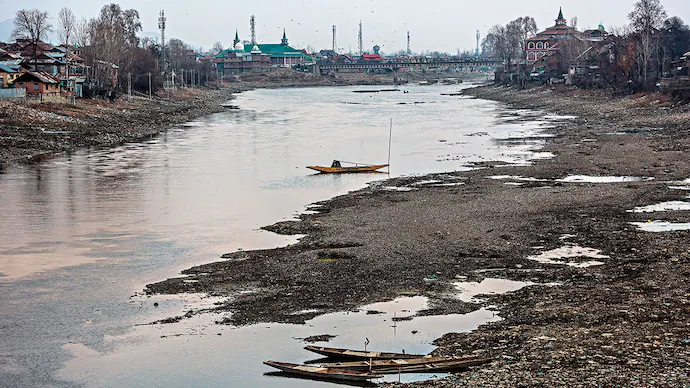
The Jhelum basin — Kashmir’s primary artery — is particularly sensitive to snowpack behavior. Reduced accumulation upstream translates into weaker late-season discharge downstream.
Hydrologists model river systems using a simple truth:
Snow today = water months later
Two consecutive deficit winters therefore guarantee future pressure, regardless of spring rainfall.
Rain cannot fully replace snow. It runs off too quickly.
Snow stores. Rain escapes.
That distinction defines mountain hydrology.
Springs Are the Early Warning System
While rivers capture attention, springs deliver the first signs of trouble.
Across Kashmir’s upland villages, springs provide drinking water to communities that predate modern pipelines. These springs depend on slow infiltration from snow-fed aquifers.
When snow declines:
-
Recharge slows
-
Spring output weakens
-
Seasonal drying expands
Local residents report springs that once flowed year-round now shrinking by late summer. Scientists treat spring health as a diagnostic tool — a biological indicator of groundwater stress.
Springs are the valley’s nervous system. When they falter, the ecosystem is signaling imbalance.
Wetlands: The Disappearing Buffer
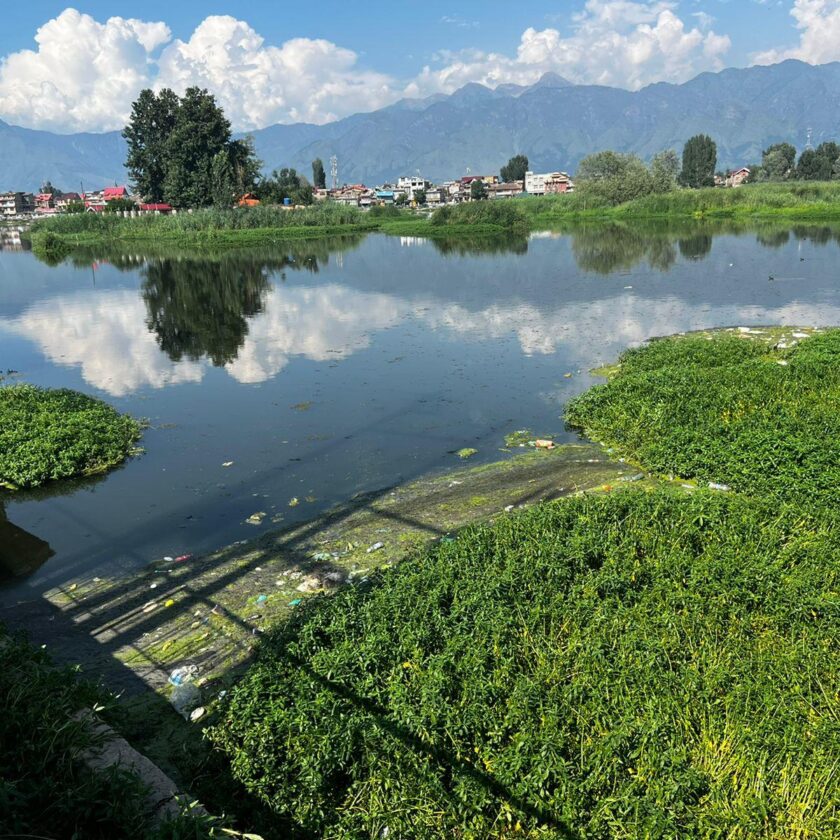
Wetlands act as natural shock absorbers. They store floodwater, release moisture gradually, and stabilize microclimates.
Kashmir’s wetlands historically functioned as seasonal regulators. Reduced snowmelt threatens that function. Without steady inflow:
-
Wetlands shrink
-
Biodiversity declines
-
Evaporation increases
-
Heat islands expand
-
Groundwater recharge weakens
Environmental planners worry that wetland loss compounds warming, creating local feedback loops that intensify heat and dryness.
Wetlands are not decorative landscapes. They are hydrological engines.
Urban Water Systems Under Silent Strain
Cities like Srinagar were engineered around assumptions of stable supply. Municipal systems expect predictable river levels and aquifer recharge.
Climate variability introduces operational stress:
-
Earlier seasonal drawdown
-
Increased pumping demand
-
Pipeline pressure fluctuations
-
Water quality risks
-
Infrastructure fatigue
Urban water planners face a paradox: demand rises as supply becomes uncertain.
This tension transforms climate from an environmental issue into an infrastructure crisis.
Adaptation here requires engineering as much as ecology.
The Storage Gap
Mountain regions historically relied on natural storage — snowfields, glaciers, wetlands, forests. Modern infrastructure has not fully replaced that capacity.
Experts warn Kashmir suffers from a storage gap:
Natural reservoirs are weakening
Artificial reservoirs are insufficient
Bridging that gap requires:
-
Micro-storage systems
-
Community water banks
-
Catchment restoration
-
Smart reservoir operations
-
Rain capture networks
The future water economy may depend less on rivers and more on distributed storage architecture.
Centralized supply is fragile in a variable climate.
The Power Equation
Hydropower stations rely on steady river discharge. Reduced snowpack threatens seasonal generation stability.
Lower summer flows mean:
-
Reduced turbine output
-
Grid variability
-
Increased fossil backup reliance
-
Revenue instability
Energy planners fear a compound risk: warming raises electricity demand while weakening hydropower supply.
Climate therefore hits both sides of the energy equation simultaneously.
Few systems are designed for that stress.
Modeling the Future
Climate models for the western Himalayas do not predict uniform drying. They predict variability — alternating extremes of deficit and sudden surplus.
This is harder to manage than steady decline.
Infrastructure is built for averages. Variability destroys averages.
Future planning must assume:
-
Erratic snowfall
-
Intense short rain bursts
-
Extended dry spells
-
Rapid melt events
-
Timing unpredictability
Kashmir’s water governance is shifting from quantity management to uncertainty management.
That is a deeper challenge.
Communities Already Adapting
Villages are quietly experimenting with solutions:
-
Traditional water harvesting revival
-
Spring protection rituals
-
Community forest management
-
Local storage ponds
-
Seasonal rationing agreements
These grassroots adaptations echo historical knowledge. Before centralized infrastructure, mountain societies survived through distributed resilience.
Modern adaptation may rediscover ancient engineering.
Climate change sometimes pushes societies backward to move forward.
The Psychological Threshold
Water scarcity does not begin when taps run dry. It begins when people stop trusting the system.
That threshold is psychological.
Residents across Kashmir increasingly talk about snow as memory, not guarantee. That shift in expectation changes behavior:
-
Hoarding tendencies
-
Early-season conservation
-
Agricultural caution
-
Migration decisions
-
Investment hesitation
Climate anxiety becomes an economic variable.
Markets respond to perception as much as precipitation.
The Valley’s Hydrological Crossroads
Kashmir stands at a transition point.
If snowfall rebounds, the crisis may ease temporarily. If deficits continue, the valley enters structural water stress. Policy decisions made now determine which future dominates.
Hydrology operates on delayed feedback. The consequences of today’s winter will echo for months — sometimes years.
The clock is slow.
But it is ticking.
Farming on a Moving Climate: Orchards, Rice Fields, and the New Risk Economy of Kashmir
How Snow Deficit Is Rewriting Agriculture, Livelihoods, and Rural Stability
When Farmers Start Watching the Sky Differently
Kashmir’s farmers have always watched the sky. But the way they watch it has changed.
Winter used to be a period of confidence. Snowfall meant security. It guaranteed spring moisture, predictable irrigation, and stable orchard cycles. Now winter has become a season of anxiety. Every missed snowfall is read as a warning.
Farmers no longer ask how much snow fell.
They ask whether enough fell to survive summer.
That shift marks the emergence of a new agricultural psychology: farming under climate uncertainty.
And uncertainty is expensive.
Apples: The Valley’s Climate Barometer
The apple economy is Kashmir’s agricultural backbone. Orchards do not simply produce fruit; they anchor rural income, export revenue, and household survival.
Apples depend on a delicate biological choreography:
-
Winter chill hours to reset dormancy
-
Gradual spring warming
-
Steady soil moisture
-
Mild summer stress
Snow deficit disrupts this sequence. Reduced winter chill can:
-
Delay flowering
-
Produce uneven bud break
-
Reduce fruit size
-
Increase pest vulnerability
-
Lower yield consistency
Apple growers describe orchards as becoming “temperamental.” Seasons feel less reliable. Trees behave differently year to year.
In agriculture, unpredictability is a financial hazard.
A farmer can survive one bad year.
Two in a row changes behavior.
Three changes strategy.
Rice Fields and Water Timing
Paddy cultivation in Kashmir depends on synchronized irrigation. Rice requires standing water at specific growth stages. When snow-fed rivers weaken early, irrigation scheduling becomes fragile.
Farmers report:
-
Narrower planting windows
-
Increased competition for canal water
-
Early-season pumping costs
-
Yield variability
Rice agriculture evolved for stable hydrology. Climate variability forces constant adjustment. That adjustment consumes labor, money, and emotional energy.
Farming shifts from routine to negotiation.
The Rise of the Risk Economy
Economists describe climate-stressed agriculture as a risk economy — a system where survival depends on managing volatility rather than maximizing output.
Farmers respond by:
-
Reducing investment in uncertain crops
-
Diversifying income sources
-
Migrating seasonally
-
Shifting to lower-risk farming methods
-
Delaying orchard expansion
This reduces productivity growth. Not because farmers lack skill, but because they lack confidence in environmental stability.
Risk discourages ambition.
And ambition drives rural development.
Pest Expansion and Heat Stress
Warmer summers extend pest survival zones. Insects once limited by cold winters are appearing earlier and lasting longer.
Farmers now face:
-
Increased pesticide dependence
-
Higher production costs
-
Crop disease unpredictability
-
Reduced organic farming viability
Heat stress compounds this pressure. Crops optimized for cool mountain climates react poorly to sustained warmth.
Agriculture is an ecosystem negotiation. When temperature shifts, every participant renegotiates.
The Water-Energy Trap for Farmers
Irrigation pumps require electricity or fuel. As natural water timing weakens, farmers compensate with mechanical extraction.
This creates a trap:
Less snow → more pumping → higher cost → lower profit
Climate stress becomes an economic feedback loop.
Small farmers are most exposed. They lack capital buffers to absorb repeated shocks. Over time, vulnerability concentrates in already fragile communities.
Climate change amplifies inequality.
Government Adaptation: Necessary but Uneven
The 20 adaptation strategies proposed by authorities represent a significant intervention. But implementation determines success.
Challenges include:
-
Infrastructure reach in remote villages
-
Farmer training capacity
-
Technology affordability
-
Maintenance sustainability
-
Institutional coordination
-
Local trust in policy
Adaptation plans often fail not because they are flawed, but because they are unevenly executed.
Climate resilience is logistics as much as policy.
Agroforestry and the Return of Hybrid Landscapes
One promising shift is agroforestry — integrating trees with crops. This model stabilizes soil moisture, reduces heat stress, and improves biodiversity.
Historically, Kashmir practiced mixed landscape farming. Modern monoculture reduced resilience. Climate pressure is pushing agriculture back toward hybrid systems.
Sometimes adaptation means rediscovering older wisdom.
Traditional farming was built for variability. Industrial farming assumed stability.
The climate is forcing a philosophical correction.
Youth and the Future of Farming
Young Kashmiris increasingly question whether agriculture remains viable as a career. Climate uncertainty influences migration decisions.
Rural youth weigh:
-
Income volatility
-
Environmental risk
-
Urban opportunities
-
Education pathways
If agriculture loses generational continuity, adaptation becomes harder. Farming knowledge is inherited. When inheritance breaks, resilience weakens.
Climate change is not only environmental. It is demographic.
Insurance and Financial Shock Absorption
Climate-resilient agriculture requires financial shock absorbers. Insurance mechanisms can stabilize farmer confidence — if accessible and trusted.
Without risk-sharing systems:
Bad season = personal catastrophe
With insurance:
Bad season = managed setback
Financial architecture determines whether climate becomes tragedy or challenge.
Kashmir’s agricultural future depends as much on economic design as on rainfall.
Farmers as Climate Scientists
Long before meteorological models, farmers tracked micro-patterns:
-
Soil texture shifts
-
Snow density memory
-
Wind behavior
-
Seasonal insect timing
-
Spring water taste
These observational systems function as localized climate science. Modern adaptation benefits when policy integrates traditional knowledge.
Farmers do not merely react to climate.
They interpret it.
And interpretation is intelligence.
The Emotional Toll
Repeated climate stress produces fatigue. Farmers speak not only of water shortages, but of psychological exhaustion:
-
Constant vigilance
-
Financial anxiety
-
Crop uncertainty
-
Intergenerational pressure
This emotional load shapes decision-making. When survival feels fragile, long-term planning collapses into short-term coping.
Climate resilience must include mental resilience.
Agriculture at a Crossroads
Kashmir’s farming sector is not collapsing. But it is entering a transitional phase where stability cannot be assumed.
The difference is subtle but decisive.
Stable agriculture grows.
Transitional agriculture survives.
Policy must decide which future dominates.
Power Without Snow: Hydropower, Energy Security, and the Climate Stress Test
When Kashmir’s Electricity Grid Starts Depending on Winter That Never Came
Snow Is Electricity in Frozen Form
In Kashmir, snowfall is not only water. It is stored energy.
Every hydropower turbine in the region is indirectly powered by winter accumulation. Snow melts, rivers flow, turbines spin, cities light up. The energy grid is therefore tied to climate memory.
When snowfall drops, the electrical system feels it months later.
Hydropower engineers describe winter snowpack as a delayed battery. Two consecutive deficit winters mean that battery has not fully charged.
And energy systems are far less forgiving than ecosystems.
The Hydropower Backbone
The Union Territory’s energy architecture relies heavily on river-fed generation. Mountain hydropower is attractive because it is renewable, relatively low-carbon, and historically reliable.
But reliability assumes predictable hydrology.
Snow deficit introduces three systemic stresses:
-
Seasonal flow instability
-
Reduced peak generation capacity
-
Higher dependence on imported power
Electricity markets punish uncertainty. When river output fluctuates, grid operators must buy power externally — often at higher cost.
Climate variability becomes a budget issue.
The Timing Problem
Hydropower plants are engineered around flow curves based on decades of historical data. Those curves assumed snowmelt timing that is now shifting.
If melt occurs earlier:
-
Generation spikes too soon
-
Storage capacity is strained
-
Late-summer output weakens
Electricity demand, however, peaks during warm months — when cooling systems, pumps, and industry require maximum power.
The grid is being pulled in opposite directions:
Less water when demand is highest.
That mismatch destabilizes planning.
The Hidden Economic Cost
Reduced hydropower output is not only a technical issue. It affects public finance.
When local generation declines:
-
Power imports rise
-
Subsidy burdens increase
-
Infrastructure stress grows
-
Energy pricing pressure builds
Energy insecurity cascades into economic insecurity. Industries hesitate to invest in regions with volatile electricity supply.
Climate change therefore becomes a macroeconomic variable.
Snowfall deficit can ripple through employment statistics.
Fossil Backup: A Climate Paradox
To stabilize the grid, authorities may increase fossil-fuel backup. This creates a paradox:
Climate stress → fossil reliance → more emissions → greater climate stress
Hydropower variability forces short-term solutions that undermine long-term climate goals.
Energy policy enters a feedback loop.
Breaking that loop requires diversification.
Grid Diversification Pressure
Experts increasingly argue that mountain regions cannot rely on single-source energy systems.
Adaptation strategies include:
-
Solar integration
-
Wind micro-grids
-
Pumped hydro storage
-
Battery infrastructure
-
Smart demand management
-
Decentralized energy clusters
The future grid may resemble a network rather than a pipeline — distributed, flexible, and responsive.
Climate forces complexity.
Simple systems fail under variability.
Infrastructure Designed for a Past Climate
Most hydropower assets were designed using 20th-century hydrological assumptions. Engineers optimized for historical averages.
Those averages are drifting.
Infrastructure lifespans span decades. Climate shifts can outpace engineering cycles. That creates a mismatch between physical design and environmental reality.
Retrofitting becomes inevitable.
And retrofitting is expensive.
Energy Security as National Security
Mountain hydropower is not only local infrastructure; it contributes to regional stability. Energy reliability influences industry, healthcare, communication, and defense systems.
When snowfall deficits threaten energy production, the issue transcends environment and enters strategic planning.
Water is power.
Power is security.
Kashmir’s climate story intersects with national resilience frameworks.
The Social Dimension of Energy Stress
Electricity instability hits vulnerable populations first:
-
Rural communities
-
Small businesses
-
Hospitals
-
Schools
-
Cold storage facilities
Agriculture depends on refrigeration and processing. Energy fluctuation multiplies economic risk.
Climate stress therefore compounds across sectors:
Water → Agriculture → Energy → Livelihood
This is not a chain. It is a web.
Pull one strand, the system trembles.
Engineers as Climate Translators
Hydropower engineers increasingly act as climate interpreters. They read river behavior as a language of change.
Observations include:
-
Earlier seasonal peaks
-
Increased sediment flow
-
Irregular discharge
-
Temperature-sensitive reservoirs
These signals form a technical narrative: the hydrological baseline is shifting.
Engineers are among the first to recognize long-term climate transitions because infrastructure reacts faster than ecosystems.
Machines complain early.
The Adaptation Challenge
Modernizing the energy grid for climate variability requires:
-
Predictive hydrological modeling
-
Flexible generation capacity
-
Storage innovation
-
Inter-regional energy sharing
-
Demand-side management
-
Climate-informed infrastructure planning
Energy adaptation is not a single project. It is an architectural redesign.
The future grid must absorb uncertainty as a feature, not a failure.
The Psychological Impact of Power
Electricity represents modern confidence. When lights flicker, trust flickers with them.
Communities measure stability through infrastructure performance. If power reliability declines, climate change becomes visible in daily life.
The abstract becomes tangible.
Climate stops being a theory.
It becomes an inconvenience.
Then a concern.
Then a political force.
A System on Trial
Kashmir’s hydropower system is entering a trial period. The next decade will test whether energy architecture can adapt faster than hydrology shifts.
If adaptation succeeds, the region stabilizes.
If not, variability becomes the norm.
Energy planners understand the stakes. Snowfall is no longer seasonal trivia. It is part of the energy equation.
Winter has become an electrical event.
Selling Snow in a Warming Valley: Tourism, Identity, and the Fragile Economy of Beauty
How Climate Variability Is Quietly Reshaping Kashmir’s Most Visible Industry
Tourism Runs on Expectation
Kashmir’s tourism industry is built less on infrastructure and more on promise. Visitors arrive expecting a climate experience — cool air, snow-lined mountains, alpine lakes, and a seasonal rhythm distinct from the Indian plains.
The valley is marketed as relief.
When winters weaken and summers warm, tourism is not destroyed — but its narrative shifts. And tourism is a narrative economy. It sells atmosphere as much as scenery.
Climate variability threatens consistency.
And consistency is what travelers buy.
The Snow Economy
Winter tourism in Kashmir depends on reliable snowfall in high-altitude destinations. Skiing, snowboarding, snow trekking, and scenic tourism form a seasonal micro-economy.
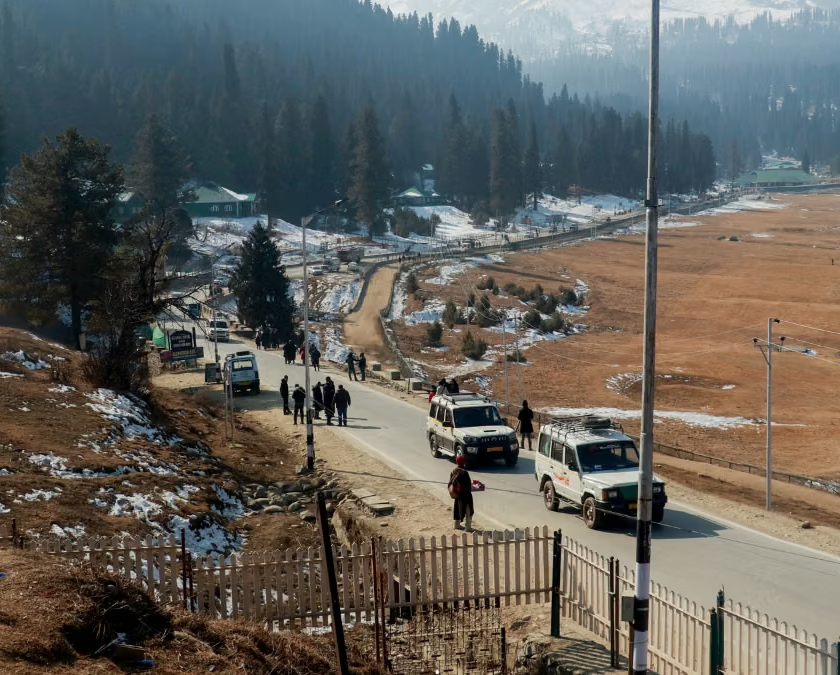
The town most exposed to snowfall variability is Gulmarg, one of South Asia’s premier ski destinations. Winter revenue sustains hotels, guides, transport operators, instructors, and small businesses.
When snowfall becomes erratic:
-
Ski seasons shorten
-
Booking confidence drops
-
Insurance costs rise
-
Infrastructure utilization declines
-
Workers face income gaps
Tourism workers describe a new anxiety: snow is no longer guaranteed.
A ski economy without predictable snow is a speculative business.
Summer Tourism: A Paradoxical Boost
Warmer summers bring a temporary paradox: increased accessibility. Roads open earlier. Passes remain navigable longer. Trekking windows expand. Travel logistics improve.
Destinations like Pahalgam and Sonmarg benefit from extended tourist seasons.
But there is a hidden trade-off.
If summer heat intensifies in the valley floor, Kashmir loses part of its identity as a cool refuge. Competing destinations at higher altitudes may absorb climate-sensitive travelers.
Tourism gains volume but risks losing brand distinction.
Beauty as Infrastructure
In Kashmir, landscape is infrastructure. Mountains, glaciers, lakes, and meadows generate income directly.
Environmental degradation therefore becomes an economic cost center:
-
Glacier retreat reduces scenic value
-
Wetland shrinkage affects biodiversity tourism
-
Forest stress alters trekking routes
-
Snowline retreat changes mountain aesthetics
Tourism markets perception. Even subtle ecological shifts can reshape traveler expectations.
Climate change edits the postcard.
Fragility Beneath Growth
Tourism numbers may rise even as climate risk grows. This creates a dangerous illusion: prosperity masking vulnerability.
More visitors mean:
-
Higher water demand
-
Increased waste pressure
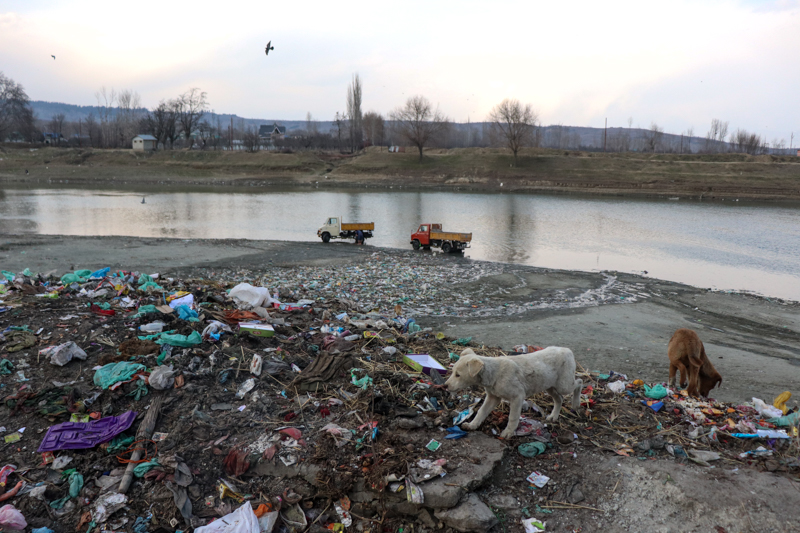
-
Infrastructure stress
-
Ecological footprint expansion
If snowfall declines while tourist load increases, the valley risks overconsuming shrinking resources.
Growth without climate accounting becomes extraction.
The Worker’s Perspective
Tourism workers operate in seasonal cycles. Guides, drivers, hotel staff, pony handlers, and vendors depend on predictable visitor flows.
Climate variability disrupts employment rhythm:
-
Sudden cancellations
-
Shortened peak seasons
-
Revenue volatility
-
Insurance gaps
-
Migration pressure
Workers describe tourism as becoming financially unpredictable. A bad winter or heat-distorted summer ripples through household stability.
Tourism income is climate income.
The Cultural Dimension
Tourism in Kashmir is not purely economic. It is a cultural performance. Visitors come seeking a particular emotional landscape — calm, cool, timeless.
Climate change threatens that cultural script.
If summers grow hotter and winters thinner, the valley’s identity shifts subtly. Residents feel this tension: tourism demands continuity while climate delivers change.
The region must negotiate between authenticity and adaptation.
Infrastructure Strain
More visitors during warmer seasons strain urban systems:
-
Water supply competition
-
Traffic congestion
-
Waste management overload
-
Energy consumption spikes
-
Lake ecosystem pressure
Tourism planners face a balancing act: expand access without exhausting resources.
Climate forces tourism to become a resource management problem.
Marketing a Moving Target
Tourism branding relies on stable imagery. Snow-capped peaks and cool summers form the backbone of Kashmir’s global appeal.
If those conditions fluctuate, marketing strategies must evolve:
-
Promote altitude diversity
-
Emphasize eco-tourism
-
Highlight cultural heritage
-
Develop four-season tourism models
-
Invest in climate-resilient attractions
The future tourist economy may depend less on snow and more on experience design.
Kashmir must sell resilience as beauty.
The Economics of Expectation
Travelers book months in advance. Snow uncertainty introduces financial risk:
-
Refund pressure
-
Insurance disputes
-
Reputation volatility
-
Booking hesitation
Tourism markets punish unpredictability. Even rumors of weak snowfall can reduce bookings.
Climate becomes a market signal.
And markets react faster than governments.
Environmental Tourism as Opportunity
Paradoxically, climate change may create new tourism niches:
-
Glacier education tours
-
climate awareness travel
-
conservation volunteering
-
ecological trekking
-
wetland restoration tourism
If managed ethically, climate storytelling could transform vulnerability into awareness-driven travel.
Tourism can evolve from consumption to participation.
Identity at a Crossroads
Kashmir’s tourism identity is entwined with its climate. The region must decide whether to resist change or reinterpret it.
Resisting means chasing a disappearing past.
Reinterpreting means designing a future brand.
The valley’s advantage is diversity: mountains, forests, lakes, culture, and altitude gradients. Climate may reshape the narrative, but it does not erase the stage.
Adaptation here is creative, not merely technical.
A Tourism Industry on Edge
Stakeholders sense transition. Investors hesitate to overcommit to snow-dependent infrastructure. Workers seek diversified income. Planners debate long-term sustainability.
Tourism is entering a cautious era.
The industry is not collapsing.
It is recalibrating.
And recalibration is the language of climate adaptation.
Governance Under Pressure: Can Policy Move Faster Than Climate?
Institutional Gaps, Bureaucratic Friction, and the Politics of Adaptation
Climate Is Faster Than Government
Climate systems operate on physics. Governments operate on paperwork.
The mismatch is becoming visible in Kashmir.
Departments are drafting plans, revising frameworks, and coordinating strategies. Yet climate signals are accelerating faster than administrative response cycles. By the time a plan is approved, conditions may already have shifted.
This is not negligence. It is structural inertia.
Modern climate governance demands speed, and bureaucracies are designed for stability — not velocity.
Fragmented Responsibility
Climate risk in Kashmir cuts across sectors:
-
agriculture
-
forestry
-
hydrology
-
energy
-
tourism
-
disaster management
-
urban planning
Each domain is governed by separate agencies with separate budgets, mandates, and reporting chains.
Inter-departmental coordination exists on paper. In practice, it is uneven.
Climate adaptation fails not because of lack of ideas — but because ideas live in silos.
The valley does not experience climate in silos.
It experiences it as a system shock.
Monitoring Without Integration
The government monitors snowfall and precipitation deficits closely. Data collection has improved significantly in recent years.
But data alone does not guarantee action.
Monitoring systems often operate independently from planning bodies. Scientific assessments do not always translate into budget allocations or infrastructure priorities.
Information must move from observation → policy → implementation.
Kashmir’s challenge is not data scarcity.
It is institutional translation.
The Budget Constraint
Adaptation is expensive.
Water conservation structures, irrigation modernization, watershed restoration, and forest expansion require sustained funding across decades.
Short-term political cycles reward visible infrastructure — roads, buildings, tourism projects. Climate resilience, by contrast, is preventative and long-term. Its success is invisible because disasters do not happen.
Invisible success is politically difficult to sell.
Yet climate adaptation is precisely the kind of investment that prevents economic collapse later.
Rural Governance Stress
Many adaptation measures depend on district-level implementation:
-
crop contingency plans
-
water harvesting structures
-
local forest management
-
village irrigation systems
District administrations already manage multiple development priorities. Climate adaptation adds a new layer of complexity.
Without local capacity building, climate policy risks becoming a top-down blueprint disconnected from ground realities.
Adaptation must be decentralized to succeed.
Legal and Regulatory Gaps
Climate resilience requires regulatory evolution:
-
groundwater extraction limits
-
urban water pricing reforms
-
wetland protection enforcement
-
land-use planning aligned with climate risk
Regulations often exist but enforcement is inconsistent. Rapid urbanization and informal construction strain ecological safeguards.
Kashmir faces a classic governance dilemma: development pressure versus ecological discipline.
Without legal clarity, climate adaptation becomes advisory instead of binding.
Energy and Hydropower Risk
Hydropower depends on consistent river flow. Reduced snowpack introduces volatility into energy planning.
Power infrastructure built for historical hydrological patterns may not perform reliably under new climate regimes.
Energy planning must now incorporate climate uncertainty models — not historical averages.
This transition requires technical expertise and long-term forecasting capacity.
Trust and Public Communication
Adaptation policy succeeds only when communities trust institutions.
If farmers, tourism workers, and urban residents perceive climate policy as abstract or disconnected, compliance weakens.
Governance must communicate climate risk in everyday language:
-
why water conservation matters
-
why crop shifts are necessary
-
why wetlands must be protected
-
why forests are economic assets
Climate is not only a scientific issue.
It is a public narrative issue.
The Governance Opportunity
Despite institutional challenges, Kashmir possesses a rare advantage: climate awareness is rising before full-scale collapse.
This is a window.
Regions that act early adapt cheaper and more effectively than those forced into crisis response.
The question is not whether governance is imperfect. All governance is imperfect.
The question is whether it can evolve fast enough.
Voices from the Valley: Human Stories in a Changing Climate
How Families, Workers, and Farmers Interpret the New Normal
The Farmer Who Watches the Sky
In many villages, winter snowfall was once a calendar. Farmers judged the coming season by snow depth.
Now winters feel unreliable.
Farmers describe anxiety replacing rhythm. Snowfall used to guarantee spring water. Today, planting decisions carry uncertainty. Some delay sowing. Others gamble on early crops.
Climate variability transforms agriculture from tradition into speculation.
And speculation is stressful.
Orchard Owners and the Chill Crisis
Fruit growers rely on winter chill hours. Apples and other temperate fruits need sustained cold to reset biological cycles.
Warmer winters disrupt flowering patterns:
-
uneven blooming
-
reduced yields
-
increased pest vulnerability
Orchard owners worry not only about harvest size, but about long-term viability of traditional varieties.
Some experiment with new cultivars. Others fear losing heritage crops tied to family identity.
Climate adaptation is not purely economic.
It is emotional.
Tourism Workers in Transition
Drivers and guides describe winters that start late and end early. Bookings fluctuate unpredictably.
A single weak snowfall season can erase savings.
Tourism workers increasingly diversify income:
-
seasonal migration
-
gig labor
-
off-season agriculture
-
informal trade
Climate is reshaping career paths without official acknowledgment.
Workers are adapting faster than policy frameworks.
Women and Water Burden
In rural households, water scarcity increases domestic labor. When springs weaken, women walk farther to collect water.
Longer distances mean:
-
reduced time for income activities
-
physical strain
-
education disruption for girls
Climate stress is gendered.
Water scarcity redistributes unpaid labor.
Adaptation planning must recognize this invisible workforce.
Youth and Climate Identity
Young residents express a different anxiety: identity shift.
They grew up hearing Kashmir described as eternally cool, snowy, and lush. Now they witness winters that feel unfamiliar.
For youth, climate change is not abstract science. It is the rewriting of homeland memory.
Some channel this into activism. Others into migration aspirations.
Climate influences belonging.
Urban Residents and Heat Perception
In cities like Srinagar, residents report summers that feel heavier and longer. Heat stress affects productivity, sleep, and public health.
Urban heat combines with water pressure and traffic congestion.
Climate change in cities feels less poetic than in mountains.
It feels like discomfort.
And discomfort accumulates politically.
Emotional Geography
Climate change produces emotional responses:
-
grief for disappearing snow
-
fear for economic stability
-
nostalgia for predictable seasons
-
anger at institutional delay
-
determination to adapt
These emotions shape behavior as much as policies do.
Climate is lived psychologically before it is measured scientifically.
The Road Ahead: Scenarios, Risks, and the Survival Blueprint
What Kashmir’s Future Depends On
Scenario 1: Managed Adaptation
In this future:
-
water systems modernize
-
agriculture diversifies
-
forests expand
-
tourism rebrands sustainably
-
governance integrates climate science
Kashmir remains habitable, productive, and economically resilient.
Climate stress becomes a management challenge — not a catastrophe.
This path requires early investment and political discipline.
Scenario 2: Reactive Survival
Here, adaptation happens only after crises:
-
emergency water rationing
-
crop failures trigger relief packages
-
tourism collapses seasonally
-
infrastructure strains repeatedly
The economy survives but stagnates. Communities operate in permanent recovery mode.
This scenario is costly and exhausting.
Scenario 3: Ecological Decline
In the worst case:
-
snowpack collapses
-
water shortages intensify
-
agriculture becomes unstable
-
migration accelerates
-
ecological systems degrade
The valley becomes economically fragile and socially stressed.
This scenario is avoidable — but not impossible.
The Survival Blueprint
Experts converge on several pillars:
Water security first
No sector survives without hydrological stability.
Climate-resilient agriculture
Crop science must move faster than temperature curves.
Forest and watershed restoration
Natural infrastructure is cheaper than engineered substitutes.
Tourism redesign
From snow dependency to ecological diversity.
Urban planning reform
Cities must prepare for heat and water stress.
Institutional integration
Departments must act as a single climate system.
The Strategic Advantage
Kashmir still has time.
Unlike regions already in irreversible collapse, the valley stands at a threshold. Climate signals are severe enough to trigger awareness but not yet catastrophic.
This is the optimal moment for intervention.
Adaptation is cheapest before desperation.
The Final Question
Kashmir’s future is not predetermined by climate models.
It is determined by governance choices, economic planning, and public participation.
Climate sets constraints.
Society chooses responses.
The valley has survived centuries of upheaval — political, social, and environmental. Its resilience is historical.
The challenge now is translating that resilience into modern climate strategy.
Snow may thin. Summers may warm.
But the story of Kashmir is not ending.
It is entering a new chapter.