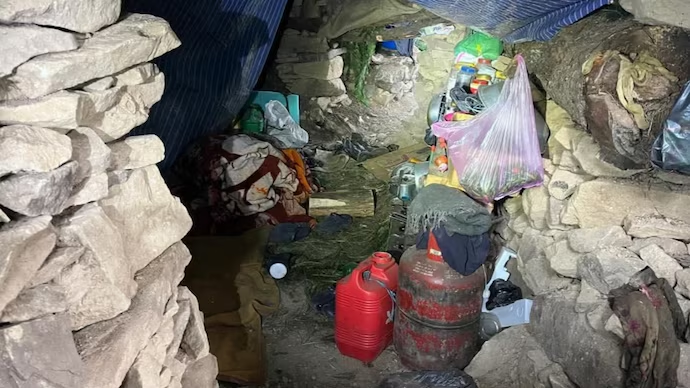
Kishtwar Terror Hideout Busted: Detentions Follow Deadly Encounter in Chatroo Forest
By: Javid Amin | 20 January 2026
A Quiet Forest, a Violent Discovery
The dense forests of Kishtwar, long regarded as both a geographical buffer and a security blind spot in Jammu and Kashmir, once again emerged at the center of counter-terrorism operations after security forces uncovered a well-fortified militant hideout in the Chatroo forest belt. What initially appeared to be a routine search operation has now expanded into a full-scale security crackdown, with several individuals detained for questioning and a multi-agency operation continuing under challenging winter conditions.
The discovery of large quantities of food, fuel, and daily-use supplies inside the hideout has raised serious concerns within the security establishment. Officials say the cache clearly points to preparations for a prolonged militant presence, underlining both the resilience of terror infrastructure and the persistent challenge of dismantling support networks in remote mountainous terrain.
The Hideout: Built for Survival, Not Transit
Location and Strategic Value
The hideout was discovered in Sonnar village near Mandral-Singhpora, deep inside the Chatroo forest area of Kishtwar district. This belt, marked by steep slopes, thick foliage, and sparse habitation, has historically been exploited by militants as a transit and staging zone between the Chenab valley and higher Himalayan reaches.
Security officials note that the terrain offers natural concealment, limited road access, and minimal mobile connectivity—factors that complicate both surveillance and rapid troop movement.
Supplies for a Long Winter
Inside the hideout, forces recovered an unusually large stockpile of provisions:
- Maggi packets and other ready-to-cook food
- Basmati rice, pulses, and dry fruits
- An LPG cylinder and cooking stove
- Blankets, utensils, and other household items
The nature and quantity of supplies strongly suggest that the militants were not merely passing through but had planned to remain concealed for weeks, possibly months, during the harsh winter season. Such preparation points to a calculated strategy aimed at avoiding detection while maintaining operational readiness.
The Encounter: January 18, 2026
How the Operation Unfolded
The operation began on January 18 following intelligence inputs about militant movement in the Chatroo belt. As security forces closed in on the suspected hideout, they came under sudden and intense fire, triggering a fierce gunfight that lasted several hours.
Casualties and Sacrifice
During the encounter, Havildar Gajendra Singh, a paratrooper, was killed in action. Seven other personnel sustained injuries, largely due to grenade splinters, underscoring the militants’ preparedness and access to explosives.
Senior officers described the encounter as one of the most intense operations in the region in recent months, highlighting the personal risk faced by troops operating in close-quarter forest combat.
Detentions and the OGW Network
Who Was Detained
A day after the hideout was busted, security forces detained several individuals from nearby areas for questioning. At least two of them are suspected to be overground workers (OGWs)—individuals who provide logistical and intelligence support to militants while remaining embedded within civilian populations.
Why OGWs Matter
Officials maintain that constructing and sustaining a hideout of this scale would not have been possible without local assistance. OGWs are believed to have helped in:
- Transporting food and fuel into forested zones
- Providing information about troop movement
- Facilitating communication and safe passage
The detentions signal a shift from purely kinetic operations to a broader effort aimed at dismantling the support ecosystem that enables militant survival.
Operation Trashi-I: A Coordinated Security Push
Multi-Agency Involvement
The ongoing operation, codenamed Operation Trashi-I, involves the Indian Army, Central Reserve Police Force (CRPF), and the Jammu and Kashmir Police. The coordination reflects a unified command approach designed to prevent militants from exploiting jurisdictional gaps.
Senior-Level Supervision
Senior officers, including the Inspector General of Police (Jammu Zone) and the Inspector General of the CRPF, are supervising the operation on the ground. Their presence underscores the strategic importance attached to neutralizing militant activity in the Chenab valley region.
Terrain and Weather: The Operational Challenge
Kishtwar’s geography presents formidable obstacles. Dense forests, deep ravines, and snow-covered trails significantly slow troop movement and complicate surveillance. Winter conditions further limit the use of aerial assets and increase logistical strain.
Security analysts note that such terrain often allows militants to disengage and retreat deeper into higher altitudes, prolonging operations and increasing the risk to forces.
Strategic Implications: Beyond One Hideout
Long-Term Militant Presence
The scale of preparation uncovered at the hideout suggests that militant groups are adapting their strategies, focusing on long-term concealment rather than short-term strikes alone.
Persistent Security Risk
Officials warn that the militants who escaped the initial cordon may still be operating in the region, posing a continued threat. Search operations are therefore being expanded, with additional troops deployed to seal escape routes.
Impact on Local Communities
Security operations of this scale inevitably affect local populations. Increased troop movement, questioning, and temporary restrictions can disrupt daily life, particularly in remote villages.
Authorities maintain that detentions are being carried out strictly for questioning and intelligence verification. However, community engagement remains critical to prevent alienation and misinformation.
A Pattern in the Chenab Valley
Kishtwar, along with Doda and Ramban districts, has seen a gradual uptick in militant activity in recent years. Security officials believe this reflects attempts by terror groups to revive older infiltration routes and expand operational footprints beyond traditional hotspots.
The busting of the Chatroo hideout fits into this broader pattern, reinforcing concerns about the Chenab valley’s evolving security landscape.
The Human Cost of Counter-Terrorism
The death of Havildar Gajendra Singh serves as a reminder of the human cost involved in such operations. Military officials have paid tribute to his sacrifice, describing him as a brave soldier who laid down his life in the line of duty.
For injured personnel, recovery will take time, underscoring the long-term physical and psychological toll of counter-terrorism duties.
What Comes Next
Security forces say Operation Trashi-I will continue until the area is fully sanitized. Intelligence-led operations, intensified surveillance, and further questioning of suspects are expected in the coming days.
Authorities stress that dismantling militant infrastructure requires sustained effort—not just neutralizing armed militants, but also breaking the logistical and support chains that sustain them.
Conclusion: A Test of Vigilance and Resolve
The Kishtwar hideout bust has exposed both the adaptability of militant networks and the complex challenges faced by security forces in Jammu and Kashmir’s rugged hinterlands.
While the detentions mark a significant step in unraveling local support structures, the broader operation remains ongoing. As forces push deeper into the forests, the episode stands as a stark reminder that counter-terrorism in the region is not defined by single encounters, but by prolonged vigilance, coordination, and resolve.
In essence, the events unfolding in Kishtwar reflect a continuing struggle—one fought not only with weapons, but with intelligence, endurance, and community trust.