Carry Your Own Water: Understanding the True Cost of Every Resource in Modern Life
By: Javid Amin | 19 January 2026
When Effort Disappears, Value Follows
Modern life is defined by convenience. Water flows at the turn of a tap. Money moves with a swipe of a finger. Food arrives at our doors with minimal effort. Electricity hums silently through wires, and time seems endlessly consumed by notifications, meetings, and entertainment. In this landscape of abundance, something subtle but profound has occurred: the disappearance of effort has diminished our sense of value.
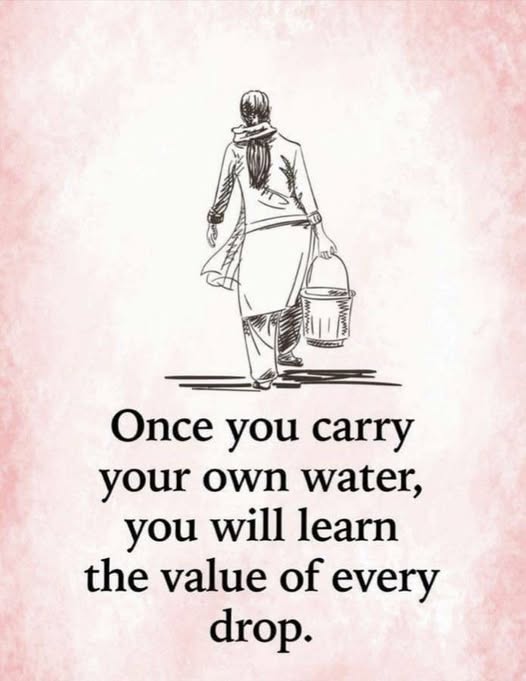
The phrase “carry your own water” originates in lived realities where survival depends on physical labour. In villages, drought-prone regions, refugee settlements, and informal urban colonies, carrying water is not symbolic—it is daily life. People wake before sunrise, walk long distances, queue for hours, and return with heavy containers balanced on shoulders or hips. Every drop carried is felt. Every spill hurts.
This essay argues that value is born from responsibility. What we do not carry ourselves, we tend to waste. What arrives effortlessly feels replaceable. From water to wealth, energy to emotions, the act of bearing responsibility reshapes perception. Scarcity teaches through pain, but responsibility teaches through awareness.
Water — The Original Teacher of Value
The Human History of Carrying Water
For most of human history, water was never invisible. Civilisations formed around rivers, wells, lakes, and springs. Cities rose where water was accessible and collapsed when it failed. Fetching water was labour-intensive, time-consuming, and central to daily survival.
Only in recent decades—primarily in urban and developed contexts—has water become abstract. Pipes replaced paths. Pumps replaced people. Taps replaced toil. In the process, water lost its physical presence in our consciousness.
Scarcity as a Brutal Instructor
When drought strikes, abstraction vanishes. Tankers arrive. Queues lengthen. Conflicts erupt. Suddenly, water is no longer taken for granted. Each bucket matters. Usage becomes calculated. Waste becomes shameful.
Yet relying on crisis to teach value is dangerous. It creates reaction without reflection. True conservation must be rooted in responsibility, not fear.
Responsibility-Based Conservation
Communities that harvest rainwater, recharge groundwater, or manage shared wells demonstrate a different relationship with water. They plan, measure, and protect. Carrying responsibility—even without physical burden—restores respect.
The lesson is simple: when you carry the consequences, you conserve naturally.
Money — When Numbers Lose Weight
The Illusion of Effortless Wealth
Digital economies have transformed money into data. Salaries are credited automatically. Payments are contactless. Loans are instant. While this efficiency has benefits, it also detaches money from effort.
When money feels weightless, spending becomes careless. Debt feels distant. Future consequences blur.
Earning vs Receiving
Those who have earned money through sustained effort—labour, entrepreneurship, or risk—tend to respect it deeply. They understand its fragility. They budget, save, and invest thoughtfully.
In contrast, money that arrives without responsibility—windfalls, unchecked credit, or entitlement—often disappears just as easily.
Carrying Financial Responsibility
Financial maturity begins when individuals carry the full weight of their choices: income generation, expenditure control, savings, and accountability. This burden, far from oppressive, creates freedom.
Money regains meaning when it carries consequences.
Energy — Invisible Power, Invisible Waste
The Comfort of Unseen Effort
Electricity is among the most misunderstood resources. It arrives silently and disappears instantly. The labour, fuel, infrastructure, and environmental cost remain hidden.
As a result, energy waste is normalized. Lights remain on. Devices idle endlessly. Efficiency is ignored.
Producing Power Changes Behaviour
Households that install solar panels or rely on backup generators experience a shift. Energy becomes measurable. Usage becomes intentional. Conservation becomes instinctive.
The moment production becomes personal, waste feels irresponsible.
Responsibility as Sustainability
True sustainability does not begin with slogans. It begins when individuals and societies feel the weight of consumption.
Food — From Sacred Resource to Disposable Commodity
Distance from the Source
Modern consumers are disconnected from food production. Supermarkets hide seasons. Packaging hides labour. Abundance hides vulnerability.
Food waste thrives in this distance.
When Effort Returns
Grow a vegetable. Cook from scratch. Speak to a farmer. Suddenly, food regains dignity. Each grain carries climate, labour, time, and uncertainty.
Responsibility transforms consumption into gratitude.
Time — The Resource We Waste Most Easily
Equal Distribution, Unequal Value
Time is universal yet unevenly respected. When schedules are imposed, time feels endless. When choices are owned, time feels scarce.
Carrying One’s Own Time
Time management is responsibility management. Saying no is carrying weight. Prioritising is labour. Focus requires discipline.
Those who carry their time consciously live deliberately.
Relationships — Emotional Resources That Deplete Quietly
Effort as Emotional Currency
Relationships weaken when effort is outsourced or assumed. Trust erodes silently.
Carrying Emotional Responsibility
Listening, showing up, apologising, and caring are forms of labour. They are emotional weights we must carry ourselves.
Healthy relationships survive on shared responsibility.
The Psychology of Effort and Value
Human psychology links effort to worth. What costs us something feels meaningful. What arrives effortlessly feels replaceable.
This is not moral failure—it is cognitive wiring.
Convenience Culture and Its Hidden Costs
Convenience reduces friction but increases waste. Systems designed to remove effort also remove awareness.
The challenge is not rejecting convenience, but restoring responsibility within it.
Teaching Responsibility Without Crisis
Education, policy, and design must reintroduce consequence gently—before scarcity enforces it brutally.
Conclusion: Carrying Our Way Back to Meaning
The wisdom of carrying one’s own water is timeless. It reminds us that responsibility is not a burden to escape but a relationship to honour.
We do not need scarcity to teach us value. We need effort, awareness, and accountability.
In carrying our resources—physically or consciously—we carry our humanity back into a world numbed by ease.