J&K’s Reservation Crossroads: What the December 3 Cabinet Meeting Could Redraw — A Deep Dive
By: Javid Amin | 03 November 2025
At the Edge of Change — Why Today’s Meeting Matters
On December 3, 2025, all eyes in Jammu & Kashmir rest on the Civil Secretariat in Jammu, where the regional Cabinet — led by Chief Minister Omar Abdullah — convenes its first full session after the annual Durbar Move back to the winter capital. The agenda has drawn more attention than routine administrative items: at its heart lies the recommendation of a Cabinet Sub-Committee (CSC) to rationalise the Union Territory’s contentious reservation structure.
If implemented, the changes could dramatically alter the caste-, region- and merit-based balance that has shaped jobs, education admissions, and community representation across J&K since 2019.
For nearly a decade now, debate has simmered over whether reservation policy—originally designed to safeguard disadvantaged groups and backward regions—has begun to skew unfairly against what many call “open-merit” aspirants. With youth unemployment soaring, educational seats scarce, and regional fault-lines deep, the stakes of the Cabinet’s decision could not be higher.
Today is more than a policy session. It is a potential turning point — one that could reshape careers, stir political unrest, or chart a new path for Jammu & Kashmir’s socio-economic future.
Understanding the Reservation Landscape in J&K — Past, Present, and the 2025 Status Quo
01. The Reservation Architecture Post-2019
After the abrogation of Article 370 and reorganisation of J&K’s constitutional status, the region’s quota system underwent extensive changes — with new categories, expanded quotas, and fresh distribution logic.
Under the current system, quota allocations (in many government jobs and admissions) include:
-
Scheduled Tribes (ST) — previously 10%, increased to 20%.
-
Scheduled Castes (SC) — 8%.
-
Residents of Backward Areas (RBA) — a geographically-rooted quota. Historically 20%, but under recent amendments significantly reshaped.
-
Other Backward Classes (OBC) / Socially and Educationally Backward Classes (SEBC) / Additional Listed Communities — variable percentages depending on category lists.
-
Economically Weaker Sections (EWS) — newly introduced after 2019 re-structure, allocated around 10%.
-
Additional quotas for remote or border-area dwellers — e.g., residents near Line of Actual Control (ALC), International Border (IB), Pahari-speaking communities, etc.
The result: a high total reservation percentage — often cited at 70% in some recent job adverts — leaving limited space for what is termed “Open Merit (OM)” or general-category aspirants.
This structure was defended by successive administrations as necessary for representation of marginalized, backward and remote-area populations in a region with unique socio-economic challenges.
02. Allegations and Discontent: Why the System Is Under Fire
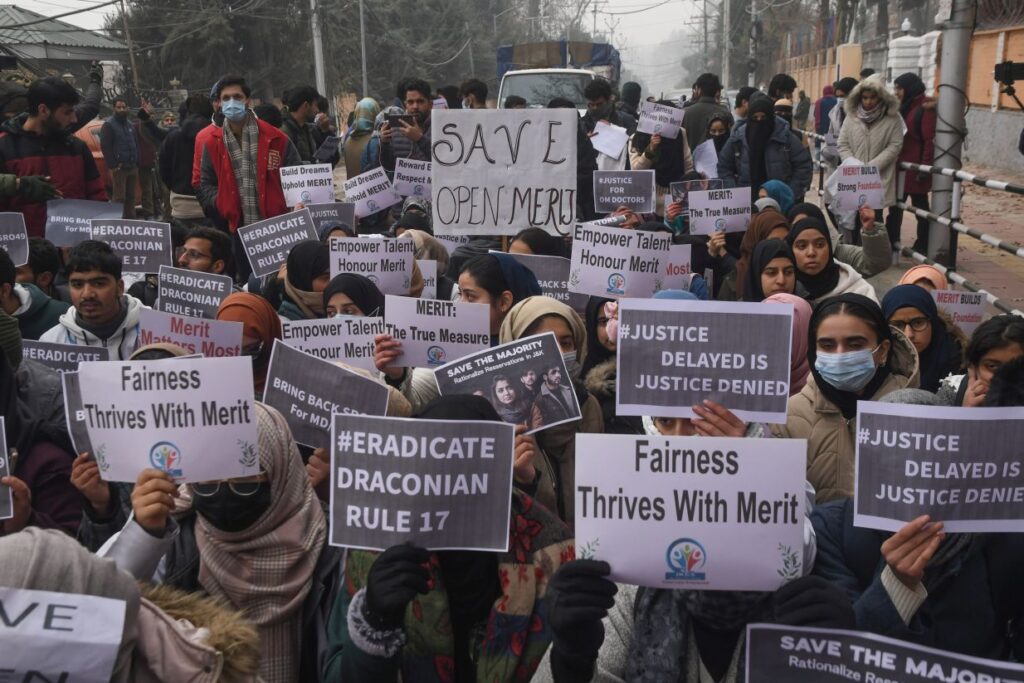
By 2024–2025, widespread criticism emerged — particularly from youth groups, open-merit aspirants, and civil society observers — calling the quotas disproportionately large and skewed.
Some key grievances:
-
Merit Suppressed: With only 30–33% positions left for open merit, many candidates argue even high scorers are being outcompeted by quota-based allocations.
-
Regional Imbalance: Recent data show issuance of reservation certificates heavily skewed in favour of Jammu region — e.g., in 2025, Jammu reportedly accounted for ~72% of new category certificates, Kashmir only 28%.
-
Questionable RBA and EWS Distribution: Critics argue that the RBA category covers a large proportion of the population, diluting its purpose as a “backward area” safeguard; similarly, many question the economic criteria for EWS.
-
Judicial and Legal Challenges: Petitioners have challenged recent quota amendments as violating national norms (like the 50% ceiling on reservations set by the Supreme Court) and discriminating against open-merit candidates.
As a result, social unrest among youth, increasing dropouts, frustration over denied opportunities, and a rising sense of systemic injustice have made reservation reform a combustible issue.
The Cabinet Sub-Committee (CSC) Report: What It Proposes, and Why Now
In response to mounting pressure, the government in December 2024 constituted a Cabinet Sub-Committee (CSC) tasked with reviewing the existing reservation matrix, assessing demographic data, application patterns, and public grievances.
After months of deliberation, the CSC reportedly recommended the following major changes (being tabled for deliberation today):
Key Recommendations:
-
Increase Open Merit (OM) quota from 30% to 40%.
-
Reduce RBA and EWS quotas by ~10% each, effectively shrinking their share but keeping ST, SC, and other constitutionally protected quotas intact.
-
Retain quotas for SC, ST, OBC, border-area categories, and other protected segments, ensuring no rollback of historically disadvantaged groups.
-
No change in total number of posts/seats — only redistribution across categories, to ensure the overall job pool remains the same but access changes.
According to insiders, the rationale behind these proposals includes:
-
Addressing “open-merit frustration” among youth.
-
Responding to data showing disproportionate certificate issuance favouring Jammu region, and complaints from Kashmir Valley about underrepresentation.
-
Ensuring the quota system remains within legal and constitutional boundaries, especially around the 50% reservation ceiling in education and jobs.
The December 3 Cabinet Meeting: What’s at Stake, What to Watch For
01. Critical Political and Social Stakes
Open Merit Aspirants & Youth: If OM quota rises to 40%, aspirants who have long felt marginalized may get renewed hope. This could lead to increased applications for government jobs, higher educational admissions, and possible relief from “merit freeze.”
Backward and Remote Area Communities (RBA): For communities that have relied on geographical quotas — often in remote and underdeveloped zones of both Jammu and Kashmir — a reduction might mean loss of opportunities. Community leaders fear marginalization, especially in the absence of alternate safeguards.
Regional Balance (Jammu vs Kashmir): Given data showing over-issuance of certificates in Jammu — 72% in 2025 alone — the reshuffle may be viewed by many in Kashmir as an attempt to rebalance representation. However, this could trigger backlash from Jammu’s beneficiaries.
Legal and Constitutional Credibility: By reducing total reservation share back toward a 50% threshold (after temporary inflation to 70%), the move could help shield the policy from legal challenges. Several petitions have already been filed in High Court over quota expansion.
02. Administrative and Governance Implications
Implementation will require:
-
Revision of recruitment and admission notifications, possibly halting some ongoing processes.
-
Recalibration of category certificates issuance, with scrutiny over demographic data and regional representation.
-
Transparent communication to manage expectations among a wide array of stakeholders — students, job-seekers, backward-area communities, tribal groups, and more.
-
Monitoring horizontal quotas (disability, border-area, ex-servicemen, etc.) once the new structure is adopted — to ensure they do not get squeezed improperly.
03. Political Risk: Protests, Mobilisation, and Backlash
Any reduction or rationalization of quota privileges risks triggering protests. Already, youth groups in both Jammu and Kashmir have expressed anger over what they view as “quota overload.”
Groups representing RBA, EWS, remote-area residents — particularly in rural Kashmir and less-developed Jammu districts — may mobilize fear of exclusion. Civil society voices have warned that trimming quotas without offering alternate safeguards (like economic uplift or targeted welfare) may deepen socio-economic divides.
Voices from the Ground: Aspirations, Anxiety, and Divided Sentiments
01. Open-Merit Aspirants and Youth Perspective
“We studied hard, cleared exams with high scores — but with only 30 percent OM seats, we are competing for crumbs. A 10-point hike in OM quota may change lives.”
— A JKSSB aspirant, Srinagar (identity withheld)
Since early 2025, there’s been growing sentiment among youth and civil-society forums that the current system unfairly marginalizes high-scoring general-category candidates. Kashmir Times+1
With OM limited, many high-rank holders find themselves displaced by lower-ranked quota-based candidates. The perception of “meritocracy crushed” is widespread, especially in government job aspirants and professional-course applicants.
02. Concerns of Remote and Backward-Area Communities (RBA & EWS Beneficiaries)
“RBA is not just a quota — it is our only ladder. Reduce it, and we lose access to jobs altogether.”
— Resident of remote area, Kupwara district
For remote-area dwellers in rural Kashmir or for economically disadvantaged families in Jammu’s hilly zones, quotas like RBA or EWS have long offered hope for socio-economic mobility. Civil society activists warn that reducing quotas without strengthening education and infrastructure could worsen inequalities.
03. Regional and Ethnic Polarization Risks
Recently released data shows gross disparities: ~71–72% of reservation certificates in 2025 went to Jammu region, while Kashmir got 28%.
For many in Kashmir Valley, this has reinforced a sense of alienation. A quota shuffle may be welcomed as rebalancing — but it can also trigger inter-regional resentment in Jammu, especially among communities that’ve benefited from the status quo.
Legal, Constitutional and Policy Dimensions: Navigating Supreme Court Norms
01. The 50% Reservation Ceiling
India’s landmark judgment in Indra Sawhney vs Union of India (1992) capped reservations at ~50% to maintain merit-based equity. Critics of J&K’s elevated quota share — especially after 2024 amendments — argued the system violated this threshold.
By reducing reservation share and boosting open-merit seats, the Cabinet’s proposed overhaul could align J&K’s policy more closely with national jurisprudence — potentially insulating it from ongoing and future legal challenges.
02. Balancing Affirmative Action and Meritocracy
Proponents of quotas argue that socio-economic deprivation, regional imbalance, and historical marginalization justify affirmative action. Opponents counter that excessive quotas undermine merit, breed inefficiency, and foster resentment.
The proposed changes represent a policy attempt to balance both — retaining affirmative safeguards while addressing merit-based fairness and demographic justice.
03. Political Stakes: Promise vs. Delivery
While quota revisions may bring relief for some, the government must ensure transparent implementation, equitable distribution, and robust grievance redressal. Without that, the radical reshuffle may deepen mistrust among those who see themselves as “left out again.”
Administrative Challenges: Can the Overhaul Be Implemented Smoothly?
Even if the Cabinet approves the CSC recommendation, several practical hurdles remain:
-
Updating recruitment and admission rules: Hundreds of ongoing or pending recruitments (by JKSSB, JKPSC) and admissions (colleges, professional courses) must be recalibrated.
-
Re-issuance / verification of certificates: Category certificates (SC/ST/RBA/EWS/others) previously issued must be audited; misuse or overlapping claims need identification.
-
Regional and community outreach: To avoid polarization, government must engage with civil society, community leaders, student unions — particularly in remote areas and among disadvantaged groups — to reassure them about protections.
-
Transparency and monitoring: A public dashboard showing seat-by-seat, category-wise, and region-wise allotments may help reduce grievances.
-
Mitigating backlash: Authorities must prepare for protests, legal challenges, and political agitation — and ideally, simultaneously launch welfare and skill-development programs to cushion impact.
The Political Landscape: Who Gains, Who Risks — Strategic Implications
01. For the Ruling Party (NC) & Coalition Stability
By pushing reservation rationalisation, the ruling coalition signals responsiveness to youth demands, potentially winning over a large segment of unemployed/open-merit aspirants. However, it risks alienating its traditional voter base among backward-area communities and tribal/quota-beneficiary groups.
02. For Opposition Parties & Emerging Political Players
Parties such as Peoples Conference, Peoples Democratic Party (PDP), and smaller regional outfits may exploit backlash to position themselves as defenders of disadvantaged communities or champions of merit — depending on their target demographic.
The quota debate may thus redefine political fault-lines: not just along regional or ethnic lines, but between merit-based youth vs. quota-based beneficiaries, and urban vs. rural / remote-area constituencies.
03. For Social Cohesion & Community Dynamics
Redistribution of quota benefits may spark tension between communities — especially if perceived as unfair or politically motivated. Effective communication and equitable transitional measures are essential to prevent social polarization.
What to Expect — Scenarios Post Cabinet Decision
Here’s a breakdown of possible outcomes and their implications:
| Scenario | Likely Outcome | Impact |
|---|---|---|
| Full approval (OM → 40%, RBA/EWS reduced) | Quota policy realigned; legal risks lowered | Relief for open-merit aspirants; anxiety among quota-beneficiaries; potential unrest |
| Partial approval / Modification | Some quota reductions; or conditional phasing | Mixed reactions; moderate relief + protest mitigation |
| Deferral or No Change | Status quo maintained | Continued frustration among youth; possible legal stay; political mobilization |
| Accompanied Welfare/Skill-Building Measures | Reshuffle + targeted development support | Balanced transition; long-term social stability |
The coming weeks will reveal which path the government chooses.
The Bigger Picture: Reservation, Equity and J&K’s Future
The urgency around quota reform reflects deeper structural anxieties — not just about jobs and admissions but about identity, equity, and social justice in post-Article 370 J&K.
-
Demographic shifts: With internal migration, displacement, and evolving social structures, quotas grounded on older census/data may no longer reflect ground realities.
-
Economic ambitions vs social justice: As youth demand fresh opportunities, balancing historically rooted affirmative action with merit-based economics becomes more complex.
-
Regional balance (Jammu vs Kashmir): Unless navigated carefully, quota changes risk exacerbating regional divides — a fault line already visible in certificate-issuance data.
-
Legal and constitutional position: Realignment toward constitutional norms (50% quota ceiling, transparent distribution) may strengthen J&K’s integration while preserving social safeguards.
Ultimately, this Cabinet session may mark a shift in how J&K defines opportunity — either as an inherited entitlement based on identity/region, or as a performance-based merit open to all.
Bottom-Line: A Turning Point — If Handled With Care
Today’s Cabinet meeting is not routine. It stands at the intersection of youth aspirations, social justice, political survival, and regional equity.
If the government implements the CSC recommendations with fairness, transparency and accompanying welfare safeguard measures, it could restore faith in meritocracy and ease long-standing frustration among open-merit aspirants.
But if changes are perceived as abrupt or biased, or if affected communities feel betrayed, the policy rejig could deepen social fault-lines, fuel protests, and erode public trust.
For Jammu & Kashmir, reservation policy is not just about quotas on paper — it is a symbol of justice, representation, and hope for the marginalized, and aspiration, opportunity, and ambition for the youth.
Today’s decisions could redraw not just a quota chart — but the social contract of an entire region.