J&K Congress Protests: Demand for Statehood Intensifies, PM Modi Asked to Resign
By: Javid Amin | 09 March 2026
Tariq Hameed Karra leads demonstrations in Jammu and Srinagar, accusing Centre of foreign policy failures and economic mismanagement
Congress Steps Up Pressure: Protests Across Jammu & Kashmir Over Statehood and Foreign Policy
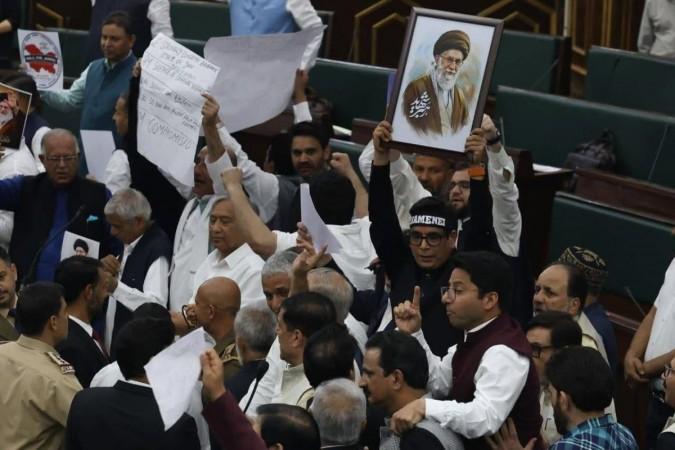
Political tensions intensified in Jammu and Kashmir as the Jammu & Kashmir Pradesh Congress Committee (JKPCC) staged protests on March 9–10, 2026, demanding the restoration of full statehood to the region and calling for the resignation of Prime Minister Narendra Modi.
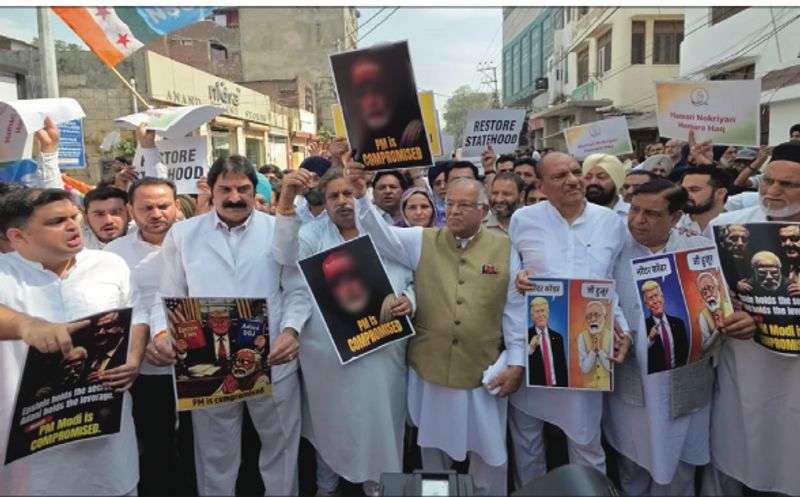
The demonstrations were led by JKPCC president Tariq Hameed Karra, who accused the central government of weakening India’s global standing and “surrendering” to the United States in the proposed India–US trade negotiations.
Congress leaders and activists gathered in Jammu’s Shaheedi Chowk, while attempts to hold protests in Srinagar faced restrictions from local authorities amid heightened security concerns.
The protests reflected growing political agitation in Jammu and Kashmir, where the demand for restoring statehood has remained a central issue since the region’s constitutional status changed in 2019.
Where the Protests Took Place
Congress workers and leaders organized demonstrations in two key locations:
Jammu: Shaheedi Chowk Protest
In Jammu, hundreds of Congress supporters assembled at Shaheedi Chowk, carrying banners and placards demanding statehood restoration.
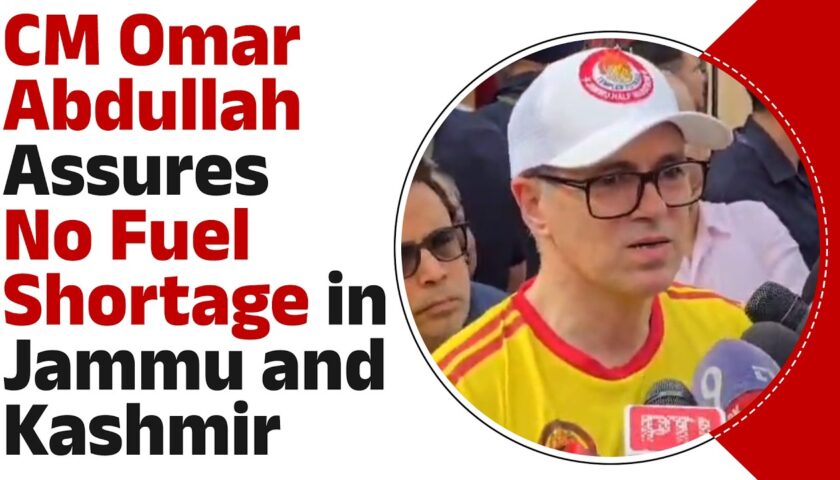
Speakers at the rally criticized the central government’s policies, raising slogans against the BJP-led administration and highlighting issues affecting ordinary citizens, including rising fuel prices.
Srinagar: Gatherings Restricted
In Srinagar, authorities restricted public gatherings in parts of the city, citing security considerations.
Despite restrictions, Congress leaders attempted to mobilize supporters and reiterated their political message through press briefings and social media outreach.
Police reportedly detained several Congress leaders during demonstrations in the Samba district, underscoring the tense atmosphere surrounding the protests.
The Central Demand: Restoration of Statehood
The primary focus of the demonstrations was the restoration of statehood to Jammu and Kashmir.
The region has been governed as a Union Territory since August 2019, when the central government reorganized the former state.
At the time, the administration led by Prime Minister Narendra Modi revoked the special constitutional provisions that had previously granted the region a degree of autonomy.
Since then, political parties across the ideological spectrum in Jammu and Kashmir—including regional parties and national parties—have consistently demanded the return of full statehood.
During the protests, Congress leaders reiterated that restoring statehood was essential for:
-
Democratic representation
-
Administrative accountability
-
Local economic development
-
Public confidence in governance
According to Karra, the restoration of statehood is not merely a political demand but a constitutional necessity to rebuild democratic institutions in the region.
Karra’s Sharp Attack on the Prime Minister
At the center of the protest rhetoric was a direct demand for the resignation of Prime Minister Narendra Modi.
Addressing protesters, Tariq Hameed Karra accused the central government of damaging India’s foreign policy credibility.
He argued that recent diplomatic developments—including negotiations around a proposed India–US trade agreement—demonstrated what he described as “policy weakness” on the international stage.
Karra alleged that the government had:
-
compromised national interests in trade negotiations
-
failed to maintain an independent foreign policy
-
weakened India’s diplomatic position globally
The Congress leader framed the issue as a matter of political accountability, stating that the prime minister should “take responsibility for foreign policy failures.”
Economic Issues Also Raised
Alongside political and diplomatic criticism, the protests highlighted economic concerns affecting ordinary citizens.
Congress leaders pointed to rising LPG cylinder prices, inflation, and unemployment as examples of what they described as policy failures.
According to protest organizers, the proposed India–US trade deal could also negatively impact local industries in Jammu and Kashmir.
Small business owners, traders, and agricultural communities were cited as sectors that could face economic pressure if the trade agreement leads to increased market competition.
By linking these economic grievances to the broader demand for statehood, Congress attempted to frame the issue as both a local governance crisis and a national policy failure.
Police Action and Detentions
Security forces closely monitored the demonstrations throughout the two-day protest period.
Authorities detained several Congress activists in parts of Samba district, particularly when protest gatherings attempted to march beyond designated areas.
Police officials stated that the restrictions were necessary to maintain law and order and prevent disruptions in sensitive areas.
Despite the detentions, Congress leaders continued to issue statements demanding political reforms and urging the central government to engage with regional parties.
Why Statehood Remains a Sensitive Issue
The demand for restoring statehood has become one of the most significant political debates in Jammu and Kashmir since 2019.
The reorganization of the region divided the former state into two Union Territories:
-
Jammu and Kashmir
-
Ladakh
While Ladakh continues as a Union Territory without a legislature, many political parties in Jammu and Kashmir have argued that the region should regain its full state status.
Supporters of statehood restoration argue that:
-
elected representatives must have greater decision-making authority
-
governance should be locally accountable
-
democratic institutions must be strengthened
Opponents, however, argue that maintaining Union Territory status allows the central government to manage security challenges more effectively.
Congress Strategy in Jammu & Kashmir
Political observers say the protests represent part of a broader strategy by the Congress party to rebuild its influence in Jammu and Kashmir.
After losing ground to regional parties over the past decade, Congress has been attempting to reposition itself as a key political force in the region.
By combining:
-
statehood demands
-
economic concerns
-
criticism of foreign policy
the party aims to connect local grievances with national political debates.
The leadership of Tariq Hameed Karra—a veteran politician who previously served in Parliament—has been central to this strategy.
Wider Political Implications
The protests highlight several important political trends:
Rising Opposition Pressure
Opposition parties are increasingly using regional issues like statehood to challenge the central government.
Centre–State Tensions
The demand for statehood reflects broader debates about federalism and governance in India.
Electoral Positioning
Political mobilization around economic issues and local autonomy could influence future elections in Jammu and Kashmir.
The Road Ahead for Statehood
The central government has previously indicated that statehood may eventually be restored to Jammu and Kashmir, though no specific timeline has been announced.
Political leaders in the region continue to press for a clear roadmap.
For the Congress party and other opposition groups, the issue remains a powerful rallying point.
Until a definitive decision is taken, the demand for statehood is likely to remain at the center of political discourse in Jammu and Kashmir.
Conclusion
The March 2026 protests led by the Jammu & Kashmir Congress represent a renewed push to restore the region’s statehood and challenge the central government’s policies.
Led by Tariq Hameed Karra, the demonstrations combined regional demands with national political criticism, including calls for the resignation of Prime Minister Narendra Modi.
While the protests may not immediately change policy, they underscore the continuing political volatility in Jammu and Kashmir and the enduring debate over the region’s constitutional future.