Asiya Andrabi Sentence Row: Mehbooba Mufti, Mirwaiz Seek Relief, Debate Intensifies
By: Javid Amin | 26 March 2026
Kashmir’s Political Crossroads: Compassion vs Security
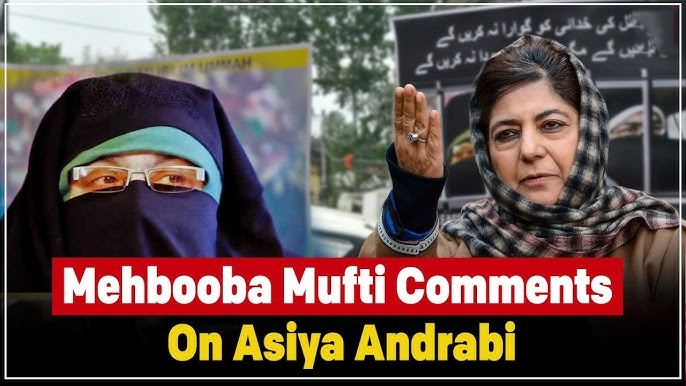
In a development that has reignited debate across political and security circles, Mehbooba Mufti and Mirwaiz Umar Farooq have publicly urged the Indian government to reconsider the life sentence awarded to separatist leader Asiya Andrabi.
Their appeal—framed on humanitarian grounds—comes shortly after Andrabi was sentenced to life imprisonment by a special court under stringent anti-terror laws. While the request emphasizes compassion, it has simultaneously triggered sharp reactions over national security, judicial integrity, and political signaling in Jammu & Kashmir.
Who Is Asiya Andrabi?
Asiya Andrabi has long been a controversial figure in Kashmir’s separatist landscape.
Key Background:
- Founder of Dukhtaran-e-Millat (DeM), a banned outfit
- Known for advocating separatist ideology and alignment with Pakistan
- Arrested multiple times over the years for anti-national activities
Legal Outcome:
In March 2026, a special court linked to the National Investigation Agency convicted Andrabi on charges including:
- Sedition
- Conspiracy to wage war against India
- Terror-related offenses under stringent laws
She was subsequently sentenced to life imprisonment, marking one of the most significant convictions involving a female separatist leader in recent years.
The Appeal: What Mehbooba and Mirwaiz Said
Mehbooba Mufti’s Position
Mehbooba Mufti, president of the Jammu and Kashmir Peoples Democratic Party, took a nuanced stance.
Key Arguments:
- Acknowledged ideological differences with Andrabi
- Called the life sentence “too harsh”
- Suggested restoring it to a fixed-term sentence (around 14 years)
- Proposed conditional parole based on age and time already spent in custody
Her framing leaned heavily on humanitarian considerations rather than political alignment.
Mirwaiz Umar Farooq’s View
Mirwaiz Umar Farooq echoed similar concerns.
Key Observations:
- Described the sentence as “severe and harsh”
- Urged a compassionate review
- Warned that excessive punitive measures could:
- Deepen alienation in the region
- Undermine reconciliation efforts
His remarks align with a long-standing position advocating dialogue and softer state approaches in Kashmir.
Legal Dimensions: Can a Life Sentence Be Relaxed?
The case sits at the intersection of criminal law, national security legislation, and executive discretion.
Applicable Laws:
- Unlawful Activities (Prevention) Act (UAPA)
- Indian Penal Code provisions related to sedition and waging war
What “Life Imprisonment” Means:
In India, life imprisonment typically implies:
- Incarceration for the remainder of natural life, unless remitted
- Possibility of remission or commutation by:
- State governments
- The President or Governor under constitutional powers
Court’s Concern:
The special court reportedly cautioned that leniency could:
- “Infuse fresh vigour” into separatist networks
- Set a sensitive precedent in terrorism-related cases
Political & Strategic Implications
1. Political Messaging
The statements by Mehbooba and Mirwaiz may reflect:
- An attempt to reposition themselves as moderate voices
- Outreach to sections of society sympathetic to humanitarian concerns
- Efforts to regain political relevance amid changing ground realities
2. Security Concerns
Security agencies remain cautious.
Key Risks:
- Potential revival of dormant separatist networks
- Symbolic empowerment of hardline elements
- Messaging that could be interpreted as state leniency
Given Kashmir’s history, even symbolic decisions carry operational implications.
3. Legal Precedent
Revisiting a life sentence in such a case could:
- Open doors for similar appeals in terrorism-related convictions
- Trigger judicial scrutiny over sentencing consistency
- Raise questions about balancing justice vs mercy
4. Public Reaction
The response across India—and within Jammu & Kashmir—has been sharply divided:
Supporters argue:
- Humanitarian grounds should prevail
- Long incarceration warrants compassion
- Rehabilitation should be considered
Critics contend:
- It undermines national security
- Disrespects judicial processes
- Sends the wrong signal in terrorism cases
Ground Reality: A Complex Socio-Political Landscape
Kashmir’s socio-political environment adds layers of complexity to the issue.
Key Factors:
- Decline in overt separatist activity in recent years
- Increased focus on development and integration
- Continued sensitivity around identity and political representation
Any decision on Andrabi’s sentence will resonate beyond the courtroom—impacting perceptions, narratives, and policy directions.
What Happens Next?
As of now:
- No official response has been issued by the central government
- Legal options remain limited unless:
- A formal appeal is filed
- Executive clemency is considered
সম্ভ সম্ভ Likely Scenarios:
- Status Quo Maintained – Sentence remains unchanged
- Judicial Review – Higher courts reassess aspects of sentencing
- Executive Intervention – Rare but possible under constitutional provisions
Expert Analysis: Between Justice and Reconciliation
From a socio-economic and political standpoint, this episode underscores a recurring dilemma in conflict regions:
How does a state balance firm enforcement of law with space for reconciliation?
Key Takeaways:
- The appeal is less about Andrabi alone and more about political signaling
- The response will indicate the government’s stance on:
- Separatism
- Rehabilitation
- Long-term peace strategy
Final Word
The call by Mehbooba Mufti and Mirwaiz Umar Farooq to reconsider Asiya Andrabi’s life sentence has opened a complex debate—one that goes beyond legal technicalities into the heart of Kashmir’s evolving narrative.
At stake are not just questions of justice and mercy, but also:
- National security priorities
- Political recalibration in the Valley
- The broader trajectory of peace and integration
Whether the appeal gains traction or not, it has already succeeded in bringing a sensitive and consequential issue back into the national conversation.