No Vande Bharat Train Between Srinagar & Jammu Yet, Say Railway Officials
By: Javid Amin | 21 February 2026
Railway Officials Clear the Air
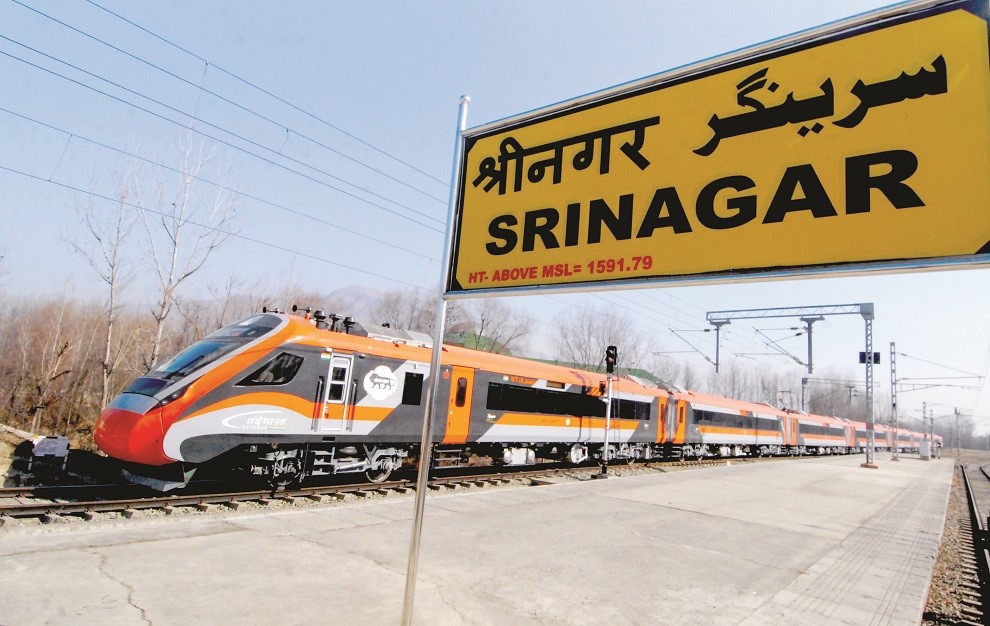
Railway authorities have clarified that there are no current plans to introduce Vande Bharat trains between Srinagar and Jammu, dampening speculation and public expectations around high-speed rail connectivity in the Union Territory.
The clarification comes amid growing public demand and political calls for modern train services in Jammu and Kashmir, particularly as Vande Bharat trains continue to expand across India.
Officials emphasized that while modernization remains a long-term goal, infrastructure readiness and safety considerations must take precedence.
Current Rail Connectivity in Kashmir
At present, rail connectivity within the Valley is primarily served by the Indian Railways network operating conventional passenger services.
The backbone of Kashmir’s internal railway system is the Banihal–Baramulla line, which connects key districts within the Valley. This stretch has significantly improved intra-regional mobility over the past decade, particularly for daily commuters and students.
However, seamless rail connectivity between the Kashmir Valley and the rest of India remains dependent on the completion of the larger Jammu–Baramulla rail link, a project that has faced engineering, geographical, and climatic challenges for years.
Why Vande Bharat Is Not Feasible Yet
The primary reason cited by officials is the incomplete and technically demanding stretch between Udhampur and Banihal.
The Udhampur–Banihal section includes:
-
Long railway tunnels through fragile Himalayan rock formations
-
High-altitude bridges
-
Complex seismic safety considerations
-
Challenging weather conditions
This segment is part of the broader Jammu–Baramulla rail link, one of India’s most ambitious mountain rail projects.
High-speed trains like Vande Bharat Express require:
-
Advanced track geometry
-
Enhanced signaling systems
-
Electrification stability
-
Speed-compatible gradients
-
Robust maintenance infrastructure
Until the entire corridor is fully operational and optimized for higher speeds, introducing semi-high-speed services would be premature.
Engineering Realities of the Himalayan Corridor
Unlike plains routes where Vande Bharat trains have been rolled out rapidly, the Kashmir rail corridor presents unique technical hurdles:
1. Tunnel Dominance
A large portion of the Udhampur–Banihal stretch runs through tunnels, including some of India’s longest railway tunnels. High-speed operations demand strict ventilation, fire safety, and emergency evacuation protocols.
2. Extreme Weather
Heavy snowfall, landslides, and temperature fluctuations impact track stability and signaling systems.
3. Seismic Sensitivity
The Himalayan belt is seismically active, requiring reinforced structural design and cautious operational scaling.
Railway officials maintain that safety margins cannot be compromised to meet public demand.
Public Demand for Modern Rail Services
Demand for Vande Bharat services between Srinagar and Jammu has grown steadily.
Passengers and political representatives argue that:
-
Modern trains would reduce travel time
-
Enhanced comfort would boost tourism
-
Improved connectivity would support business mobility
-
Symbolically, it would integrate J&K with national rail modernization
As Vande Bharat trains expand nationwide, expectations naturally extend to Kashmir.
However, railway authorities have reiterated that expansion follows infrastructure readiness — not political timelines.
Future Prospects: What Needs to Happen
Officials indicate that once the Katra–Banihal stretch is fully operational and technically stabilized, the possibility of faster trains may be reassessed.
The full operationalization of the Jammu–Baramulla rail link would:
-
Enable uninterrupted rail travel from Kashmir to mainland India
-
Improve freight logistics
-
Increase tourism accessibility
-
Provide scope for upgraded rolling stock
At that stage, semi-high-speed services could be technically viable.
Until then, authorities emphasize gradual scaling rather than premature deployment.
A Broader Modernization Context
The Union Government has aggressively expanded Vande Bharat services across multiple states, showcasing rail modernization as a flagship infrastructure initiative.
Yet Kashmir remains a special case due to terrain complexity. The region’s rail story is less about speed and more about connectivity completion.
Railway planners privately note that finishing the Himalayan corridor itself is a historic engineering achievement. Speed upgrades are secondary.
Balancing Expectations and Engineering
The debate reflects a familiar development tension in Jammu & Kashmir:
-
Aspirations for parity with national infrastructure
-
Ground realities shaped by geography
While Vande Bharat trains symbolize progress, connectivity reliability matters more than velocity.
Passengers currently prioritize:
-
Regular service
-
Weather-resilient operations
-
Seamless transfers
-
Safety assurance
High-speed branding without structural readiness could undermine public confidence.
Conclusion: Patience Before Speed
There are no immediate plans to introduce Vande Bharat trains between Srinagar and Jammu. Railway officials have made that clear.
The focus remains on completing and stabilizing the Udhampur–Banihal section of the Jammu–Baramulla rail link. Once that foundational work is done, the conversation about faster trains may return.
For now, Kashmir’s railway journey is about finishing the track — not accelerating on it.
Modernization is coming. But in the Himalayas, engineering timelines move on geological logic, not political momentum.