BJP MLA Devyani Rana Attacks J&K Budget: Why Omar Abdullah’s NC MLAs Applauded Her in Assembly
By: Javid Amin | 08 February 2026
A rare moment of bipartisan civility in the Jammu and Kashmir Assembly reveals how political legacy, parliamentary tradition, and symbolism still matter in a deeply polarised landscape
A Moment That Stopped the House
The Jammu and Kashmir Legislative Assembly is not known for political gentleness—especially when budgets are on the table. Sharp interruptions, desk-thumping protests, and ideological trench warfare have long defined its proceedings.
That is precisely why what unfolded during the budget debate for ₹1.13 lakh crore (2026–27) caught everyone off guard.
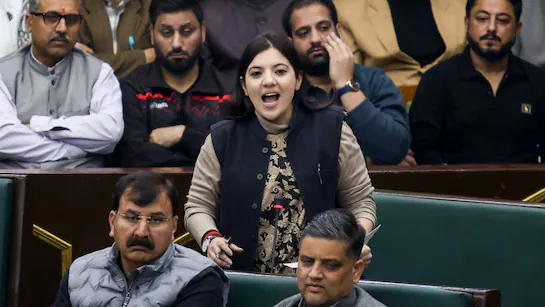
A BJP MLA, making her maiden speech, launched a direct and pointed critique of the Omar Abdullah–led National Conference (NC) government’s budget priorities. She questioned cuts in disaster management spending despite recent floods and warned of the consequences of reduced allocations for education.
Yet, instead of heckling or silence, something unusual happened.
NC MLAs applauded her.
They thumped their desks.
They acknowledged her words.
For observers, journalists, and even seasoned legislators, the moment raised a single pressing question:
Why would the ruling party applaud a speech tearing into its own budget?
The answer lies at the intersection of parliamentary tradition, political legacy, personal history, and a quiet acknowledgment that some conventions still transcend party lines.
Who Is Devyani Rana? Understanding the Speaker Before the Speech
To understand the applause, one must first understand who Devyani Rana is—and where she comes from.
Devyani Rana is not just another first-time legislator from the Bharatiya Janata Party. She is the daughter of the late Davinder Singh Rana, one of Jammu’s most influential political figures over the past several decades.
Davinder Singh Rana: A Bridge Between Regions and Parties
Davinder Singh Rana was:
-
A senior National Conference leader from Jammu
-
A trusted aide and close associate of Omar Abdullah
-
A politician widely regarded as a consensus-builder across regions
-
Later a BJP leader, after his exit from the NC
-
A figure whose death in 2024 marked the end of an era in Jammu politics
Even after changing parties, Rana retained personal respect across ideological lines—particularly within the National Conference, where many senior leaders had shared decades of political association with him.
For NC MLAs, Devyani Rana is not merely a political opponent. She is also the political heir of a colleague, mentor, and ally from the party’s own past.
That legacy mattered deeply in the Assembly that day.
The Setting: A Budget Debate Loaded With Political Tension
Budgets are political documents. In Jammu and Kashmir, they are even more so.
The 2026–27 budget, presented by the Omar Abdullah government, came under scrutiny for:
-
Allocation priorities
-
Post-disaster preparedness
-
Social sector spending
-
Regional balance between Jammu and Kashmir
The opposition BJP, which has sought to reclaim political ground in the Union Territory, approached the debate with an aggressive strategy—highlighting governance gaps and financial decisions that could resonate with the public.
Devyani Rana’s speech was part of that broader critique.
But her tone, content, and context made it different.
What Devyani Rana Actually Said: A Sharp, Structured Critique
Contrary to any notion of symbolic participation, Devyani Rana’s speech was substantive and confrontational.
She did not hedge her criticism.
1. Disaster Management: Questioning the Cuts
One of the most pointed sections of her speech focused on disaster preparedness.
She highlighted that:
-
Disaster management allocation was reduced from ₹719 crore to ₹350.76 crore
-
This reduction came despite recent floods and climate-linked vulnerabilities
-
The cuts, she argued, undermined preparedness, response capacity, and relief mechanisms
In a region prone to floods, landslides, and extreme weather events, the argument struck at a sensitive nerve.
2. Education: Warning of Long-Term Consequences
Rana then turned to education spending.
She pointed out:
-
A ₹193 crore reduction in education allocations
-
The potential for school closures or forced mergers
-
The disproportionate impact on rural and underserved communities
-
The long-term consequences for children’s learning outcomes
Rather than framing the issue as partisan, she positioned it as a developmental concern—one that could affect generations.
3. Overall Budget Philosophy
Her broader critique suggested:
-
Misplaced priorities
-
Insufficient attention to resilience-building sectors
-
A disconnect between recent ground realities and fiscal decisions
It was not a soft debut speech.
It was an attack—measured, but unmistakable.
So Why the Applause? The Speaker’s Role
The first and most immediate reason lies in parliamentary procedure.
Speaker Abdul Rahim Rather’s Intervention
Before Devyani Rana began, Assembly Speaker Abdul Rahim Rather made a clear request to the House:
Members should encourage the new MLA, as it was her maiden speech.
In legislative bodies across India, a first speech is traditionally accorded courtesy, regardless of party affiliation.
The Speaker’s request was not symbolic—it was procedural guidance.
By applauding, NC MLAs were:
-
Following the Speaker’s direction
-
Upholding legislative decorum
-
Reinforcing the Assembly’s institutional dignity
This alone explains much of the reaction—but not all of it.
Beyond Procedure: The Weight of Political Memory
Politics in Jammu and Kashmir is intensely personal.
Relationships outlast alliances.
History shadows the present.
For many NC legislators seated in the House, Devyani Rana was not a stranger.
She was Davinder Singh Rana’s daughter.
A Legacy That Commands Respect
Despite his eventual move to the BJP, Davinder Singh Rana:
-
Spent decades in the National Conference
-
Was deeply involved in party organisation in Jammu
-
Helped bridge regional divides within the party
-
Maintained personal relationships even after political realignment
His death in 2024 was mourned across party lines.
Applauding his daughter’s maiden speech was, for many NC MLAs, a gesture of respect to a shared past, not an endorsement of present criticism.
Symbolism Over Substance: What the Applause Was—and Wasn’t
It is crucial to clarify what the applause did not mean.
-
It did not signal agreement with her critique
-
It did not weaken the NC’s defence of its budget
-
It did not indicate ideological softening
Instead, it represented:
-
Respect for parliamentary tradition
-
Recognition of a political legacy
-
Encouragement of a new legislator
-
A rare display of civility in an adversarial space
In Indian legislatures, such moments are uncommon—but not accidental.
Why This Moment Matters in Today’s Politics
In an era where politics is increasingly polarised, performative, and combative, this moment stood out precisely because it was restrained and symbolic.
1. It Reaffirmed Institutional Norms
Legislatures are not just battlefields; they are institutions with traditions.
The applause reinforced the idea that:
-
Debate can be sharp without being disrespectful
-
New voices deserve encouragement
-
Institutions matter beyond party lines
2. It Highlighted the Enduring Power of Legacy
Political families remain influential—not just electorally, but emotionally.
Devyani Rana’s reception showed that:
-
Legacy can soften political hostility
-
Personal histories still shape public conduct
-
The past continues to inform the present in J&K politics
3. It Sent a Subtle Message to the Public
For citizens watching, the moment conveyed something rare:
That politics does not always have to be bitter.
That disagreement can coexist with dignity.
How the BJP Interpreted the Moment
From the BJP’s perspective, the applause was not embarrassing—it was advantageous.
It allowed the party to:
-
Highlight the seriousness of Rana’s critique
-
Portray her as a credible, respected voice
-
Showcase bipartisan acknowledgment without compromising opposition stance
For a first-time MLA, the optics were powerful.
What This Means for Devyani Rana’s Political Future
Maiden speeches are often forgettable.
This one was not.
Devyani Rana emerged from the debate as:
-
A confident legislator
-
A substantive critic of governance
-
A figure who commands attention across party lines
Her challenge going forward will be to:
-
Translate symbolism into sustained political work
-
Balance legacy with independent identity
-
Maintain credibility beyond moments of courtesy
What This Means for Omar Abdullah and the NC
For the ruling party, the episode did not weaken its position.
Instead, it:
-
Reinforced its image as institutionally mature
-
Showed confidence in allowing criticism
-
Highlighted its continued respect for political traditions
In the long run, such moments can strengthen democratic legitimacy rather than dilute authority.
A Rare Pause in a Noisy Democracy
Indian politics today thrives on confrontation.
Television debates reward outrage.
Social media amplifies conflict.
Legislatures often mirror that noise.
Which is why a brief pause—marked by applause for an opponent—felt significant.
It reminded observers that beneath the slogans and strategies, politics is still practiced by humans shaped by memory, respect, and institutions.
Conclusion: Applause as a Political Language
The applause for Devyani Rana was not an accident.
It was not hypocrisy.
It was not agreement.
It was a carefully layered political language—spoken without words.
A language that said:
-
We disagree, but we respect you.
-
You are new, and you are welcome.
-
Your father mattered to us.
-
This House is bigger than any one party.
In a time when such language is increasingly rare, that may be why the moment resonated far beyond the Assembly floor.