Bangladesh 2026 Election: BNP Landslide Victory Under Tarique Rahman | Deep Analysis
By: Javid Amin | 12 February 2026
Dawn of a New Political Chapter in Bangladesh
The South Asian nation of Bangladesh witnessed a dramatic political shift in February 2026 as early results from the 13th general election indicated a landslide victory for the Bangladesh Nationalist Party (BNP) under the leadership of Tarique Rahman. By mid-morning on February 13, provisional tallies showed the party comfortably surpassing the simple majority threshold in the 300-seat Jatiya Sangsad (parliament). These outcomes, though yet to be formally certified by the Bangladesh Election Commission (EC), are being widely hailed as the most significant democratic change in decades.
This moment represents not only a major electoral upset but a rebirth of Bangladesh’s political landscape following the tumultuous 2024 uprisings that ended the long-dominant rule of the Awami League, led by Sheikh Hasina. The elections were also conducted alongside a crucial referendum on an 84-point reform package known as the July National Charter, adding a constitutional dimension to this historic vote.
In this feature, we dissect the election results, explore the key political players, examine international reactions, and analyse what this transformation means for Bangladesh’s domestic and foreign policy direction.
The Election Results: BNP Emerges Dominant
Unprecedented Lead as Votes Are Counted
As counting proceeded through the early hours of February 13, multiple media reports indicated that the BNP-led alliance was heading for a commanding victory. By 8.30 am local time, projections showed BNP comfortably crossing the simple majority mark of 150 seats, with a strong showing in constituencies nationwide.
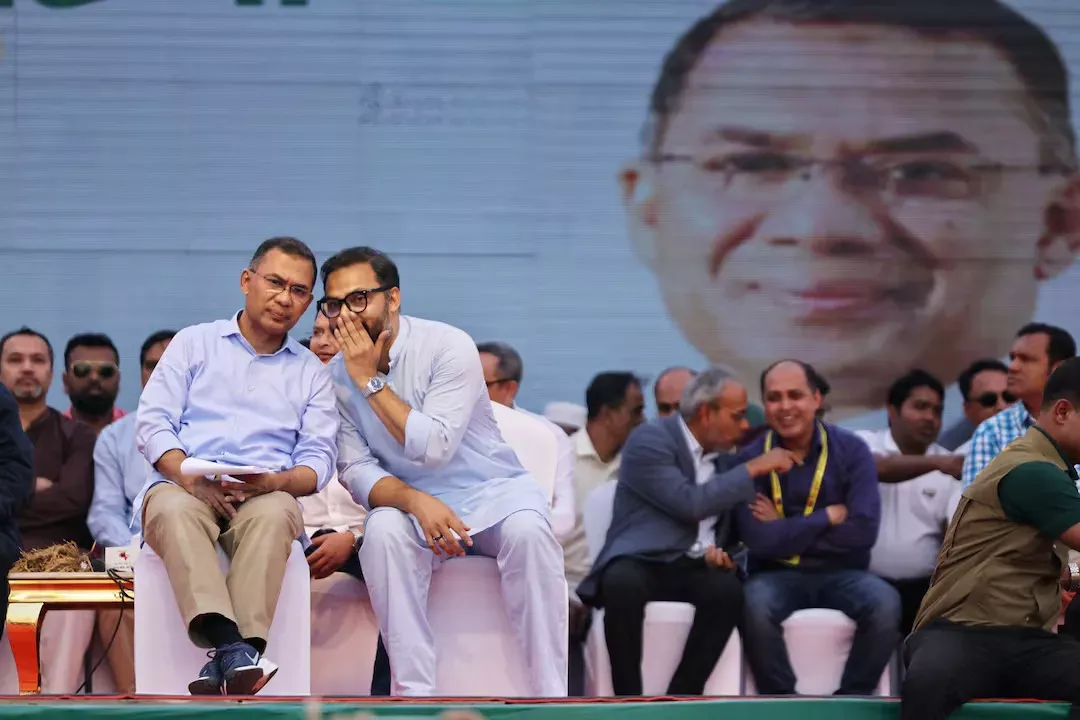
Unofficial results released by local outlets confirmed that Tarique Rahman himself had won both of the constituencies he contested—Dhaka-17 and Bogra-6—underscoring his personal political resurgence and deep popular support.
In Dhaka-17, Rahman secured 72,699 votes, defeating his closest rival from Jamaat-e-Islami by over 4,300 votes. In the Bogra-6 seat, he achieved a landslide victory, garnering 216,284 votes compared to just under 98,000 for the Jamaat candidate—a margin of more than 118,000 votes.
The BNP’s electoral performance was not limited to its chairman’s wins. Several senior leaders—including Salahuddin Ahmed, Amir Khasru Mahmud Chowdhury, Lutfozzaman Babar, Mirza Abbas, and Reza Kibria—also secured parliamentary seats as counting progressed.
At the same time, the Islamist party Jamaat-e-Islami and its allies managed to hold notable ground in several constituencies, winning a significant number of seats as the primary opposition force.
Meanwhile, the National Citizen Party (NCP)—a relatively new political formation born out of the 2024 student-led uprising—won seats in six constituencies, including a narrow victory in Dhaka-11, reflecting a rising youth-driven political force.
Why This Victory Matters
Bangladesh’s political history has been dominated by two towering figures—Sheikh Hasina of the Awami League and Khaleda Zia of the BNP—engaged in fierce rivalry for nearly three decades. This 2026 election marks the first major contest following Hasina’s ouster in August 2024 after sustained protests led by Gen-Z student movements.
With the Awami League suspended from contesting and Hasina herself living in exile, the election became a fresh contest between re-energised BNP forces and established Islamist parties. BNP’s near-majority victory thus represents both a return to mainstream politics for the party and a strategic realignment in the country’s governance.
The National Citizen Party: Youth, Reform and New Voices
One of the most remarkable developments of this election was the performance of the National Citizen Party (NCP). Born out of the July 2024 uprising and led by youth activists, the NCP positioned itself as a reform-oriented alternative to traditional party politics.
Although smaller in seat share compared to the BNP and Jamaat, the NCP’s six seats underscore growing support for grassroots, youth-centred political movements that emerged from mass discontent with entrenched political elites.
Previously, the NCP had campaigned vigorously for transformative reforms—including calls for a new constitution, anti-corruption measures, and expanded democratic rights—elite pledges widely known as the July Charter.
The party’s electoral success marks a progressive inflection point in a parliament that has traditionally seen power concentrated among older, established leadership. It signals a generational shift in Bangladesh politics, elevating voices shaped by recent social movements and activism.
International Reactions: Broad Diplomatic Engagement
The international community responded swiftly to the unfolding election results, with prominent world leaders offering congratulations and underlining hopes for renewed cooperation.
India
Prime Minister Narendra Modi issued a warm congratulatory message to Tarique Rahman, highlighting the longstanding ties between India and Bangladesh. Modi described the results as a testament to democratic engagement and expressed India’s desire to deepen bilateral cooperation in development, trade, and regional security.
Similarly, Congress chief Mallikarjun Kharge echoed congratulations on behalf of his party, emphasizing shared historical and cultural bonds between India and Bangladesh.
United States
The United States Embassy in Dhaka also welcomed the BNP’s results, calling them a “historic victory” and reaffirming Washington’s commitment to democratic principles and close cooperation with Bangladesh’s next government.
Pakistan and Other Neighbours
Official statements from Pakistan extended congratulations to the BNP leadership, noting the significance of the democratic transition. Other regional neighbours and multilateral bodies have also signaled positive engagement, recognizing the election as a crucial moment for stability in South Asia.
Historical Context: Transformations Since 2024
To understand the magnitude of the BNP’s 2026 victory, it’s necessary to revisit the dramatic political changes Bangladesh experienced since the mid-2020s.
The 2024 Student-Led Uprising
In July 2024, waves of public unrest erupted across Bangladesh, largely driven by Gen-Z student groups rallying against corruption, unemployment, and structural economic issues. These protests eventually forced the resignation of long-time Prime Minister Sheikh Hasina and led to a nationwide demand for systemic reform.
The aftermath saw the formation of a transitional government led by Muhammad Yunus, Nobel Peace Prize laureate, tasked with shepherding the country toward a more equitable political landscape and preparing for free and fair elections.
These events reshaped Bangladesh’s political terrain, breaking decades of political inertia and societal division between the two dominant parties.
Domestic Implications: Governance, Reform and Challenges Ahead
BNP’s Policy Priorities
While celebrating their electoral success, BNP leaders have outlined ambitious policy directions, including:
-
Economic revival and job creation
-
Strengthening democratic institutions
-
Judicial reforms and transparency
-
Social inclusion and infrastructure development
However, analysts caution that the party will need to balance popular expectations with pragmatic governance strategies, addressing long-standing issues such as inflation, poverty reduction, rural development, and youth employment.
Role of Jamaat-e-Islami and Parliamentary Opposition
The Jamaat-e-Islami alliance, despite not matching the BNP’s majority, has secured a significant presence in parliament. As a key opposition bloc, it could shape legislative debates, particularly on social policy, civil liberties, and religious issues.
Effective opposition—which balances rigorous scrutiny with constructive engagement—will be crucial for consolidating democratic norms and preventing political polarization from fracturing governance.
NCP and Future Reform Movements
The NCP’s success, though modest in numbers, has wider implications for Bangladesh’s democratic architecture. By representing a fresh, reform-driven constituency, the party could influence parliament toward generational reforms, enhanced citizen rights, and expanded youth participation in governance.
Conclusion: A Turning Point for Bangladeshi Democracy
The 2026 general election in Bangladesh stands as a historic milestone—one that not only brought the BNP under Tarique Rahman back into a position of decisive power but also embodied the aspirations of millions who marched for change in 2024. As provisional results strengthen, Bangladesh now prepares for an era of political renewal, economic challenges, and a redefined global role.
The road ahead will demand leadership that bridges old political divides, embraces inclusive policymaking, and delivers on the promises of a more representative and accountable democracy.
This election is more than a victory—it is a mandate for transformation in one of South Asia’s most dynamic and populous nations.