Unity of Jammu and Kashmir Non-Negotiable: Omar Abdullah’s Political Line in a Time of Regional Churn
By: Javid Amin |20 January 2026
A Familiar Debate in a Changed Political Landscape
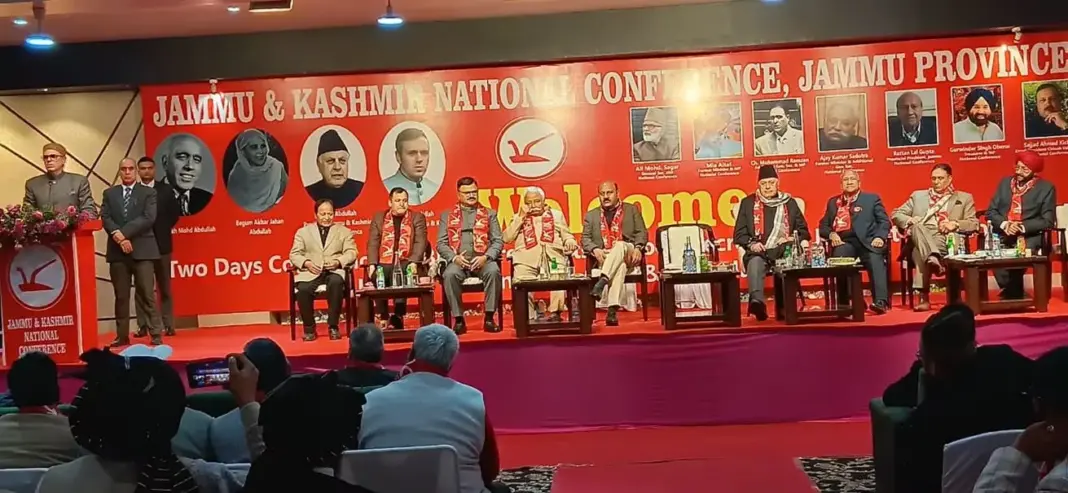
The question of Jammu and Kashmir’s unity has resurfaced yet again—this time against the backdrop of a deeply altered constitutional, political, and emotional landscape. At a National Conference (NC) convention held in Jammu, former Chief Minister and NC vice-president Omar Abdullah delivered a forceful rejection of demands seeking the bifurcation of Jammu and Kashmir. His words were unambiguous: the unity of Jammu and Kashmir is non-negotiable, and any attempt to divide the region—whether on regional, religious, or political lines—would be detrimental, particularly to Jammu itself.
This assertion is not new in the history of Jammu and Kashmir’s politics. Yet, it carries renewed significance in the post-2019 environment, where the abrogation of Article 370, the downgrading of the former state into a Union Territory, and the separation of Ladakh have fundamentally reshaped regional discourse. Omar Abdullah’s statement must therefore be read not merely as a party position, but as a broader socio-political intervention aimed at countering fragmentation narratives that have gained traction in certain quarters of Jammu.
Omar Abdullah’s Core Message: Unity Above All Else
At the heart of Omar Abdullah’s address was a categorical assertion of unity. Invoking the symbolism of the National Conference’s plough-bearing flag, he declared that as long as the party remains politically relevant, “no power on earth will dare attempt to divide the region on regional or religious lines.” This rhetoric is steeped in both history and strategy.
The NC has traditionally positioned itself as a party that transcends regional binaries between Jammu and Kashmir. By invoking the party flag, Omar Abdullah tied the idea of unity not only to constitutional principles but also to the political legacy of Sheikh Abdullah and the foundational narrative of the party. The message was clear: unity is not a negotiable political tactic; it is an ideological cornerstone.
This emphasis on unity also serves a defensive purpose. In recent years, narratives portraying Jammu and Kashmir as irreconcilably divided regions—with competing identities and interests—have gained visibility. Omar Abdullah’s speech sought to push back against this framing, arguing that such divisions are politically manufactured rather than organically rooted in the lived realities of the people.
Rejection of Bifurcation: Why Omar Abdullah Says It Hurts Jammu
One of the most striking aspects of Omar Abdullah’s speech was his insistence that demands for separating Jammu from Kashmir are, in fact, against Jammu’s own interests. This argument directly challenges the rationale put forward by groups advocating bifurcation, who claim that Jammu has been historically neglected under what they describe as Valley-centric governance.
Political Marginalization
According to Abdullah, bifurcation would significantly reduce Jammu’s political leverage at the national level. As part of a larger, more diverse region, Jammu benefits from shared representation, collective bargaining power, and broader visibility. A smaller, isolated administrative unit, he argued, would struggle to command the same attention or influence in New Delhi.
Economic Interdependence
Economically, Jammu and Kashmir function as an interconnected system. Tourism circuits link the plains of Jammu with the valleys of Kashmir. Trade routes, agricultural supply chains, and service economies overlap. Abdullah warned that administrative separation would disrupt these linkages, harming livelihoods rather than improving governance.
Social and Cultural Costs
Beyond economics and politics, Abdullah highlighted the social costs of division. Families, communities, and cultural networks span across regional boundaries. Bifurcation, he suggested, risks hardening identities in ways that deepen mistrust and erode centuries-old coexistence.
Pro-Jammu Governance Record: Countering the Neglect Narrative
A central pillar of Omar Abdullah’s argument was his effort to counter the claim that the National Conference has historically neglected Jammu. To do so, he listed a series of welfare and governance measures implemented during NC-led governments that directly benefited the Jammu region.
Expanded Ration Quotas
Increased ration quotas were cited as a measure that provided tangible relief to economically vulnerable populations in Jammu. These policies, Abdullah argued, were designed to ensure food security across regions, not just in the Valley.
Free Bus Rides for Women
The introduction of free public transport for women was framed as a gender-inclusive policy with significant uptake in Jammu’s urban and semi-urban areas. Abdullah positioned this initiative as evidence of NC’s commitment to social equity beyond regional lines.
Enhanced Pensions
Enhanced pension schemes for senior citizens, widows, and other vulnerable groups were another example used to underline the NC’s welfare-oriented governance approach. According to Abdullah, these measures had a disproportionate positive impact in Jammu, where demographic profiles differ from those of Kashmir.
Free Land for Landslide Victims
In a region prone to natural disasters, particularly in hilly districts of Jammu, the provision of free land to landslide victims was highlighted as a humane and region-sensitive intervention.
Restoration of the Darbar Move
Perhaps the most symbolically charged measure mentioned was the restoration of the historic Darbar Move—the seasonal shifting of the capital between Srinagar and Jammu. For Abdullah, this practice represented administrative inclusivity and recognition of Jammu’s political importance. Its disruption, he implied, had contributed to feelings of alienation that divisive politics now seeks to exploit.
Political Context: Why the Unity Debate Has Returned
The renewed calls for bifurcation cannot be understood in isolation. They are the product of a broader political churn that followed the reorganization of Jammu and Kashmir in 2019. The separation of Ladakh, in particular, set a precedent that altered public expectations and political imaginations.
Post-2019 Realignments
The downgrading of Jammu and Kashmir from a state to a Union Territory created a governance vacuum and intensified competition among regional narratives. In this environment, identity-based demands—whether regional, ethnic, or religious—found fertile ground.
BJP’s Political Strategy
Omar Abdullah’s speech also implicitly addressed the Bharatiya Janata Party’s political strategy in Jammu. By positioning itself as the champion of Jammu’s distinct identity, the BJP has sought to consolidate its base in the region. Abdullah’s rejection of bifurcation is thus also a counter-narrative aimed at exposing what he describes as the long-term risks of such politics.
Comparative Positions: Unity vs Separation
| Issue | Omar Abdullah & National Conference | Pro-Bifurcation Voices in Jammu |
|---|---|---|
| Unity of J&K | Non-negotiable, essential for stability | Seen as outdated and restrictive |
| Impact on Jammu | Separation harms political and economic interests | Separation improves governance and identity |
| Political Strategy | Inclusive, legacy-based regionalism | Identity-driven regional assertion |
| Vision for Future | Shared development and reconciliation | Administrative and political autonomy |
This comparison highlights the fundamentally different visions shaping the debate: one rooted in integration and historical continuity, the other in administrative pragmatism and identity assertion.
Risks of Divisive Politics: A Warning from Experience
Omar Abdullah’s cautionary note—that “narrow and divisive politics has harmed Jammu in the past and will continue to do so”—draws on historical experience. Periods of heightened regional polarization in Jammu and Kashmir have often coincided with political instability, economic stagnation, and social unrest.
Divisive politics, Abdullah argued, tends to promise quick solutions but delivers long-term complications. By fragmenting public opinion, it weakens collective bargaining power and distracts from structural issues such as unemployment, infrastructure gaps, and governance deficits.
The Challenge of Regional Balance
While defending unity, Abdullah also acknowledged an uncomfortable truth: unity cannot be sustained without equitable development. Persistent disparities in infrastructure, employment opportunities, and political representation fuel resentment and provide ammunition to separatist narratives.
For unity to remain meaningful, Abdullah suggested, future governments must prioritize balanced regional development across Jammu, Kashmir, and Ladakh. This requires transparent resource allocation, inclusive policy-making, and sustained political dialogue.
Electoral Implications: Reading the Speech Politically
Beyond ideology, Omar Abdullah’s speech carries clear electoral implications. By adopting a strong pro-Jammu tone while rejecting bifurcation, he is attempting to rebuild the NC’s credibility in a region where the party has struggled electorally in recent years.
The emphasis on welfare measures and symbolic gestures like the Darbar Move is designed to reconnect with voters who feel politically orphaned in the post-2019 order. At the same time, the speech seeks to consolidate the NC’s core base by reaffirming its commitment to unity and constitutional politics.
Symbolism and Legacy: The NC Flag as a Political Statement
The invocation of the NC’s plough-bearing flag was not incidental. Symbols matter deeply in Jammu and Kashmir’s politics, where history and memory play an outsized role. By foregrounding the flag, Abdullah positioned the NC as the custodian of a political tradition that predates contemporary divisions.
This symbolism also serves as a reminder that the unity debate is not merely administrative—it is deeply emotional, tied to identity, dignity, and collective memory.
Conclusion: Unity as a Political Choice, Not a Given
Omar Abdullah’s rejection of bifurcation demands is best understood as both a warning and a proposition. The warning is clear: divisive politics, however tempting in the short term, carries long-term costs for Jammu and Kashmir alike. The proposition is equally clear: unity, while challenging to sustain, offers a more stable and inclusive path forward.
In asserting that the unity of Jammu and Kashmir is non-negotiable, Abdullah has reaffirmed the National Conference’s ideological core while attempting to adapt it to a changed political reality. Whether this message resonates beyond party loyalists remains to be seen. What is certain, however, is that the debate over unity versus division will continue to shape the region’s political discourse in the years to come.
In essence, Omar Abdullah’s speech was not merely about rejecting bifurcation—it was about reclaiming a narrative of shared destiny in a region increasingly tempted by the politics of separation.