‘Sold Kashmir for Power?’ — AIP, Mehbooba Mufti, and the Unfinished Reckoning of the PDP-BJP Alliance
By: Javid Amin | 08 January 2026
More than seven years after the fall of the PDP-BJP coalition government, the political aftershocks of that experiment continue to reverberate across Jammu and Kashmir. The latest trigger is a sharp and unusually personal attack by the Awami Ittehad Party (AIP) on former Chief Minister Mehbooba Mufti, accusing her of having “sold Kashmir for power” and now attempting to justify what they describe as a historic betrayal.
The statement is not merely a routine exchange between rival parties. Instead, it reflects a deeper and unresolved reckoning within Kashmiri politics — one where questions of legitimacy, compromise, and responsibility remain raw, and where the legacy of the 2015–2018 PDP-BJP alliance continues to shape public memory, political credibility, and electoral narratives.
This article unpacks the AIP’s accusations, Mehbooba Mufti’s defence, the historical context of the coalition, public reactions, and why this clash matters in today’s fragmented and deeply polarised political landscape of Jammu and Kashmir.
The AIP’s Charge: “Selling Kashmir for Power”
The Awami Ittehad Party, founded by jailed MP Engineer Rashid, has positioned itself as a sharp critic of what it calls the “failures and compromises” of mainstream Kashmiri parties. In its latest statement targeting Mehbooba Mufti, AIP leaders accused her of:
-
Prioritising political power over Kashmiri aspirations
-
Normalising an alliance with the BJP, a party widely viewed in the Valley as ideologically hostile to Kashmir’s special status
-
Contributing to political alienation that deepened during and after her tenure
According to the AIP, Mehbooba’s recent speeches emphasising dignity, reconciliation, and dialogue amount to an attempt to retrospectively justify decisions that, in their view, caused irreversible damage to public trust.
The party’s language is deliberately confrontational. Words like “betrayal,” “compromise,” and “selling out” are used not just to criticise policy decisions, but to question Mehbooba Mufti’s moral authority to speak about Kashmiri dignity today.
Why Mehbooba Mufti Is Central to This Debate
Mehbooba Mufti is not just another former chief minister. She carries a political legacy shaped by:
-
Her father Mufti Mohammad Sayeed, founder of the PDP
-
The party’s original promise of “healing touch” politics
-
The unprecedented alliance with the BJP
For many Kashmiris, Mehbooba symbolises the moment when mainstream politics crossed an ideological red line by partnering with a party that opposed Article 370 and Jammu & Kashmir’s special constitutional position.
While critics see her as complicit in that shift, Mehbooba has consistently argued that the coalition was a strategic necessity in a fractured electoral mandate — not an ideological surrender.
This fundamental disagreement over interpretation lies at the heart of the current AIP-PDP confrontation.
The PDP-BJP Alliance: How It Began
2014 Verdict and the Coalition Compulsion
The 2014 Jammu and Kashmir Assembly elections produced a deeply divided verdict:
-
The PDP emerged as the largest party in the Valley
-
The BJP swept Jammu
-
No party had a clear majority
In this scenario, the PDP argued that a coalition with the BJP was unavoidable if political stability was to be ensured. The alliance was framed as a “bridge between Jammu and Kashmir” — a partnership meant to reconcile regional and ideological divides.
For the PDP leadership, refusing the alliance would have meant political paralysis. For critics, agreeing to it meant sacrificing core principles.
2016: Mehbooba Mufti Takes Charge
After the death of Mufti Mohammad Sayeed in early 2016, Mehbooba Mufti assumed office as Jammu and Kashmir’s first woman Chief Minister. She inherited not only power but also a deeply sceptical public mood.
Mehbooba defended the continuation of the coalition by arguing that:
-
Engagement was better than confrontation
-
The alliance offered leverage with New Delhi
-
Stability was essential in a conflict-affected region
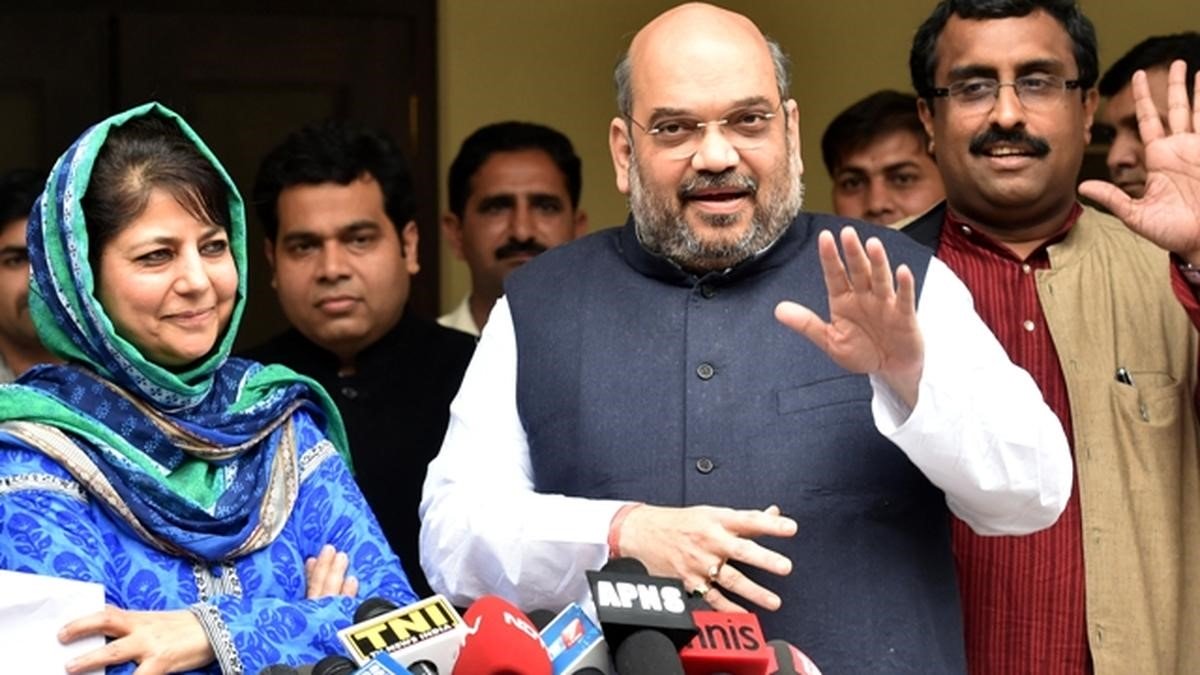
However, the optics were damaging. Images of PDP leaders sharing platforms with BJP leaders fed a perception that the party had drifted away from its original ideological moorings.
Rising Alienation and Growing Discontent (2016–2018)
The period of Mehbooba Mufti’s chief ministership coincided with:
-
Intensifying protests in the Valley
-
Widening youth alienation
-
Increased security operations
-
Political fatigue with mainstream parties
Opposition voices — including the AIP — began explicitly framing the PDP-BJP government as a symbol of betrayal. For them, the coalition represented a surrender to New Delhi’s political narrative rather than a defence of Kashmiri interests.
This perception hardened over time, even as Mehbooba argued that she had limited room to manoeuvre within the coalition.
June 2018: Collapse of the Alliance
In June 2018, the BJP abruptly withdrew support from the PDP-led government, citing security concerns and governance issues. Mehbooba Mufti resigned, and Governor’s Rule was imposed.
For many Kashmiris, this moment confirmed their worst fears:
-
The alliance ended not on PDP’s terms, but BJP’s
-
The promised “bridge” collapsed unilaterally
-
Mainstream leadership appeared powerless
The AIP and similar groups argue that this collapse exposed the asymmetry of power within the coalition — and reinforced the idea that the PDP had miscalculated disastrously.
Post-2019 Politics and the Article 370 Factor
The abrogation of Article 370 in August 2019 fundamentally reshaped Kashmir’s political landscape. For the PDP, already weakened by the coalition’s fallout, the move was devastating.
Mehbooba Mufti repositioned herself as a vocal critic of New Delhi’s decisions, frequently speaking about:
-
Restoration of dignity
-
Democratic rights
-
Political reconciliation
However, opponents like the AIP insist that her post-2019 stance lacks credibility precisely because of her earlier alliance with the BJP.
In their view, the PDP-BJP coalition normalised the political pathway that eventually culminated in the abrogation of special status.
Mehbooba Mufti’s Defence: Pragmatism, Not Betrayal
Mehbooba Mufti has repeatedly rejected the “betrayal” narrative. Her defence rests on three key arguments:
-
Coalition as Compulsion
She argues the alliance was dictated by electoral arithmetic, not ideological alignment. -
Damage Control Logic
According to her, engagement with the BJP allowed the PDP to soften policies and act as a moderating influence. -
Hindsight Bias
Mehbooba maintains that critics judge the coalition with the benefit of hindsight, ignoring the constraints of that moment.
Her recent calls for reconciliation and dignity are positioned as lessons learned, not denials of past complexity.
Public Reaction: Polarised and Unresolved
Public opinion in Kashmir remains sharply divided:
| Stakeholder | Position | Tone |
|---|---|---|
| AIP | Mehbooba sold Kashmir for power, now justifies betrayal | Aggressive, accusatory |
| Mehbooba Mufti / PDP | Coalition was pragmatic, reconciliation still possible | Defensive, conciliatory |
| Public | Split between anger over alliance and sympathy for constrained choices | Polarised |
For many younger voters, the PDP-BJP episode symbolises the failure of mainstream politics altogether. For others, it represents a tragic but unavoidable compromise in a hostile political environment.
Why the AIP Is Reviving This Debate Now
The AIP’s renewed attack is strategic. By foregrounding “betrayal,” the party seeks to:
-
Undermine Mehbooba Mufti’s moral authority
-
Position itself as uncompromised and principled
-
Capture public frustration with traditional parties
This rhetoric resonates particularly with constituencies disillusioned by decades of conflict, broken promises, and political reversals.
Why This Clash Matters Today
The AIP-Mehbooba confrontation is not about the past alone. It reflects unresolved questions that continue to shape Kashmir’s politics:
-
Can compromise ever be justified in conflict zones?
-
Does pragmatism excuse ideological reversal?
-
Who bears responsibility when political experiments fail?
Until these questions find consensus — or at least closure — Kashmir’s political discourse is likely to remain cyclical, emotionally charged, and deeply divided.
Conclusion: A Legacy Still on Trial
The PDP-BJP alliance may have ended in 2018, but its moral and political trial continues. For the AIP, Mehbooba Mufti embodies a moment of surrender. For Mehbooba, that moment represents constrained leadership in an unforgiving system.
As Jammu and Kashmir navigates a future marked by uncertainty, new political actors, and shifting power equations, the unresolved legacy of that coalition serves as a reminder: in Kashmir, political decisions are never buried — they are remembered, reinterpreted, and relentlessly contested.