Kashmir’s Food Safety Credibility Crumbles: 119 Dead Chickens With a ‘Clean’ Certificate Spark Outrage
By: Javid Amin | 08 December 2025
A Disturbing Discovery at Dawn
The story begins on an ordinary winter morning in Srinagar — the kind where life in Kashmir moves slightly slower, bundled under layers of wool and cold breath. But what unfolded at Aluchi Bagh Bund was anything but ordinary. As workers and volunteers opened a truck carrying 2,700 poultry birds, they found a horrifying sight:
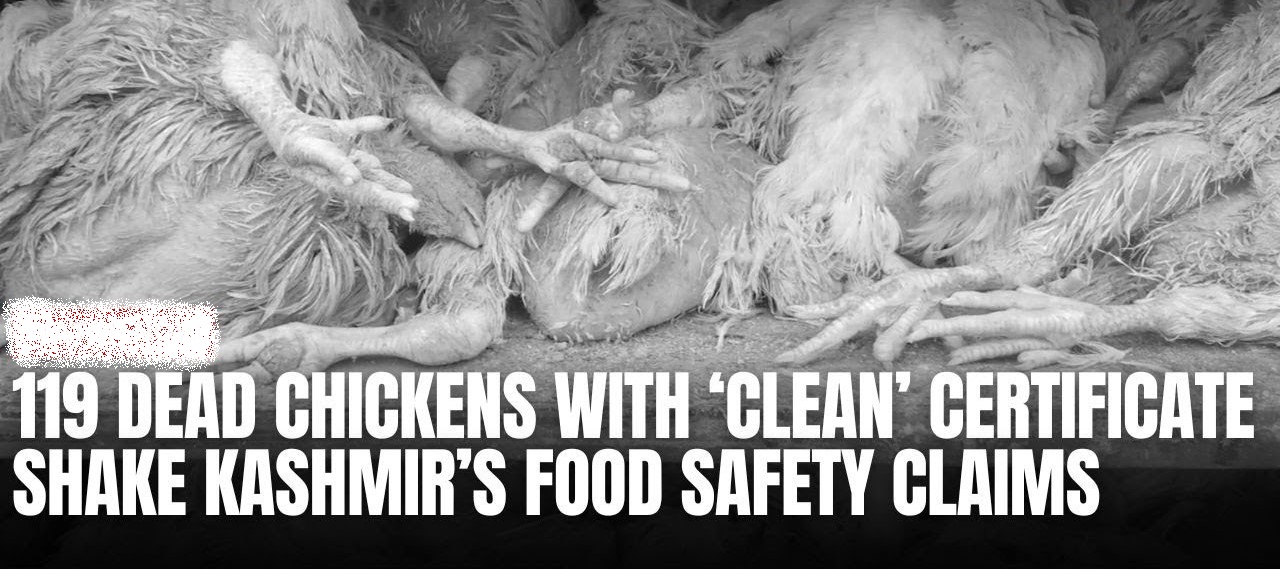
119 chickens lay dead, stiff, and rotting.
Yet the shock didn’t end there.
Just hours earlier, the same consignment had received a “clean and healthy” certificate from officials of the
Animal Husbandry Department
at the Zig-Lower Munda Check Post in Qazigund. According to the paperwork, all birds were alive, healthy, and fit for sale.
The contradictions were glaring. The implications — far worse.
Civil society groups, including volunteers from
Animal Rescue Kashmir,
were among the first to raise the alarm. Videos and photographs circulated, triggering a wave of public anger and renewed scrutiny on Kashmir’s already shaky food safety monitoring.
This incident didn’t occur in isolation. It follows multiple seizures of rotten meat, unlabelled poultry, and repeated controversies involving systemic failures in Kashmir’s livestock chain.
Together, they paint one troubling picture:
Kashmir’s food safety system is dangerously fragile — and the public is paying the price.
The Timeline — What Exactly Happened?
01. The Check Post Clearance
According to records, the truck passed through the official veterinary checkpoint where veterinarians from the
Animal Husbandry Department
examined the consignment.
They issued a clean chit, declaring that:
-
All 2,700 birds were alive
-
The poultry showed no signs of disease
-
The consignment was safe for transport and sale
The clearance raised two immediate questions:
-
How did 119 birds die just hours after this “healthy” certification?
-
Were the birds already dead and missed during inspection?
Both possibilities are alarming.
02. Arrival in Srinagar: The Shocking Discovery
When the truck reached Aluchi Bagh Bund in Srinagar, it was unloaded by local workers. Activists and volunteers who were present at the unloading site noticed the foul smell first — a telltale sign of death and decay.
Upon closer inspection, they counted:
119 dead chickens, many already stiff and cold
Some showing signs consistent with prolonged stress or suffocation
Others possibly dead for hours before arrival
Videos recorded at the site quickly went viral.
Officials initially downplayed the situation, calling it “normal mortality.” But the numbers tell a different story.
Normal poultry transport mortality: 0.1–0.5%
Mortality in this consignment: ~4.4%
Nearly 10 times higher than industry norms.
03. Official Explanation: “Stress, Cold, Delays…”
Officials attributed the deaths to:
-
Starvation
-
Transport exhaustion
-
Extreme cold (hypothermia)
-
Delays caused by traffic congestion
While these are legitimate causes of poultry mortality, they raise the counter-question:
If conditions were bad enough to kill 119 birds, why was the consignment certified healthy?
This contradiction is central to the scandal.
The Larger Problem — A System Designed to Fail?
01. Loopholes in Kashmir’s Food Safety Chain
Kashmir relies heavily on imports of poultry from outside the region, especially Punjab. Each night, dozens of trucks cross into the Valley loaded with thousands of birds.
Ideally, every truck undergoes:
-
Health inspection
-
Verification of mortality
-
Issue of transport clearance
-
Compliance checks on hygiene & conditions
But ground reports reveal a different story.
Inspections are often hurried or superficial
Mortality is rarely checked cage-by-cage
Transport conditions are almost never regulated
Follow-up checks in city markets are minimal
The Zig-Lower Munda post — the point of clearance in this incident — handles a massive volume of traffic, making thorough inspections challenging.
But the lack of capacity cannot justify the consequences.
02. A History of Rotten Meat and Regulatory Negligence
The dead-chicken incident comes at a time when Kashmir is already reeling from multiple food safety scandals.
Recent cases include:
-
Seizure of rotten and unlabelled meat
-
Detection of expired poultry stock in Srinagar markets
-
Concerns about illegal slaughterhouses
-
Reports of uninspected poultry entering the Valley at night
-
Cases of dead-on-arrival poultry sold to consumers
Activists have repeatedly argued that inspections are inconsistent and often influenced by:
-
Lack of manpower
-
Administrative bottlenecks
-
Possible collusion
-
Pressure from poultry cartels
03. The Trust Deficit: When Institutions Lose Credibility
For consumers, the recurring incidents have triggered fear and anger.
When officials issue a “clean” certificate, the public expects it to mean something.
When activists find 119 dead birds just hours later, the certificate becomes a symbol of failure.
This is more than a food safety issue — it’s a crisis of faith.
When trust in monitoring institutions erodes, all other sectors suffer:
-
Market confidence weakens
-
Local businesses take a hit
-
Demand for poultry drops
-
Prices destabilize
-
Livelihoods of thousands get affected
Trust, once broken, is difficult to rebuild.
Voices From the Ground — What Stakeholders Say
| Stakeholder | Position | Implications |
|---|---|---|
| Animal Husbandry Department | “All birds were alive at the check post.” | Suggests inspection may have been superficial or incomplete |
| Animal Rescue Kashmir | “We found 119 dead birds during unloading.” | Highlights the crucial role of civil society |
| Officials (post-incident) | Blame stress, starvation, hypothermia | Indicates lack of preventive measures |
| Consumers | Express shock, anger, distrust | Food safety crisis deepens |
01. What the Poultry Transporters Say
Transporters argue that:
-
Long delays in winter traffic are common
-
Extreme cold kills weak birds
-
Ventilation systems in many trucks are outdated
-
Roadside checks cause additional delays
While some of these arguments hold weight, they don’t justify 100+ deaths.
02. What Meat Sellers Say
Retail poultry vendors in Srinagar say the issue is bigger than one truck.
A vendor at Bemina remarked:
“Sometimes the birds come weak, stressed, or half-dead. We have complained many times. No one listens.”
Their voices highlight the systemic nature of the problem.
03. What Consumers Feel
Consumer distrust has skyrocketed.
A shopper from Lal Chowk summarized the public mood:
“First the rotten meat scandal, now dead chickens with a clean certificate?
What exactly are we eating? Who is protecting us?”
This sentiment reflects widespread frustration.
The Public Health Dimension — A Disaster Waiting to Happen
01. Can Dead Poultry Reach the Food Chain?
Yes — and that’s the biggest danger.
Dead birds, especially those that die during transport, decompose quickly and can be infected with:
-
Salmonella
-
E. coli
-
Campylobacter
-
Toxins from rotting tissue
If such poultry sneaks into the supply chain, it can cause:
-
Food poisoning
-
Severe gastrointestinal infections
-
Systemic health complications
-
Even outbreaks in worst cases
02. Kashmir’s Weak Mechanisms for Disposal of Dead Birds
There is no strict, supervised mechanism for:
-
Collecting
-
Transporting
-
Destroying
-
Documenting
dead-on-arrival birds.
This makes it easier for some sellers to illegally mix them with fresh stock — a practice reported repeatedly across India.
Why the Clean Certificate Matters — And Why It Failed
The “clean” certificate from the Animal Husbandry unit is supposed to act as a legal guarantee.
It ensures the consignment:
-
Contains only live, healthy birds
-
Has no disease
-
Has acceptable mortality
-
Is safe for consumption
When this certificate is wrong, incomplete, or issued casually, it creates a massive chain of risks.
This incident shows three possible failures:
-
Negligent inspection
-
Inaccurate reporting
-
Possible omission or manipulation
All three represent structural weaknesses that require urgent reform.
Kashmir’s Poultry Economy — The Unsung Victim
Kashmir consumes millions of poultry birds every month, especially during winters when other livestock products decline. The sector involves:
-
Farmers
-
Retail sellers
-
Transporters
-
Wholesalers
-
Cold-chain operators
-
Hatcheries
-
Veterinarians
Any scandal disrupts livelihoods instantly.
After this incident:
-
Retail demand dropped for days
-
Consumers shifted to fish, mutton, or vegetarian options
-
Sellers faced losses
-
Truckers reported harassment at checkpoints
-
The poultry lobby pressed for damage control
The economic ripple effect is real.
What Needs to Be Fixed — A Blueprint for Reform
01. Strengthening Check Post Protocols
Inspection must involve:
-
Random cage-level mortality checks
-
Mandatory digital documentation
-
Photograph/video evidence
-
Real-time data upload
-
Penalties for faulty certification
02. Ensuring Humane Transport Conditions
Trucks must be fitted with:
-
Proper ventilation
-
Winter-proofing
-
Feed/water systems
-
Veterinary emergency kits
-
Real-time GPS tracking
03. Independent Oversight
Civil society groups and independent veterinarians should periodically monitor:
-
Mortality patterns
-
Hygiene conditions
-
Compliance with regulations
04. Transparency Through Public Dashboards
Authorities should publish:
-
Number of trucks cleared
-
Mortality levels
-
Seizures made
-
Violations detected
Transparency builds trust.
05. Stringent Penalties for Violations
Penalties must apply to:
-
Transporters mixing dead birds with live ones
-
Officials issuing false certificates
-
Retailers selling dead poultry
-
Wholesalers hiding mortality
Conclusion — More Than a Scandal, A Warning
The discovery of 119 dead chickens in a consignment certified clean just hours earlier is not merely an administrative mistake. It is a flashing red signal for a system stretched thin, under-regulated, and lacking accountability.
At the heart of this crisis are three fundamental truths:
1. Food safety is not optional — it is a public right.
2. Institutions must be transparent, vigilant, and trustworthy.
3. If the current system is not fixed, the next scandal might cost lives.
Kashmir deserves better.
Consumers deserve better.
And the credibility of food safety bodies must be rebuilt — not through statements, but through action.