Biting Cold Wave Grips Kashmir in December 2025 | Sub-Zero Temps, Power Crisis & Frosty Daily Life
By: Javid Amin | 10 December 2025
Kashmir Under a Winter Hammer
As December 2025 advances, the snow-clad mountains and tranquil valleys of Kashmir are witnessing another, more ruthless manifestation of winter: a biting cold wave accompanied by sub-zero temperatures across much of the region. In towns, villages and tourist hotspots alike, thermometers have fallen sharply — bringing frost, snow, and a host of new challenges for residents already reeling from a protracted dry spell.
This is not merely cold; it is a winter season arriving early, intensifying quickly, and layering old vulnerabilities with fresh ones: power deficits, health pressures, frozen pipes, disrupted daily routine, and growing uncertainty.
In this article, we examine the cold wave’s scope, its impacts on people and infrastructure, how it intersects with water-stress and ecological degradation, and what it may mean for Kashmir before and during the harsh 40-day winter period known as Chillai Kalan.
The Chilling Numbers: Where Kashmir Stands
Recent data from meteorological sources and local weather-watchers show that night temperatures across major parts of Kashmir Valley have plunged well below freezing — often dipping to the coldest levels of the season so far.
-
According to official records, Shopian district registered a temperature of –4.2 °C, making it among the coldest places in the Valley recently.
-
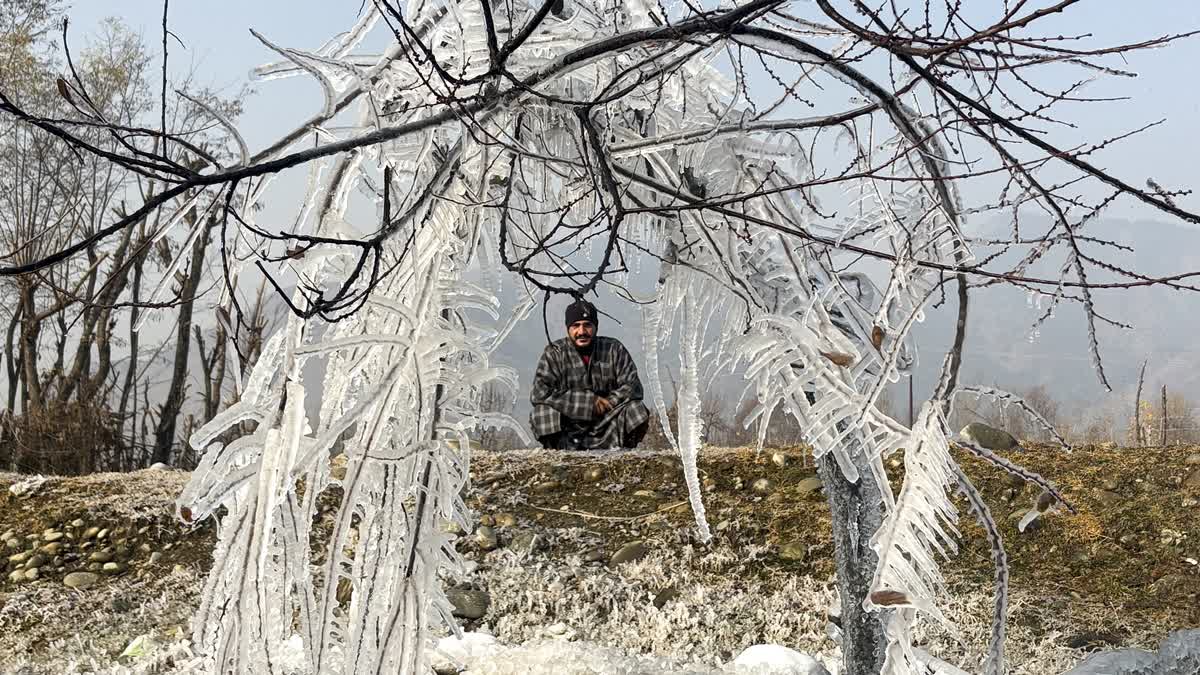
In Srinagar, the winter capital region, night temperatures dropped to around –2.4 °C to –2.5 °C, prompting widespread frost and icy dawns.
-
Hill and tourist areas like Gulmarg recorded lows around –2.5 °C, while snow — first of the season — appeared in higher reaches, signaling arrival of full-blown winter.
-
Other areas such as Pahalgam were also under freezing conditions, amplifying the difficulties for residents and visitors alike.
Weather analysts attribute this sharp drop in temperature to a combination of persistent dry weather and clear night skies, which allow rapid heat loss from the ground and intensify radiative cooling — making nights crueler than usual.
Impact on Daily Life: Frost, Frozen Pipes and Disrupted Routines
For many Kashmiris, the cold isn’t simply an inconvenience — it is a disruption of basic routines. Mornings begin with frost-covered rooftops, frozen taps, icy vehicles, and chilly air that bites deeply even indoors.
Frozen Infrastructure & Disrupted Water Supply
-
Reports from residents in Shopian describe “frozen taps overnight,” forcing households to melt snow for drinking water.
-
Roads, especially in higher reaches and mountain passes, are becoming slippery with frost and thaw-freeze cycles — a challenge for commuters, transporters and emergency services alike.
Heating Woes Amid Power Crisis
Perhaps the most acute hardship emerging is the region’s power shortage. The local authorities estimate a shortfall of nearly 500 MW against demand, triggering unscheduled power cuts both in rural and urban zones.
As a result:
-
Modern heating solutions like electric heaters, water heaters, and hot-water systems are proving unreliable.
-
Families are reverting to traditional methods — lighting wood stoves, using clay firepots (kangris), bundling up in thick pherans, and relying on hot beverages like kahwa and nun chai to ward off the cold.
-
Guesthouses, lodges and hotels — especially in tourist hotspots such as Gulmarg — report difficulties maintaining heating and hot-water services, hurting business at a time when winter tourism usually begins.
Health and Hygiene Concerns
With plunging temperatures, frost and smoke from wood-fires, local medical facilities report a spike in flu-like illnesses, chest ailments and respiratory problems. Several districts have seen increased hospital visits as dry air, cold nights and lower air quality take their toll.
Additionally, limited warm water supply, frozen taps, and interrupted electricity make hygiene and sanitation a challenge — particularly for vulnerable populations, elderly residents, and children.
Tourism, Mobility & Economic Ripples
Winter in Kashmir has often meant snowfall, skiing, cozy guesthouses and snow-clad landscapes — a draw for tourists and a boost for local economies. This year, however, the early cold wave presents a mix of opportunity and risk.
-
On one hand, light snow and sub-zero nights in resorts like Gulmarg and in higher hills are beginning to attract tourists seeking early winter beauty.
-
On the other hand, icy roads, unpredictable snowfall, power outages, and inconsistent heating — especially in budget lodging — are adding uncertainty for travellers. Many guesthouse owners admit guests are delaying bookings or seeking assurance on heating and hot water availability.
-
Local transporters, taxi-operators and logistics workers warn about increasing risk on mountain roads: black-ice, frozen surfaces, and limited daylight make travel riskier. Some suggest goods and fuel supply might slow or see disruptions.
Thus, the cold wave offers a precarious balancing act: winter’s scenic allure weighed against harsh realities of infrastructure, safety, and comfort.
Power Deficit: The Elephant in Kashmir’s Winter Room
The 500 MW deficit in power supply looms as one of the most critical structural challenges this winter.
Causes: Hydropower Drop, Dry Spell and Increased Demand
-
The bulk of Kashmir’s electricity is hydro-electric, which depends on sufficient river and stream flows. The ongoing dry spell — part of a prolonged rainfall deficit — has cut water discharge, causing generation to slump dramatically.
-
Combined with increased demand from heating needs, this has stretched the supply system beyond capacity. Even with external power imports, shortages persist.
-
Transmission losses and infrastructural inefficiencies add another layer of challenge, limiting effective distribution even further.
Consequences — Households, Businesses and Tourism
-
Many households report only a few “power windows” each day, forcing reliance on traditional heating and improvisation.
-
Small businesses, shops, guesthouses and lodges face operational difficulties: inconsistent heating, inability to provide hot water, reduced evening footfall, higher fuel or firewood consumption — reducing profitability.
-
Tourism — a key winter-economy engine for Kashmir — is wavering. While snow lends allure, the discomfort and unpredictability associated with power cuts, heating failures, and icy logistics are deterring some travellers.
Early Chillai-Kalan: Winter’s Harshest Phase Comes Sooner
The Valley is bracing for the onset of Chillai Kalan, the 40-day period of Kashmir’s harshest winter, which traditionally starts around 21 December.
This year, many of Chillai Kalan’s features — deep freeze, widespread frost, sub-zero nights, snow-cover in higher belts — have arrived early. Factors working in tandem: a prolonged dry spell leaving the ground bare, clear skies accelerating night cooling, reduced moisture in air and land, and a heat-deficit building up over weeks.
If this early onset persists or worsens, the winter could turn harsher than usual — challenging the resilience of people, infrastructure, and nature alike.
Beyond the Cold: Climate Signals & Ecological Concerns
While freezing temperatures dominate headlines today, experts urge caution: the cold wave must also be viewed in the context of deeper, longer-term environmental stress already affecting Kashmir.
-
The region has recently seen dramatic water stress, rainfall deficits, shrinking snow and ice feed — all weakening the natural buffer of glaciers, springs, and watersheds that sustain rivers, agriculture, and ecology.
-
The on-going cold wave, arriving amid dry conditions, may exacerbate freeze-thaw cycles, stress soil, and disturb fragile ecosystems; flora and fauna — already stressed by changing seasons — could suffer further.
-
In a region where water, snowmelt, and ecological balance have historically defined life — the emergence of such extremes (dry spells followed by intense cold) may reflect shifting climate patterns.
Thus, the current winter is not just a seasonal phase — it is a warning flag, an indicator of deeper climate-driven transformations.
Human Stories: Lives Under Frost, Adaptation, Resilience
Amid statistics and forecasts, real stories from the ground reflect the cold wave’s human impact:
-
In Shopian, residents described early mornings stepping out to frozen water taps — forced to rely on melted snow for basic needs. “Water had frozen overnight,” one local said.
-
In tourist lodges around Gulmarg, proprietors admitted they were stocking up on firewood and blankets — bracing for power outages and a winter season that may stretch longer than usual.
-
For transporters delivering essentials — food, fuel, medical supplies — icy roads, frozen passes and short daylight mean increased danger and slower deliveries, often at higher costs.
-
Many households have reverted to traditional winter gear and methods: pherans (traditional woollen cloaks), kangris (clay firepots), wood-stoves — a sign of resilience, but also of resource constraint due to power scarcity.
These stories remind us that behind every number is a human life — one negotiating survival, comfort, warmth, and dignity in harsh conditions.
What Needs Immediate Attention — Policy, Preparedness & Community Action
Given the dual crisis of cold and power shortage, urgent interventions are essential. Key areas that demand attention:
1. Stabilise Power Supply & Provide Alternative Heating Support
-
Local authorities should prioritise ensuring minimum uninterrupted electricity for essential services: hospitals, water pumps, street-lighting, heating in public shelters.
-
Subsidised or community-level distribution of traditional heating supplies (firewood, kangris, blankets) could provide relief during outages.
-
Distribution of insulated containers, provision of thermal clothing subsidies, and public-awareness campaigns could help mitigate health risks.
2. Weather Forecasting, Early Warning & Public Advisory
-
Meteorological departments and disaster-management agencies must issue frequent forecasts, frost warnings, and guidance for snow, ice, and cold-related hazards.
-
Public advisories on safe heating practices (to avoid fire or smoke inhalation), frost-related infrastructure precautions (e.g., insulating pipes), and health guidance (keeping warm, proper hydration, avoiding smoke inhalation) should be issued region-wide.
3. Long-Term Climate & Water Management Strategy
-
The current cold wave — while acute — should also prompt renewed focus on long-term water resource management, glacial monitoring, and ecological conservation. Declining snow and ice, water deficits, and ecological stress signal increasing climate vulnerability.
-
Restoration of natural water bodies, support for watershed conservation, reforestation, and sustainable tourism (that doesn’t overburden fragile ecosystems) must be part of winter-resilience planning.
-
Local governments, civil society, and communities should collaborate on adaptation strategies: renewable energy (solar, biomass heaters), efficient heating solutions, water-storage infrastructure, and resilient housing insulation.
4. Support for Vulnerable Populations & Economic Relief for Affected Sectors
-
Special attention must be given to vulnerable populations: elderly, children, those with respiratory or chronic illnesses — ensuring access to healthcare, warming shelters, clean water, adequate food and warm clothing.
-
Tourism-dependent businesses – guesthouses, small lodges, transporters, local vendors – may need targeted support (fuel or firewood subsidies, temporary heating grants, low-interest loans) to survive uncertain winters.
-
Agricultural and horticultural communities, already hit by erratic precipitation and water stress, need advisories, support in frost protection, and measures for long-term adaptation (crop diversification, frost-resistant horticulture, greenhouse options).
Why This Matters: A Crossroads for Kashmir’s Winter, People and Environment
The current cold wave in Kashmir, especially arriving so soon and with sharp severity, is not just another winter — it is a signal. A signal of fragile systems under stress: power infrastructure vulnerable to hydrological variation; water scarcity from deficient snow and rainfall; ecological balances disturbed; livelihoods exposed; and communities struggling to adapt.
As the region moves into Chillai Kalan — the harshest phase of winter — what happens in the next few weeks could define not just the comfort of residents, but the resilience of Kashmir’s environment, economy, and social fabric.
If managed properly, this could be a moment of adaptation, resilience-building, and systemic reform. But if ignored — the risks are real: deepening hardship, environmental degradation, increased health crisis, and loss of life or livelihood.
Conclusion — Kashmir’s Cold Reality: Resilience Amid Fragility
Kashmir’s 2025 winter has descended early and harshly. Sub-zero nights, frozen pipes, powerless homes, bitter frost, and slushy slopes are altering daily life and testing patience — and endurance.
Yet, beyond the struggle, there is resilience: people returning to age-old ways, communities improvising heating, lodges adapting, transporters navigating icy paths, civil society raising awareness, and silence broken by voices of warning and concern.
But resilience cannot substitute for infrastructure. Comfort cannot replace planning. The cold wave brings into sharper focus what many environmental and climate experts have warned: Kashmir — for decades reliant on glacial melt, natural snowfall, and seasonal water cycles — is entering a phase of ecological, climatic and social uncertainty.
Whether the valley weathers it with grace or suffers a lasting blow depends on what happens next: the speed of response, the strength of governance, the unity of communities, and the seriousness with which long-term environmental and infrastructural challenges are addressed.
For now, Kashmir shivers — but beneath its frost, the quiet pulse of hope, adaptation and survival endures.