TADA Court Frees Accused in 1989 Rubaiya Sayeed Kidnapping: Why CBI’s Arrest of Shafat Ahmad Shangloo Fell Through
By: Javid Amin | 02 November 2025
A Surprise Turn in a 36-Year-Old Case
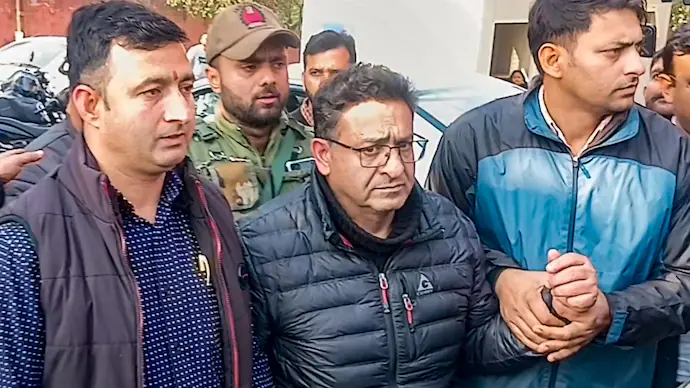
On 2 December 2025, a special TADA court in Jammu delivered a verdict that sent shockwaves through ongoing investigations into one of Kashmir’s most infamous episodes — the 1989 abduction of Rubaiya Sayeed, daughter of then-Union Home Minister Mufti Mohammad Sayeed. The court rejected the custodial remand request of Shafat Ahmad Shangloo, arrested just a day earlier, citing a lack of incriminating material in the central agency’s own chargesheet. The decision led to his immediate release, casting serious doubts on the legitimacy and efficacy of the long-pending investigation.
The dramatic reversal has revived painful memories and raised urgent questions — about justice delayed, investigative standards, evidence standards, and whether three-and-a-half decades of pursuit will now yield little more than a metaphorical shrug.
Background: The 1989 Kidnapping, JKLF, and Why the Case Still Matters
-
On 8 December 1989, militants belonging to the now-banned Jammu and Kashmir Liberation Front (JKLF) abducted Rubaiya Sayeed — then a 23-year-old medical intern in Srinagar.
-
The abduction caused outrage, triggered political tremors, and eventually led to the release of five jailed militants in exchange for her freedom — a deal widely considered a turning point in Kashmir’s militancy saga.
-
Over the years, the case became emblematic — haunting J&K’s collective memory, tied to the onset of insurgency and political upheaval.
-
In 2021, after renewed judicial scrutiny, the central agency filed a fresh chargesheet and framed charges against key accused.
More than three decades later, the arrest of Shangloo — alleged to be a JKLF associate and close aide of top militant leadership — had been touted as a major breakthrough. The CBI claimed he carried a reward of ₹10 lakh and had been absconding.
But the haste with which this hope turned to release raises bigger questions — not only about this individual arrest, but about the overall strength and direction of the investigation.
What the Court Found — And Why CBI’s Custody Plea Failed
When presented with the custody request, the TADA-designated court (Third Additional District & Sessions Judge, Jammu) carefully examined the CBI’s submissions and concluded:
-
No mention of Shangloo in the official charge-sheet or its list of accused.
-
No incriminating material linking him to the abduction, attack or conspiracy was shown. The court noted that the investigating officer himself had earlier extended “benefit of doubt” under Section 169 of CrPC to Shangloo.
-
No grounds for further remand or questioning, as there was nothing new warranting prolonged custody.
Consequently, the court rejected the CBI’s plea for judicial remand and ordered his immediate release — a verdict widely described in media as a “major setback” to the central agency.
In his first public reaction after release, Shangloo insisted on his innocence, stating he was never absconding and had lived in Srinagar; he described the court order as “a victory of truth.”
Why the Release Matters: Legal, Investigative & Social Implications
1. Underlines the Importance of Evidence, Not Hype
The court’s decision reaffirmed a fundamental principle: arrests — even in politically or historically charged cases — must rest on credible, documented evidence. The absence of formal mention in the charge sheet and lack of concrete material was enough to demolish the CBI’s justifications.
2. Major Blow to CBI’s Credibility in This Case
Just a day earlier, the agency heralded Shangloo’s arrest as a decisive break in a 36-year-old case, waving reward notices and associating him with top JKLF leadership. The rapid walk-out from court — without custody — raises serious questions about diligence, investigational standards, and whether the arrest was more about optics than evidence.
3. Justice Delayed — But Not Denied: The Problem with 35-Year-Old Cases
When cases linger for decades, evidence degrades, witnesses fade, records go missing. Arresting alleged conspirators after 35+ years demands extraordinary caution. The ruling suggests courts remain gatekeepers against revived but unsubstantiated claims.
4. Impact on Victims, Witnesses & Public Memory
For many, the 1989 abduction remains a live wound. Every accused, every arrest, carries emotional weight. The release may deepen mistrust among victims and survivors towards the investigative and judicial process. It may also discourage future revivals of old cases — not because they are weak, but because proof standards have become prohibitively high.
5. Wider Challenge: Jammu & Kashmir’s Long-Pending Cases and Evidence Gaps
The case now spotlights a pattern: many terror-related and politically sensitive cases from the late 1980s–1990s are being revived after decades. But memory fades, documents vanish, and the fragile nature of evidence presents serious challenges for justice — or even closure.
What Happens Next: Key Questions & Possible Scenarios
Will CBI Appeal or File Fresh Charges?
With remand denied and the court citing a lack of evidence, the logical step is either to appeal the decision or build a stronger case. Will CBI have new witnesses, forensic material, or intelligence to substantiate the claim? That remains to be seen.
Does This Undermine Public Confidence in 1980s–90s Cases?
For victims and families, the release may reopen wounds — highlighting the fragile nature of justice after decades. The question now is: how many of these old cases can realistically expect closure?
What Does It Say About Investigation Standards in Terror-Age Cases?
It underlines that even in high-profile cases, investigators must avoid haste and ensure thorough documentation. The decision may prompt a re-evaluation of long-drawn investigations across militancy-era cases.
Will This Influence Future Policy on Cold Cases?
Policymakers and law-enforcement agencies may be forced to reconsider how decades-old cases are revisited, what standards of evidence apply, and whether alternate justice mechanisms (truth commissions, historical inquiry, witness protection) are more appropriate than criminal trials.
Conclusion: A Court Verdict That Resonates Beyond One Man’s Freedom
The release of Shafat Ahmad Shangloo is more than just a procedural development in a single case — it holds symbolic and practical significance for Jammu & Kashmir’s criminal justice framework, for the credibility of investigative agencies, and for how society confronts decades-old trauma.
In a case that once symbolized the chilling onset of militancy and political instability, the court’s decision underscores two critical truths:
-
Even after 36 years, justice must be rooted in evidence, not conjecture.
-
The passage of time does not grant investigators a licence to arrest first and justify later.
For those who hope the case still delivers closure — victims, survivors, families — the ruling is a bitter reminder of how long the road to justice can be, and how uncertain it remains.
But for the rule of law, the verdict is a reaffirmation: in democracy, accusations count for little without proof — even for the gravest crimes of the past.