Bring Them Home — Mehbooba Mufti’s HC Plea to Transfer Kashmiri Detainees to Valley Jails
By: Javid Amin | 10 December 2025
A Plea for Humanity and Justice
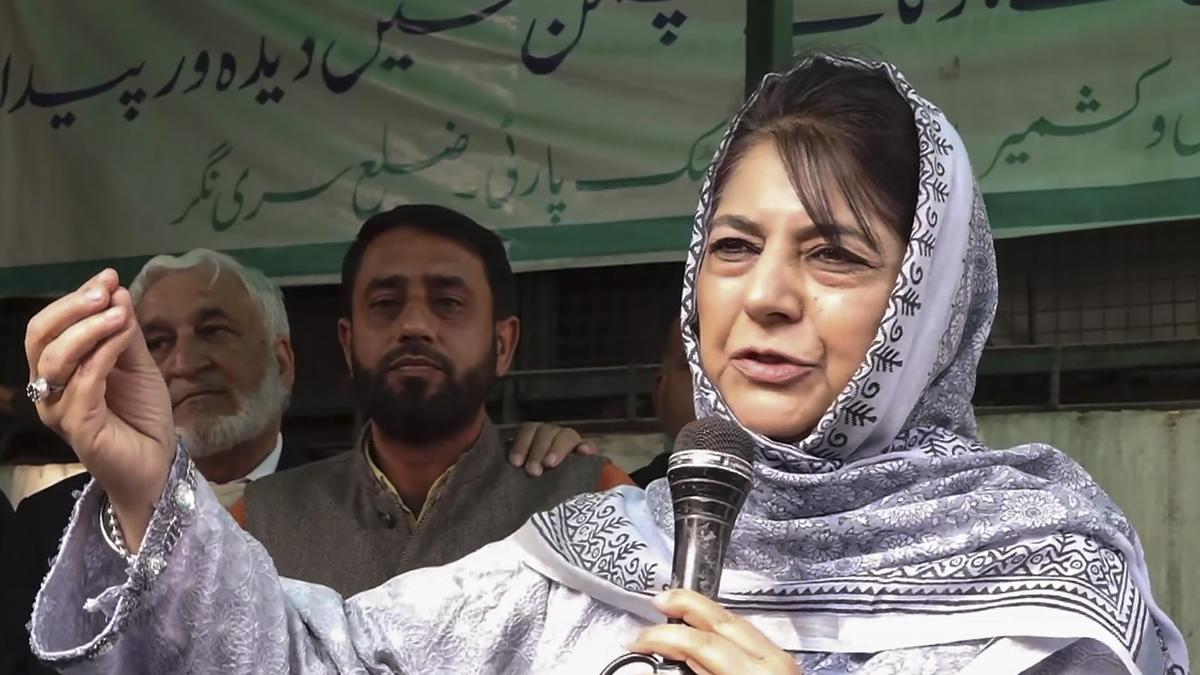
When a mother voluntarily walks 270 kilometres from Kashmir to Jammu to visit her imprisoned son, the journey is heartbreak made visible. Such was the moment shared by Mehbooba Mufti on social media — a powerful visual of human suffering that accompanied her latest plea before the High Court. Her petition calls for the repatriation of Kashmiri detainees — many undertrials — currently lodged in jails outside Jammu & Kashmir back to local valley prisons.
The appeal goes beyond a legal argument: it is a call for dignity, fairness, and recognition of families’ rights to access justice under humane conditions. As the court now considers her PIL (Public Interest Litigation), the decision could shape the treatment of undertrial prisoners across the region — balancing security concerns with constitutional, humanitarian imperatives.
What Mehbooba’s Petition Seeks: Legal, Humanitarian & Systemic Relief
Immediate Demands
-
The petition asks for transfer of all undertrial prisoners belonging to Jammu & Kashmir, lodged in jails outside the UT (including places like Jammu’s Kot Bhalwal, prisons in other states), back to jails within J&K.
-
It demands issuance of writ of mandamus under Article 226 of the Constitution to direct the Union government, the J&K Home Department, and relevant law-enforcement agencies to execute repatriation without delay, unless there are case-specific and written reasons justifying continued out-of-UT detention.
Rights, Access and Dignity
-
The plea argues that housing undertrials far from their homes infringes on fundamental rights under Article 14 (Equality before law) and Article 21 (Right to life and personal liberty / dignity) of the Indian Constitution.
-
It highlights the impact on fair trial rights — access to counsel, ability to meet legal advisors and review evidence, attend court hearings — which become severely constrained when prisoners are at great distance.
-
The petition calls for a standardised protocol ensuring weekly family visits (or at least regular visits), unhindered lawyer-client meetings, prompt production of prisoners in court, and dedicated travel/accommodation support (for at least one family member per month) for as long as the prisoner is outside J&K.
Oversight, Transparency and Periodic Review
-
For cases where external detention continues (e.g. “security cases”), the petition demands quarterly judicial review, with prison authorities required to provide written justifications for continued out-of-UT lodging.
-
It seeks the creation of a monitoring and grievance-redressal committee to audit family-visit logs, lawyer-client meetings, production in court, and ensure compliance with rights and standards — effectively bringing oversight and accountability.
The Human Cost: What Families and Undertrials Endure
Emotional Strain, Financial Hardship, and Isolation
According to Mehbooba Mufti, thousands of Kashmiris have been arrested since 2019 and many remain undertrial — detained in prisons far away from their hometowns.
For their families, this distance inflicts deep, recurring trauma. Many simply cannot afford the frequent travel costs. Some have reportedly sold land, jewellery, or property to fund legal expenses and travel.
Some families remain unaware of their loved ones’ exact location, making visits nearly impossible. Others struggle to coordinate legal representation, since remote incarceration hinders regular meetings between undertrials and their lawyers — severely affecting their right to preparatory legal support.
In her PIL and public statements, Mufti calls this rigid practice “a punishment by distance,” arguing that for under-trial prisoners — presumed innocent until proven guilty — prolonged detention away from home amounts to a violation of dignity, fairness, and justice.
Impact on Fair Trial and Legal Rights
When undertrials are lodged far from their home UT, several practical problems ensue:
-
Difficulty in confidential consultation between accused and counsel. In complex cases with voluminous evidence and long witness lists, effective defence requires frequent meetings — often impossible under remote detention.
-
Delays in court proceedings, frequent adjournments, and compromised ability to attend hearings — undermining timely justice and burdening the judicial process.
-
The psychological toll of isolation: in many cases, detainees remain away from family for years — adding to uncertainty, anxiety, and mental stress.
Why This Petition Now — Context and Timing
The Aftermath of 2019 and Its Fallout
The petition explicitly references the reorganisation of Jammu & Kashmir in 2019 (when the region lost statehood and was reorganised into Union Territories) as a turning point. After that, many detainees — including those detained under preventive or anti-terror laws — were reportedly lodged in jails outside J&K, purportedly for security or administrative reasons.
Mehbooba Mufti argues that while security concerns are valid, the blanket or prolonged out-of-UT detention has turned into structural injustice, disproportionately harming ordinary detainees and their families — especially those from poor socio-economic backgrounds.
Exhausted Other Avenues: Political, Administrative, Legislative
Before approaching the High Court, Mufti said she had taken multiple earlier steps: she wrote to Union Home Ministry, the Director General of Police, and the J&K Chief Secretary seeking data and action on repatriation — but received no response.
Her party also moved a resolution in the J&K Assembly for repatriation of undertrials — but the resolution was reportedly rejected.
When administrative and legislative paths failed, she resorted to the judiciary, filing the PIL in late October 2025, under the framework of constitutional justice and human rights enforcement.
Her personal appearance before the High Court on November 3–4 — rather than delegating the case — underscores the political weight she attaches to this issue.
Legal and Constitutional Arguments: Rights, Equality, Dignity & Due Process
Article 14: Equality Before Law
The petition argues that Kashmiri under-trial prisoners detained far from their home region are at a disadvantage compared to those lodged locally — in terms of access to court, counsel, family support, timely hearings. This disparity, the plea contends, violates the principle of equality under Article 14.
Article 21: Right to Life and Personal Liberty (Including Dignity and Fair Trial Rights)
Under Article 21, every citizen is entitled to life and personal liberty with dignity, including access to legal aid, fair trial, family contact, and humane custodial conditions. The petitioners contend that distant detention dismantles these protections — indiscriminately treating under-trials (who are presumed innocent) as convicts, undermining their right to effective defence and dignity.
Presumption of Innocence & Fair Trial Principle
The legal argument emphasises that under-trial prisoners are not convicts. Subjecting them to the hardship of far-away detention, restricted family/legal contact, and delayed hearings transforms the process itself into a kind of punishment. This, the plea argues, violates the core tenet of presumption of innocence and fair procedure.
Institutional Reform: Protocols, Oversight, Transparency
Beyond individual transfers, the petition seeks systemic change: a standardised protocol for detention, family visits, lawyer access, regular judicial oversight for exceptional external detention, and a monitoring committee to ensure compliance. Such reforms, the plea argues, would align the regional jurisprudence with national and international standards for humane treatment of detainees.
What Is at Stake: Broader Implications for Justice, Rights & Governance
For Undertrial Prisoners & Their Families
-
If the court allows transfers, it could ease emotional, financial, and logistical burdens on families. Regular visits, easier access to legal counsel, and faster hearings may restore some dignity and fairness.
-
It would set a precedent that distance cannot be weaponised to make access to justice impossible — especially for undertrials.
-
It may improve transparency and accountability, especially if oversight mechanisms and protocols are institutionalised.
For the Judiciary and Governance in J&K
-
A favourable ruling would reaffirm the role of judiciary to uphold constitutional rights even in politically sensitive, security-laden contexts.
-
It would challenge the practice of prolonged out-of-region detention, compelling authorities to justify transfer decisions on a case-by-case basis, and subject them to periodic review.
-
It could force a structural overhaul of detention and under-trial protocols, aligning them with human-rights and fair-trial standards.
For the Political and Human Rights Discourse
-
The petition brings attention to the largely unseen suffering of ordinary detainees and their families — beyond the high-profile political prisoners.
-
It underscores that after 2019, many inhabitants of J&K have lost not just statehood but access to justice and due process — a matter of fundamental rights, not politics.
-
The case might inspire similar demands in regions where under-trial detainees are lodged far from their home districts or states — raising questions about federal practices, prison policy, and human rights compliance across India.
Counterpoints & Challenges: Security, Capacity and Implementation
Legitimate Security Concerns and Risk Assessments
Authorities may argue that many detainees remain in out-of-UT jails for valid security reasons — risk of local radicalisation, inter-communal tensions, sensitive cases, or fragile local law-and-order. The petition does not deny this but demands case-by-case justification and regular reviews rather than blanket detention.
Infrastructure & Capacity Constraints
Transferring a large number of detainees — potentially thousands — back to valley jails would require adequate local jail infrastructure, capacity for secure custody, logistics for transfer, and legal-administrative coordination. The High Court may need to weigh resource constraints, crowding risk, security protocols, and rehabilitation facilities.
Risk of Delays, Administrative Back-sliding
Even if the court orders repatriation, implementation might be delayed or selective. Without robust monitoring, oversight mechanisms, and commitment, the transfer could become symbolic. The effectiveness would depend on administrative will, coordination between UT and Central agencies, and transparency in execution.
The Broader Backlog: Undertrials, Cases, Overcrowding, Legal Aid
Transfer addresses the symptom — remote detention — but not necessarily root causes: high undertrial backlog, delayed trials, weak legal aid infrastructure, prison overcrowding, or charges based on preventive detention laws. Without comprehensive reforms, this petition alone may not solve systemic flaws.
Why This Moment Matters: Human Rights, Justice & Democracy in J&K
The petition by Mehbooba Mufti comes at a critical moment — six years after the reorganisation of J&K in 2019, during which thousands have been detained, many under harsh laws. By combining legal advocacy, human-rights arguments, and sheer public empathy (through that video of a mother walking 270 km), the plea reframes the issue: this is not about politics — it’s about dignity, fairness, and access to justice.
In a polarized political environment, such a move may serve as a small but significant step toward restoring institutional faith. If the High Court grants relief, it could begin a gradual shift in how detainees — especially undertrials — are treated, not just in J&K, but potentially across India’s conflict-affected or sensitive regions.
Bottom-Line: Beyond Detention — Toward Humane Justice
What Mehbooba Mufti is asking for is neither political favour nor preferential treatment. It is a plea for basic human dignity: that undertrial prisoners — presumed innocent unless proven guilty — should not be punished before trial by being cut off from family, legal aid, and fair access to courts.
Her petition urges the judiciary to recognise that distance — linearly measured in kilometres — can translate into injustice, isolation, and undue hardship. By asking “bring them home,” she is seeking more than territorial repatriation: she is demanding restoration of rights, humane custody, and fairness in justice.
The High Court now has the opportunity to set a landmark precedent — balancing legitimate security concerns with constitutional safeguards, humanitarian values, and the foundational principle that justice must also be accessible, equitable, and dignified.
If the court — and subsequently the administration — acts on the petition, it could mark a turning point in legal and human rights jurisprudence for Jammu & Kashmir: the beginning of what humane justice, not just incarceration, should look like.